Saturday, September 23, 2023

Connection Machine Joins All to All to Optimize Better


Optimization problems—such as scheduling the hundreds of National Football League (NFL) games while attempting to abide by the league’s many, many rules—can take huge computing resources. Some such problems are impractical even for today’s supercomputers. Inspired by quantum phenomena and other physics-based ways of computing, researchers have been trying to develop dedicated computers that can solve these thorny problems faster and more efficiently.

In the latest such effort, engineers at University of Minnesota have come up with way to encode these problems onto a chip built using standard CMOS circuits. Like other so-called Ising machines, it models an interconnected network of magnetic spins. But unlike others, it manages to connect all 48 spins to each other. In the past few years, such all-to-all connections have proven to be key to quickly tackling many problems.

“48 all-to-all connections is a non-trivial milestone.”
—Peter McMahon, Cornell University

Ising models turn optimization problems into a collection of interconnected magnetic moments, or spins, which can be either “up” or “down”. These spins are connected to each other, and neighboring spins want to have opposite directions. The optimization problem is mapped to the strength and polarity of these connections. The whole collection is then allowed to relax into a state where it gets as close as it can to all the spins getting what they want; the total energy of the system is minimized, and that’s the answer to the optimization problem.

Doing this in software or even in digital hardware designed to speed Ising algorithms has had some success, but it’s been limited. The new approach “uses nature to solve the problem,” says Chris Kim, the University of Minnesota professor of electrical engineer who led the research. “Nature wants to settle down to a lower energy state.”

The heart of the chip is an array of interconnected inverter circuits. Chaining one inverter after another produces an oscillator circuit. The array is basically 48 oscillators in both the horizontal and vertical directions. Where each horizontal and vertical oscillator meet is a weighted connection representing the strength of the link between two spins. In that way every spin is connected to every other.

The oscillations interact in a way that mimics an Ising model moving to a lower energy state. After a few microseconds, a circuit reads the phase of the oscillations at different points, delivering the answer.

The first chip was made in a 65-nm process, which uses planar transistors. Kim hopes to make a version in a more advanced technology that uses FinFETs to prove that it works even when scaled down.

His team also plans to develop a block of circuits that would rapidly check the quality of the solution that the Ising circuits come up with. Optimization accelerators can get stuck at a solution that works but isn’t the best one possible. To get it unstuck, the quality checker would perturb the solution, run the model again, compare the answers, and possibly loop through the process again. These little nudges can eventually deliver the optimal answer.

The research, published in Nature Electronics last month, was the first to emerge from $6.8 million grant from the DARPA Quantum-Inspired Classical Computing (QuICC) program. The goal is to point a path to a 500-fold performance improvement in the amount of energy needed to solve big optimization problems relevant to the U.S. Department of Defense. Kim’s test chip consumed 105 milliwatts for the most densely connected problem it solved, but problems with sparse connections took as little as 16 milliwatts. The Minnesota group collaborated with researchers at Intel on the testing.

The size of optimization problems

The biggest stumbling block toward the Ising chip’s having a big impact, according to Kim, is that it’s unlikely that this technology can deliver the much larger all-to-all connections needed for industrially relevant problems. Researchers will have to find a way to leverage hundreds or even thousands of these arrays to solve large problems, in the way that many GPUs are used to train large AIs.

Nevertheless, even getting to 48 is an accomplishment.

“48 all-to-all connections is a non-trivial milestone,” says Peter McMahon, an assistant professor of applied engineering and physics at Cornell University who is part of a competing team in DARPA’s quest for Ising technology. “The headline result sounds really impressive, and there’s really some novelty in the way they achieved this.”

McMahon is a pioneer in optical Ising machines, which rely on pulses of light, a technology Microsoft Research has been developing. But in the DARPA program, he’s part of a team working on an Ising chip based on superconducting circuits.

McMahon agrees with Kim that a big problem facing these technologies is that few interesting problems fit into 48-spins that can’t already be solved efficiently on a CPU.
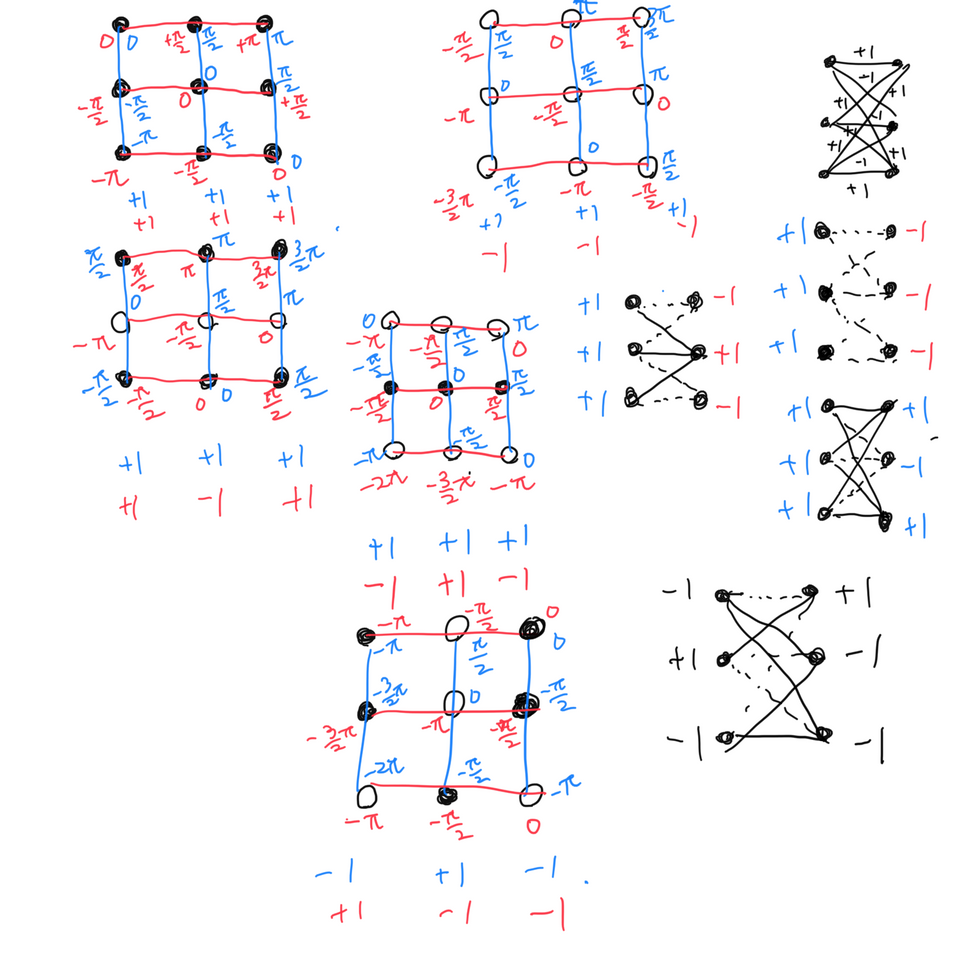
Hand drawn red, blue, and black squares with numbers at the vertices. The new chip started as a hand-drawn sketch.Chris Kim

But researchers at Princeton University have found one problem that does. 5G and future 6G wireless relies on the use of so-called massive multiple input multiple output (MIMO) antenna systems. Such systems send and receive signals on multiple antennas at once to increase the data rate. However, interference is inevitable with so many antennas active at once. There are algorithms to untangle the signals, but they are currently too cumbersome for base station computers to complete in the few milliseconds they have.

The solution today is to have way, way more antennas available at the base station than there are cellular users in the area, which is inefficient to say the least. The Princeton team, which includes McMahon and is led by Kyle Jamieson, came up with an Ising model solution that doubles throughput compared to the industry standard and could fit in the chip-scale systems DARPA is developing. Kim’s group has begun a collaborating with the Jamieson’s team.

Reference: https://ift.tt/8lUDeic

Friday, September 22, 2023

3 iOS 0-days, a cellular network compromise, and HTTP used to infect an iPhone


3 iOS 0-days, a cellular network compromise, and HTTP used to infect an iPhone

Enlarge (credit: Getty Images)

Apple has patched a potent chain of iOS zero-days that were used to infect the iPhone of an Egyptian presidential candidate with sophisticated spyware developed by a commercial exploit seller, Google and researchers from Citizen Lab said Friday.

The previously unknown vulnerabilities, which Apple patched on Thursday, were exploited in clickless attacks, meaning they didn’t require a target to take any steps other than to visit a website that used the HTTP protocol rather than the safer HTTPS alternative. A packet inspection device sitting on a cellular network in Egypt kept an eye out for connections from the phone of the targeted candidate and, when spotted, redirected it to a site that delivered the exploit chain, according to Citizen Lab, a research group at the University of Toronto’s Munk School.

A cast of villains, 3 0-days, and a compromised cell network

Citizen Lab said the attack was made possible by participation from the Egyptian government, spyware known as Predator sold by a company known as Cytrox, and hardware sold by Egypt-based Sandvine. The campaign targeted Ahmed Eltantawy, a former member of the Egyptian Parliament who announced he was running for president in March. Citizen Lab said the recent attacks were at least the third time Eltantawy’s iPhone has been attacked. One of them, in 2021, was successful and also installed Predator.

Read 22 remaining paragraphs | Comments

Reference : https://ift.tt/jCLAfXD

Video Friday: Robot Dance


Video Friday is your weekly selection of awesome robotics videos, collected by your friends at IEEE Spectrum robotics. We also post a weekly calendar of upcoming robotics events for the next few months. Please send us your events for inclusion.

IROS 2023: 1–5 October 2023, DETROIT
CLAWAR 2023: 2–4 October 2023, FLORIANOPOLIS, BRAZIL
ROSCon 2023: 18–20 October 2023, NEW ORLEANS
Humanoids 2023: 12–14 December 2023, AUSTIN, TEX.
Cybathlon Challenges: 02 February 2024, ZURICH, SWITZERLAND

Enjoy today’s videos!

Musical dancing is an ubiquitous phenomenon in human society. Providing robots the ability to dance has the potential to make the human robot co-existence more acceptable. Hence, dancing robots have generated a considerable research interest in the recent years. In this paper, we present a novel formalization of robot dancing as planning and control of optimally timed actions based on beat timings and additional features extracted from the music.

Wow okay all robotics videos definitely need confetti cannons.

[ DFKI ]

What an incredibly relaxing robot video this is.

Except for the tree bit, I mean.

[ Paper ] via [ ASL ]

Skydio has a fancy new drone, but not for you!

Skydio X10, a drone designed for first responders, infrastructure operators, and the U.S. and allied militaries around the world. It has the sensors to capture every detail of the data that matters and the AI-powered autonomy to put those sensors wherever they are needed. It packs more capability and versatility in a smaller and easier-to-use package than has ever existed.

[ Skydio X10 ]

An innovative adaptive bipedal robot with bio-inspired multimodal locomotion control can autonomously adapt its body posture to balance on pipes, surmount obstacles of up to 14 centimeters in height (48 percent of its height), and stably move between horizontal and vertical pipe segments. This cutting-edge robotics technology addresses challenges that out-pipe inspection robots have encountered and can enhance out-pipe inspections within the oil and gas industry.

[ Paper ] via [ VISTEC ]

Thanks, Poramate!

I’m not totally sure how you’d control all of these extra arms in a productive way, but I’m sure they’ll figure it out!

[ KIMLAB ]

The video is one of the tests we tried on the X30 robot dog in the R&D period, to examine the speed of its stair-climbing ability.

[ Deep Robotics ]

They’re calling this the “T-REX” but without a pair of tiny arms. Missed opportunity there.

[ AgileX ]

Drag your mouse to look around within this 360-degree panorama captured by NASA’s Curiosity Mars rover. See the steep slopes, layered buttes, and dark rocks surrounding Curiosity while it was parked below Gediz Vallis Ridge, which formed as a result of violent debris flows that were later eroded by wind into a towering formation. This happened about 3 billion years ago, during one of the last wet periods seen on this part of the Red Planet.

[ NASA ]

I don’t know why you need to drive out into the woods to drop test your sensor rack. Though maybe the stunning Canadian backwoods scenery is reason enough.

[ NORLab ]

Here’s a footage of Reachy in the kitchen, opening fridge’s door and others, cleaning dirt and coffee stains.

If they ever make Reachy’s face symmetrical, I will refuse to include it in any more Video Fridays. O_o

[ Pollen Robotics ]

Inertial odometry is an attractive solution to the problem of state estimation for agile quadrotor flight. In this work, we propose a learning-based odometry algorithm that uses an inertial measurement unit (IMU) as the only sensor modality for autonomous drone racing tasks. We show that our inertial odometry algorithm is superior to the state-of-the-art filter-based and optimization-based visual-inertial odometry as well as the state-of-the-art learned-inertial odometry in estimating the pose of an autonomous racing drone.

[ UZH RPG ]

Robotic Choreographer is the world’s first dance performance-only robot arm born from the concept of performers that are bigger and faster than humans. This robot has a total length of 3 meters, two rotation axes that rotate infinitely, and an arm rotating up to five times for 1 second.

[ MPlusPlus ] via [ Kazumichi Moriyama ]

This video shows the latest development from Extend Robotics, demonstrating the completion of integration of Mitsubitshi Electric Melfa robot. Key demonstrations include 6 degrees-of-freedom (DoF) precision control of with real-time inverse kinematics, dual Kinect camera low latency streaming and fusion, and high precision control drawing.

[ Extend Robotics ]

Here’s what’s been going on at the GRASP Lab at UPenn.

[ GRASP Lab ]

Reference: https://ift.tt/pgVBbOR

Industrial Light & Magic Engineer Wins a Technical Oscar


Winning an Academy Award is probably not something most engineers ever expect to do. But it was a fitting honor for Jim Vanns, who won a 2023 Technical Achievement Award—commonly referred to as a Technical Oscar—from the Academy of Motion Picture Arts and Sciences for his work on the high-performance computing systems behind the blockbuster films Gravity (2013) and Guardians of the Galaxy (2014). He shared the award with Mark Hills, a former colleague at the London-based visual-effects studio Framestore. The pair wrote the software to manage the cutting-edge computing cluster that Framestore used to create its computer-generated imagery, or CGI. Their software is still being used today.

Jim Vanns


Employer:

Industrial Light & Magic, London

Title:

Principal production engineer

Education:

Joint honors degree in computer science and music, Canterbury Christ Church University, Canterbury, England

“The great thing about the Academy Awards is that they raise awareness of the technology being used, which would be impossible to make films without,” Vanns says. “These awards show that the dependence on technology is understood and appreciated, rather than just assuming making movies is all about the creative teams.”

Vanns, who now works at Disney-owned Industrial Light & Magic, in London, was an avid cinephile growing up. But he didn’t realize until after college that his coding skills would be his entry into the film industry.

“I have always loved movies,” he says, “but I never really thought there would be a chance to apply my computer science knowledge to making them.” And with the growing importance of visual effects (VFX) in moviemaking, he says, there are increasing opportunities for the more technically minded to make their mark on the silver screen.

2023 Sci-Tech Awards: Mark Hills and Jim Vanns | FQ Render Farm Management System www.youtube.com

Inspired by the Lord of the Rings

Vanns grew up in Tonbridge, England, and played guitar for several bands as a teenager. He began tinkering with the software used to produce music. The programs often crashed unexpectedly, so he dug into the underlying code to find out why. That was his first taste of computer science. “I got into reverse engineering and understanding how computers worked under the hood,” he says.

Meanwhile, his father was gently nudging him to study something with a more “realistic” career path than music. Vanns decided to combine his interests, majoring in computer science and music at Canterbury Christ Church University, in Canterbury, England.

After graduating with a joint honors degree in both fields in 2001, Vanns worked for a time writing software, and seemed to be setting off on a fairly conventional IT career. But his love of cinema set him on a different path. While watching the bonus content on the DVD version of The Lord of the Rings: The Two Towers (2002), he was captivated by a discussion about the CGI in an iconic battle scene. The scene’s large numbers of computer-generated characters were created on a dedicated cluster of high-performance computers—a render farm—that converted the data from a 3D computer model into a photo-realistic video.

Vanns had assumed that the only computer science jobs in the film industry were related to creating the graphics themselves, something he hadn’t studied. But that DVD discussion opened his eyes to the extensive software development and systems management that went into producing CGI. Eager to break into the industry, he began applying for jobs, and in 2006 he was hired as a systems programmer at Framestore.

“It was that ‘foot in the door’ opportunity that I was after,” he says. “I think a lot of people end up falling into my line of work, but for me it was very much a conscious decision to try to get into the industry.”

Award-winning rendering software

After a few years of learning the ropes and working on a variety of projects, Vanns was assigned to revamp the management software for Framestore’s render farm. The company had just been hired for the VFX-heavy Gravity and needed to switch to a far more computationally taxing form of rendering called path tracing. The approach simulates the physics of light more faithfully than other approaches do, leading to scenes with more realistic and dynamic lighting.

The project was going to stretch Framestore’s render farm nearly to its breaking point, Vanns recalls, so it needed software that could squeeze every drop of efficiency out of the hardware. But the company also wanted to future-proof its systems. Vanns and Hills had to create software that would last a decade and could handle 10 times the workload required for Gravity as the company’s render farm grew.

At its heart, the challenge they faced was one of resource management, Vanns says. “We had this render farm made up of 100,000 processor cores, but the company was often working on three different shows at the same time,” he says. “It was all about how we divvied up the cores.”

The goal was to ensure that the processors were used as efficiently as possible, and that different tasks running on the same machines didn’t end up competing for resources, like memory. That required some clever scheduling and networking. The team was also given the job of creating a responsive user interface that could provide real-time updates on the progress of rendering jobs.

The resulting system, dubbed the FQ renderfarm engine, is what earned Vanns and Hills their Academy Award. The software went live in 2010 and is still in use at Framestore today. “They have had to do very few code changes,” Vanns says. “The system still runs just as it was designed.”

“The great thing about the Academy Awards is that they raise awareness of the technology being used, which would be impossible to make films without.”

After completing the FQ project, Vanns wanted a new challenge. He joined the London office of Industrial Light & Magic in 2014 as a senior production engineer. The first project he worked on involved researching whether the company could shift the bulk of its computing workload onto the cloud. That meant imagining how to build the company’s entire global VFX infrastructure from scratch using the latest cloud technology.

“It was real ‘the world is your oyster,’ blue-sky-thinking kind of stuff,” he says.

The project was fascinating, Vanns says, but the company concluded that a wholesale shift to the cloud didn’t make sense. It would be difficult to migrate the legacy software, and the investments the company had already made in hardware meant it was unlikely to save much money. However, insights gained from the project led to improvements to the company’s IT infrastructure. Vanns is currently developing a new data-storage system that resulted from the project.

How to break into the movie-tech business

When it comes to a software-development career in the VFX industry, graphics-related work gets most of the attention. But Vanns says there are plenty of other interesting roles available.

“I don’t think it’s really well understood how much work is involved in terms of building databases, operating systems, networks, and all that slightly less grand software,” he says.

The requirements for the movie industry are similar to those for software engineering jobs in other sectors, Vanns says. An understanding of algorithms and data structures is a must. The industry relies heavily on the Linux operating system, so relevant experience is also required.

Those who want to write software to support the creation of CGI will need to learn how the process works, Vanns says. It involves coordination among the various departments specializing in different aspects of VFX, including textures, animation, and lighting, which all have different requirements and workflows.

Most important, though, is the ability to find creative solutions to problems. Complications are inevitable when managing computer systems made up of thousands of devices and used by thousands of people, who are often scattered around the globe.

“I think an underestimated aspect problem solving is creativity,” Vanns says. “Being able to think not only analytically but also creatively about how you might solve a problem is a must.”

Reference: https://ift.tt/SgnZU1F

Thursday, September 21, 2023

Incomplete disclosures by Apple and Google create “huge blindspot” for 0-day hunters


Incomplete disclosures by Apple and Google create “huge blindspot” for 0-day hunters

Enlarge (credit: Getty Images)

Incomplete information included in recent disclosures by Apple and Google reporting critical zero-day vulnerabilities under active exploitation in their products has created a “huge blindspot” that’s causing a large number of offerings from other developers to go unpatched, researchers said Thursday.

Two weeks ago, Apple reported that threat actors were actively exploiting a critical vulnerability in iOS so they could install espionage spyware known as Pegasus. The attacks used a zero-click method, meaning they required no interaction on the part of targets. Simply receiving a call or text on an iPhone was enough to become infected by the Pegasus, which is among the world’s most advanced pieces of known malware.

“Huge blindspot”

Apple said the vulnerability, tracked as CVE-2023-41064, stemmed from a buffer overflow bug in ImageIO, a proprietary framework that allows applications to read and write most image file formats, which include one known as WebP. Apple credited the discovery of the zero-day to Citizen Lab, a research group at the University of Toronto’s Munk School that follows attacks by nation-states targeting dissidents and other at-risk groups.

Read 20 remaining paragraphs | Comments

Reference : https://ift.tt/79q8wgA

Get Up to Speed on AI, IoT, and Smart Grid


The adoption of emerging technologies has drastically increased since 2020, according to a McKinsey & Co. survey. Understanding the latest technology trends can allow you to strengthen your competitive edge. Developing your technical skills and investing in yourself are great ways to advance from your current position and help you thrive in your industry.

To help technical professionals working in industry develop their skills in the latest technologies, IEEE recently launched the IEEE Academies learning paths. The program is designed to teach in-demand technical concepts in a new way to industry professionals. IEEE Academies provide learners with webinars, tutorials, recorded videos, IEEE Xplore Digital Library articles, and other educational offerings. Each learning path is presented in an easy-to-understand manner and does not require deep prerequisite knowledge of the subject.

The current IEEE Academies’ topics are artificial intelligence, the Internet of Things, and the smart grid. Here is an overview of what the three courses cover.

  • Artificial Intelligence. As organizations continue to automate day-to-day operations, AI has become more significant. The global AI market value is expected to reach US $267 billion by 2027, according to KR Elixir. Like humans, AI systems can improve their performance based on the data they collect. To equip individuals with the necessary knowledge for future AI developments, the IEEE Academy on Artificial Intelligence teaches basic concepts in data, types of learning models, measuring efficiency, and optimizing machine learning. This course explores the applications of AI in different industries, such as manufacturing, education, finance, and health care, by defining problems and identifying possible AI solutions.
  • Internet of Things. This technology, which has risen to be one of the most important technologies of the 21st century, provides users with interconnectedness and efficiency. Smart thermostats, smart watches, and smart appliances are a few of the IoT applications that seamlessly exchange data with each other through the Internet. By the end of this year, the IoT market is projected to grow to nearly $1.4 billion, nearly doubling in value from 2020. The IEEE Academy on IoT consists of two learning paths: Communication Standards and Computing Platforms. The courses provide an overview of standardized machine communication, as well as state-of-the-art applications and likely future trends on computing platforms.
  • Smart Grid. The self-healing nature of the smart grid is composed of new technologies, automation, controls, and computers that work together to respond quickly to electricity demand. The benefits of adopting a smart grid include improved security, faster restoration of electricity, and lower electricity rates. The IEEE Academy on Smart Grid covers topics such as distribution automation and microgrids in two learning sections. The comprehensive Distribution Automation path teaches the fundamentals of the existing power distribution system, how to automate the system, and ways to add advanced functionalities. The Microgrid program reviews how small grids can be integrated with wind, solar photovoltaic, and storage systems, and it covers operation planning. The program also addresses trends and solutions as well as the challenges, benefits, and applications of the technologies.

Upon completion of the courses, learners earn professional development hours or continuing education units as credentials and digital badges that can be shared on social media. Visit the IEEE Learning Network to see member and nonmember pricing and to learn more. Reference: https://ift.tt/Lf3WiJG

A New Energy-Efficient Hydrogel Pulls Water From Air


Using a new kind of hydrogel material, researchers at the University of Texas, Austin have pulled water out of thin air at temperatures low enough to be achieved with sunlight.

Atmospheric water harvesting draws water from humidity in the air. If the humidity levels are high enough, a system can pass fog through a mesh or cool the air below the dew point to condense the moisture and collect liquid water. But in low-humidity conditions and arid areas, water vapor has to be extracted directly from the air as a gas.

The Texas technique is aimed at the latter. It has two key steps, first acting like a dehumidifier to collect the water, then releasing it for use. Other researchers have looked into similar methods for absorbing water vapor using material such as silicas and metal organic frameworks, which “have their own pros and cons,” says Guihua Yu, a professor of engineering at UT Austin who led the research, published 11 September in Proceedings of the National Academies of Science.

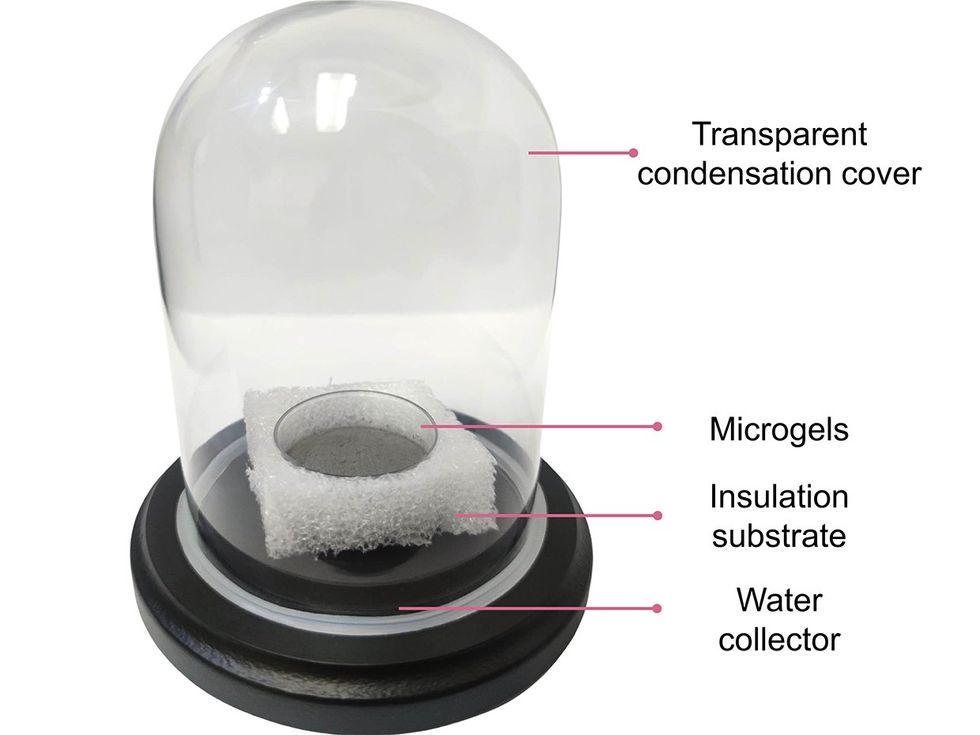
A clear dome sits on a pedestal. Inside is a dish with black powder surrounded by some white foam. A label over the dome say transparent condensation cover, while other labels point to the water collector, insulation substrate, and microgels. The prototype device developed at UT Austin relies on a new hydrogel to efficiently pull water from the air and, more importantly, release it more efficiently than other hydrogels.The University of Texas at Austin

Many of the materials used to pull humidity from air come with one particular con: If the substance absorbs water easily, it also requires a significant amount of energy to release that water later. Yu’s team has developed a new synthetic material to potentially address this key complication. The material is a hydrogel, a polymer network that naturally retains a lot of water. But the new material requires less energy to release that water than other hydrogels, making it possible for the system to operate with sunlight as the sole energy source.

How Atmospheric Water Harvesting Works

The new hydrogel is more efficient in its uptake and release of water thanks to its structure, which pairs two distinct segments: a network of sites that absorb and store water and thermoreactive segments that help to release liquid water.

On the absorption side, the advantage comes from immobilizing salt ions in the polymer structure. Conventional hydrogels are like “bulky jello” laced with salt ions that help draw in and liquify the vapor. However, they risk leaking those salts each time they release water and may become limited in how much they are able to absorb, Yu says. By fixing the salt ions in place, this new hydrogel confines areas of absorption to avoid these issues.

The gel’s thermoreactive nature, meanwhile, is key for releasing the stored water. When the material is heated above a threshold temperature, it transitions from retaining water to expelling it. By interspersing thermoreactive segments among smaller areas of absorption, this material releases water at a relatively low temperature, achievable with solar energy alone. The hydrogel can release more than 80 percent of absorbed water in about 20 minutes at a temperature of 40°C—hot, but not uncommon in desert environments. In Phoenix, Az., for example, high temperatures average about 41°C during the month of July.

Other water harvesting devices currently available, like those from SOURCE and Watergen, are primarily intended for use in moderate conditions, Yu says. But Yu and his colleagues at UT Austin developed theirs with arid atmospheres in mind. It follows earlier research funded by the U.S. Department of Defense’s Defense Advanced Research Projects Agency (DARPA), which aimed to help provide drinking water for soldiers stationed in desert conditions.

While the ultimate goal of the technology is its use in desert areas, the project is still focused on the fundamental science, rather than practical concerns such as cost. Hydrogels vary in cost, depending on the materials, and Yu hopes to begin developing less expensive, more scalable versions of the technology soon.

Of the techniques currently in development, other water harvesting technologies are likely closer to commercial applications, according to Chiara Neto, a professor of physical chemistry at the University of Sydney. Yu’s research “provides guidance on how to increase efficiency of the water capture process,” Neto says. “However, its fundamental nature means that practical considerations are not necessarily at the forefront.”

Despite the work still needed, this is an “important step toward real-world application,” says Lenan Zhang, a research scientist at MIT who also studies methods for extracting atmospheric water vapor. Acting as a proof of concept, Zhang says, this fundamental science provides the “upstream innovation” needed to help provide the world with access to clean water.

Reference: https://ift.tt/vqVQIeb

PC shipments fall 20.1 percent in “sharpest decline” since Q1 2023

<p>PC shipments saw a steep drop of about 20 percent in Q3 2026, analysts reported this week.</p> ...