Wednesday, October 21, 2026

Manfred “Fred” J. Schindler Is 2027 IEEE President-Elect


<img src="https://spectrum.ieee.org/media-library/smiling-portrait-of-a-middle-aged-white-man-in-a-suit-jacket.jpg?id=68452816&width=1245&height=700&coordinates=0%2C469%2C0%2C469"/><br/><br/><p>IEEE Life Fellow <a href="https://candidates.ieee.org/candidates/nominees/manfred-fred-j-schindler/" rel="noopener noreferrer" target="_blank">Manfred “Fred” J. Schindler</a> has been elected as the 2027 <a href="https://spectrum.ieee.org/2027-ieee-president-elect-candidates" target="_self">IEEE president-elect</a>. He will begin serving as president on 1 January 2028.</p><p>Schindler, who was nominated by the <a href="https://spectrum.ieee.org/ieee-board-of-directors-oct25" target="_self">IEEE Board of Directors</a>, received 16,421 votes in the election. Senior Member <a href="https://candidates.ieee.org/candidates/nominees/david-koehler/" rel="noopener noreferrer" target="_blank">David Alan Koehler</a> received 13,874 votes.</p><h3>Schindler’s Top 3 Goals as President-Elect</h3><br/><ol><li>Strengthen IEEE’s connection with industry by coordinating events across geography, industry, and technology to revitalize professional activities, especially ones for young professionals.</li><li>Champion the improvement of IEEE’s digital infrastructure to eliminate manual processes and modernize interfaces.</li><li>Prioritize the advancement of technology to benefit future generations by expanding and supporting IEEE initiatives and programs.</li></ol><p>At press time, the results were unofficial until the IEEE Board of Directors accepts the IEEE Teller’s Committee report in November.</p><p>Schindler, an expert in microwave semiconductor technology, is an independent consultant supporting clients with technical expertise, due diligence, and project management.</p><p>Throughout his career, he led the development of microwave integrated-circuit technology, from lab demonstrations to high-volume commercial products. He has numerous technical publications and holds 11 patents.</p><p>Schindler served as CTO of Anlotek, and director of <a href="https://www.qorvo.com/" rel="noopener noreferrer" target="_blank">Qorvo</a> and <a href="https://www.linkedin.com/company/rfmd" rel="noopener noreferrer" target="_blank">RFMD</a>’s Boston design center. He was applications manager at <a href="https://www.ibm.com/about" rel="noopener noreferrer" target="_blank">IBM</a>, engineering manager at ATN Microwave, and a lab manager at <a href="https://www.rtx.com/" rel="noopener noreferrer" target="_blank">Raytheon</a>.</p><p>An IEEE volunteer for more than 30 years, Schindler served as the 2024 vice president of <a href="https://ta.ieee.org/" rel="noopener noreferrer" target="_blank">IEEE Technical Activities</a> and the 2021–2022 Division IV director. He was chair of the <a href="https://events.ieee.org/ieee-conferences-committee/" rel="noopener noreferrer" target="_blank">IEEE Conferences Committee</a> from 2015 to 2018 and president of the <a href="https://mtt.org/" rel="noopener noreferrer" target="_blank">IEEE Microwave Theory and Technology Society</a> (MTTS) in 2003. He received the society’s 2018 <a href="https://mtt.org/distinguished-service-award/" rel="noopener noreferrer" target="_blank">Distinguished Service Award</a> and its 2015 N. Walter Cox Award. His award-winning micro-business column has appeared in <a href="https://ieeexplore.ieee.org/xpl/RecentIssue.jsp?punumber=6668" rel="noopener noreferrer" target="_blank"><em><em>IEEE Microwave Magazine</em></em></a> since 2011.</p><p>He also led the 2025 <a href="https://spectrum.ieee.org/ieee-presidents-note-march-2025" target="_self">One IEEE to Enable Strategic Investments in Innovations and Public Imperative Activities adhoc committee</a>.</p><p>Schindler is an <a href="https://spectrum.ieee.org/ieee-hkn-honor-society-15" target="_self">IEEE–Eta Kappa Nu</a> honorary life member and a MTTS honorary life member.</p> Reference: https://ift.tt/LlQjnV3

How Wikipedia’s Editors Keep the Online Encyclopedia Human-Written


<img src="https://spectrum.ieee.org/media-library/surreal-collage-of-a-womans-face-with-geometric-shapes-pencil-and-wikipedia-globe.png?id=68486571&width=2000&height=1500&coordinates=68%2C0%2C69%2C0"/><br/><br/><p>Ellia Lebleu is a founding member of<a href="https://en.wikipedia.org/wiki/Wikipedia:WikiProject_AI_Cleanup" rel="noopener noreferrer" target="_blank"> the WikiProject AI Cleanup</a>, a volunteer effort launched in 2023 to find and remove AI-generated material from <a data-linked-post="2674904016" href="https://spectrum.ieee.org/wikipedia-at-25" target="_blank">Wikipedia</a> that breaks the website’s guidelines. When the cleanup began, <a data-linked-post="2677241069" href="https://spectrum.ieee.org/ai-scientist-research-paper-format" target="_blank">AI writing</a> was often betrayed by conspicuous clichés. Today, the project’s volunteers are developing tools to detect subtler forms of machine-generated content and debating AI’s role in the world’s most widely used encyclopedia. </p><p><strong>When did you realize Wikipedia had a problem with AI-generated material?</strong></p><p><strong>Ellia Lebleu:</strong> It was around December 2023. A few other editors and I were chatting on Wikipedia’s Discord server, and we had all seen very strange articles with the same odd characteristics. They repeated phrases like “stands as a testament” or “rich cultural heritage.” They sometimes had conclusion sections, or sections called “Why is this important?” That was very typical of ChatGPT in 2023 and early 2024 but very odd for Wikipedia articles—and very easy to spot. Then I decided, let’s create an official project on Wikipedia so more people can deal with this.</p><h3>Ellia Lebleu</h3><br/><p>Ellia Lebleu is a founding member of the WikiProject AI Cleanup. Lebleu is pursuing a Ph.D. in AI at the <a href="https://www.inria.fr/fr/centre-inria-universite-rennes" target="_blank">Inria Center of the University of Rennes</a>, part of France’s national research institute for digital science and technology.</p><p><strong>How do editors spot AI-generated writing today?</strong></p><p><strong>Lebleu:</strong> By 2025, the signs of AI writing were becoming subtler and more structural. For example, AI loves the “rule of three,” negative parallelisms, and other structures of speech that aren’t conclusive by themselves but become meaningful as they accumulate. We also look beyond the article. If someone writes five articles of thousands of words each in 5 minutes, there is reason to suspect AI.</p><p><strong>Does the AI problem just appear in the main text, or also in citations?</strong></p><p><strong>Lebleu: </strong>Fake or misleading citations have become a major worry. Sometimes an AI hallucinates a citation entirely, although that’s much rarer today because of retrieval-augmented generation that allows the AI to find sources. More often, it finds a real source but gets its content completely wrong. AI citations that don’t actually support what is being written are extremely commonplace.</p><p><strong>English Wikipedia recently </strong><a href="https://en.wikipedia.org/wiki/Wikipedia:Writing_articles_with_large_language_models" rel="noopener noreferrer" target="_blank"><strong>prohibited editors</strong></a><strong> from using LLMs to generate articles. How much AI-generated content is still getting through?</strong></p><p><strong>Lebleu:</strong> I’ve been working with [AI-detection company]<a href="https://www.pangram.com/" rel="noopener noreferrer" target="_blank"> Pangram</a> to estimate the proportion of AI-generated content. I tested it on Wikipedia content from before ChatGPT and found no false positives, so its results provide a very conservative lower bound. In late 2025, it flagged perhaps 20 percent of new articles and drafts as AI-generated. In early 2026, that went down to 15 or 16 percent. But we don’t yet know whether that’s because our recent policies have had an effect or because models are getting more powerful and Pangram hasn’t had time to adapt.</p><p><strong>Is Wikipedia using AI to combat AI?</strong></p><p><strong>Lebleu:</strong> Another editor from the project has made an AI source verifier, which goes through the sources on a page and checks whether they match the claims. Since it is itself an AI model, there is no guarantee that it will be correct every time. But if you want something that works at scale and filters out obvious cases, it’s a good first step. The Wikimedia Foundation is also working on a tool called <a href="https://www.mediawiki.org/wiki/Edit_check/Paste_Check" rel="noopener noreferrer" target="_blank">Paste Check</a>, which can flag text pasted directly from some AI chatbots.</p><p>And we’ve seen Claude sometimes say, “I can’t write a Wikipedia article; it would go against Wikipedia’s policies.” If all major AI companies implemented that kind of prompt refusal, it wouldn’t solve the problem entirely, because there are still open-weight models that can be tweaked to avoid restrictions. But it would help with people who use commercial models and aren’t especially familiar with the technology. </p><p><strong>Can you tell if the rule prohibiting AI writing is working?</strong></p><p><strong>Lebleu: </strong>It’s still a little early to tell. We see possible effects, such as prompt refusal and the apparent slight drop in AI-generated content. But again, we don’t yet know if that is because models are getting better or because beginners are learning the rules. The vast majority of AI-generated content is submitted by beginner editors, so we’ve made many efforts to make the rule very visible in welcome messages, editing help, and advice. </p><p><strong>What if AI becomes capable of writing truly reliable Wikipedia articles?</strong></p><p><strong>Lebleu:</strong> That’s one of the big questions we’re facing. When the guideline was passed, it was for very practical reasons: We were flooded with AI content, we didn’t have good tools, and we needed to put a stop to it. But since then, it has taken on a more philosophical dimension. Many people have called Wikipedia “the last good place on the internet.” Being a place that was, in theory, free from AI slop has become part of Wikipedia’s identity.</p><p>A lot of Wikipedia’s communication is now centered on the idea that we’re a human-written encyclopedia. Even AI companies find that interesting. It can be valuable to have a purely human-written corpus on which to [train] AI systems. The fact that Wikipedia is still that, and will remain that for at least the near future, makes it a precious resource that isn’t replicated anywhere else.</p><p>But will the people who read and contribute to Wikipedia want it to become partially AI-generated if that makes it more comprehensive? We could preserve Wikipedia’s identity as a human-written corpus while also offering an AI-assisted option.</p><p><strong>Has Wikipedia reckoned with the idea of “Google Zero”—a possible future in which websites no longer get traffic from Google search?</strong></p><p><strong>Lebleu:</strong> If everything goes through AI search and websites plummet to zero visibility, how do we expose Wikipedia and show that it can be edited and that people can still contribute? Wikipedia is frequently cited in [Google’s] AI Overviews, but users may only see an AI answer citing Wikipedia. They may not realize that Wikipedia is a living project they can edit and contribute to.</p><p>The Wikimedia Foundation is working on an attribution framework that could give AI users more information about the article [being cited]: when it was last edited, how comprehensive it is, whether editors have flagged problems, and perhaps even a call to action. In the future, readers might even contribute through AI models: “The AI cited Wikipedia, but there seems to be an error. Can I make an edit request and add this other source I found?”</p><p>I can see a very strong symbiotic relationship between Wikipedia and AI models in the future. I don’t see Wikipedia disappearing, but I can see it taking a very different shape. Yesterday, AI was something to clean up. Today, it’s a tool to help us with the cleanup. Tomorrow, it will be the air we breathe.</p><p><em>A condensed version of this article appears in the November 2026 print issue as “Ellia Lebleu.”</em><br/></p> Reference: https://ift.tt/9nHbLxr

Tuesday, October 20, 2026

PHP warns it plans to release 2 emergency patches imminently


<p>Website admins, brace yourselves. Fixes for what are believed to be uncommonly severe vulnerabilities are scheduled to drop in a little more than 12 hours for PHP, a programming language that powers websites and Web applications everywhere.</p> <p>PHP maintainers <a href="https://www.php.net/archive/2026.php#2026-10-20-1">said Monday</a> that they planned to release patches for two vulnerabilities, both with severity ratings of 9.2 out of a possible 10.</p> <h2>Waiting for PHP2Shell</h2> <p>“All PHP users are encouraged to prepare now so they can upgrade as soon as the release is available,” the advisory stated. “We reserve the right to release earlier should details of either vulnerability become public, or should evidence of active exploitation appear in the wild.”</p><p><a href="https://arstechnica.com/security/2026/10/php-maintainers-tell-web-devs-to-prepare-themselves-for-critical-security-patches/">Read full article</a></p> <p><a href="https://arstechnica.com/security/2026/10/php-maintainers-tell-web-devs-to-prepare-themselves-for-critical-security-patches/#comments">Comments</a></p> Reference : https://ift.tt/lnVSxvz

The Internet goes on high alert after discovery of 8 compromised TLS certs


<p>Security personnel around the world are on high alert Tuesday following the discovery of eight TLS certificates with private keys so weak they could allow anyone to mint trusted browser and app credentials for any site on the Internet.</p> <p>As of late morning Tuesday, browser makers and some major apps and programming languages had blocked all eight of the intermediate certificates. There are no reports of certificate transparency logs, which track the issuance of all browser-trusted certificates, showing the compromised keys being used maliciously. The threat remains far from over, however, because it will be hard and time-consuming to update other key parts of the Internet, such as Linux distributions and embedded and Internet of Things devices.</p> <h2>One word: bonkers</h2> <p>The eight intermediate certificates belong to India-based certificate authority eMudhra Limited. An <a href="https://emudhra.we-have-a-problem.com">informal advisory</a> published to emudhra.we-have-a-problem.com over the weekend posted the message “We have a problem here - Wayne.” The words were digitally signed using the private key of one of the eMudhra certificates. With proof that the reporting party had control of the key, defenders scrambled because the same key could be used to sign unauthorized certificates that would be trusted by millions of servers worldwide.</p><p><a href="https://arstechnica.com/security/2026/10/the-internet-goes-on-high-alert-after-discovery-of-8-compromised-tls-certs/">Read full article</a></p> <p><a href="https://arstechnica.com/security/2026/10/the-internet-goes-on-high-alert-after-discovery-of-8-compromised-tls-certs/#comments">Comments</a></p> Reference : https://ift.tt/gXv9a47

Meta Muse exposes users' personal and business secrets when they share conversations


<p>Muse, the new general-purpose AI agent from Meta, can expose sensitive information when users share conversations through Web links, researchers reported Monday.</p> <p>Like many online services, Muse allows users to share searches, conversations, images, and similar content with other people. Such share features usually involve clicking an option to create a unique URL that anyone can use to load a page hosting the content. To keep potentially sensitive information from being accessible to unintended people, the URLs typically contain a long sequence of text that can’t be easily guessed.</p> <h3>A single query is all that's required</h3> <p>Muse, which Meta CEO Mark Zuckerberg <a href="https://arstechnica.com/security/2026/09/muse-metas-extraordinarily-privileged-ai-assistant-has-a-serious-0-day/">said last month</a> was “built from the ground up for privacy and security,” seems to take the same precautions. But a central design decision for constructing URLs has made the links easy to discover. As a result, researchers from security firm Claroc <a href="https://blog.claroc.io/ghostshares-muse-passive-dns/#_">said</a> they were able to enumerate 6,800 links Muse users created for sharing conversations with others. After opening a few hundred of them, the researchers found information that was clearly not intended to be publicly available, including:</p><p><a href="https://arstechnica.com/security/2026/10/meta-muse-exposes-users-personal-and-business-secrets-when-they-share-conversations/">Read full article</a></p> <p><a href="https://arstechnica.com/security/2026/10/meta-muse-exposes-users-personal-and-business-secrets-when-they-share-conversations/#comments">Comments</a></p> Reference : https://ift.tt/INMn5kr

Monday, October 19, 2026

ReactOS reaches major milestone with NTFS install support


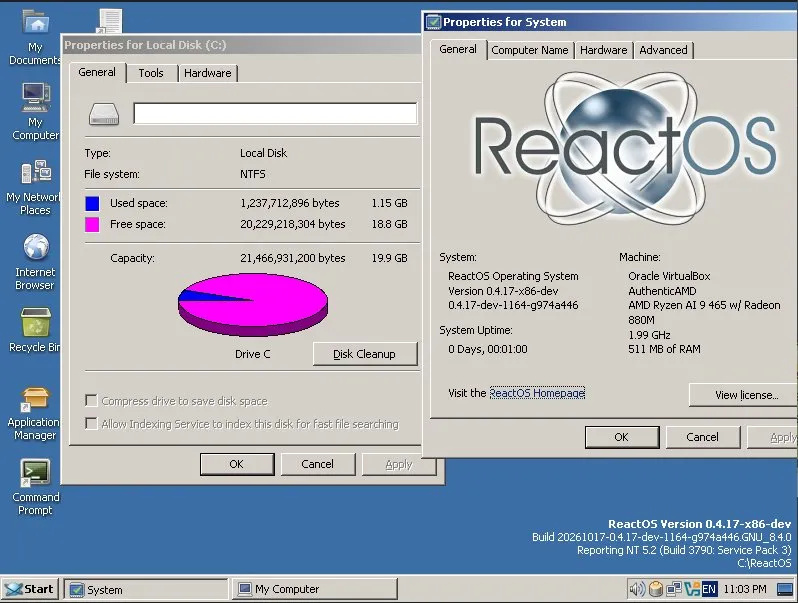
<p>Open source Windows alternative <a href="https://reactos.org/">ReactOS</a> has reached a major milestone: The operating system can now be installed directly onto an <a href="https://en.wikipedia.org/wiki/NTFS">NT Files System</a> drive partition. <a href="https://www.phoronix.com/news/ReactOS-NTFS-Driver">As reported by Phoronix</a>, the move to NTFS clears a long-standing hurdle for the project and brings it one step closer to finally reaching beta.</p> <p>Prior to this latest announcement, ReactOS required users to keep a FAT32 partition for installations. A proprietary Microsoft-developed filesystem, NTFS can trace its roots back through the Windows NT family lineage <a href="https://en.wikipedia.org/wiki/Windows_NT_3.1">starting in 1993</a> with Windows NT 3.1. The variant introduced with Windows XP in 2001 remains the standard used by most Windows systems today. With ReactOS's stated goal of reaching <a href="https://en.wikipedia.org/wiki/Binary-code_compatibility">binary compatibility</a> with Windows Server 2003, being confined to FAT32 partitions was a practical barrier to clear on the way to reproducing the Windows environment.</p> <p>However, users looking to hop off the Windows train shouldn't be grabbing their bags just yet. ReactOS wrote that the new driver still "lacks caching (which causes inferior performance), journaling and security support." So while the new driver is here, even the most intrepid of OS tinkerers should tread carefully. The ReactOS team warned in its <a href="https://x.com/reactos/status/2111565384767922202">announcement on X</a> that there are still "potentially undiscovered bugs."</p><p><a href="https://arstechnica.com/information-technology/2026/10/reactos-reaches-major-milestone-with-ntfs-install-support/">Read full article</a></p> <p><a href="https://arstechnica.com/information-technology/2026/10/reactos-reaches-major-milestone-with-ntfs-install-support/#comments">Comments</a></p> Reference : https://ift.tt/kJQZFgW

The Robot I Didn’t Expect to Build


<img src="https://spectrum.ieee.org/media-library/author-jonathan-hurst-a-tall-slim-white-man-wearing-a-black-long-sleeve-shirt-and-dark-jeans-stands-next-to-his-digit-5-humano.jpg?id=68441166&width=1200&height=800&coordinates=0%2C1230%2C0%2C1230"/><br/><br/><p><strong><a href="https://www.agilityrobotics.com/" rel="noopener noreferrer" target="_blank"><span>Agility Robotics</span></a>, the </strong>company I cofounded out of <a href="https://mime.engineering.oregonstate.edu/research/drl/" target="_blank">my robotics lab at Oregon State University</a> in 2015, has just launched <a href="https://spectrum.ieee.org/humanoid-robot-safety" target="_self">Digit 5</a>. It’s designed to be the first humanoid robot that can safely and economically do useful work at scale, allowing us to bring tens of thousands of humanoid workers into the real world. Engineered to lift 23-kilogram bins onto high shelves and with a battery that can run for 90 minutes on a 9-minute charge, Digit 5’s goal is to handle heavy warehouse tasks shift after shift, filling the need for labor in jobs that are too physically stressful or too dull for humans to want to do.</p><div class="rm-embed embed-media"><iframe height="110px" id="noa-web-audio-player" src="https://embed-player.newsoveraudio.com/v4?key=q5m19e&id=https://spectrum.ieee.org/agility-robotics-digit-5-redesign&bgColor=F5F5F5&color=1b1b1c&playColor=1b1b1c&progressBgColor=F5F5F5&progressBorderColor=bdbbbb&titleColor=1b1b1c&timeColor=1b1b1c&speedColor=1b1b1c&noaLinkColor=556B7D&noaLinkHighlightColor=FF4B00&feedbackButton=false" style="border: none" width="100%"></iframe></div><p><span>Digit 5 is what Agility has been working toward for over a decade. But the robot is heavy and bulky, lacking the graceful natural motion of its predecessors, and it’s farther than I thought possible from the robot I dreamed of building when I started this company. To deliver a useful commercial product, Agility has taken a path that is very different from what I first imagined.</span></p><h2>From ATRIAS to Digit</h2><p>My dream has always been to build robots that combine locomotion and manipulation to move through the world and interact with it as people do. I seek a mastery of motion, achieved through devices designed to navigate the constraints of physics with elegance. When I started the <a href="https://mime.engineering.oregonstate.edu/research/drl/" target="_blank">Dynamic Robotics Laboratory</a> at Oregon State in 2008, we began with a theory derived from decades of work in biomechanics: that a simple “spring-mass” model (a body supported by legs that act like springs) should be able to reproduce every known walking and running gait found in animals.</p><p>We put theory into practice by building the bipedal robot <a href="https://spectrum.ieee.org/atrias-robot-dodgeball-barrage" target="_self">ATRIAS</a>—short for “Assume The Robot Is A Sphere,” a <a href="https://en.wikipedia.org/wiki/Spherical_cow" target="_blank">joke among physicists</a> about reducing a complex system to its simplest possible form. ATRIAS looked like a large microwave on stilts because it was only intended to demonstrate the physics of human walking and running. This was the first glimmer of achieving my dream; even though ATRIAS wasn’t designed to look like us, it still seemed natural, and even somehow alive, when it settled into a walking gait.</p><p>With the success of ATRIAS, the barriers to progress shifted from scientific to engineering and organizational, and a startup company seemed like the way to bridge the gap from a one-off research concept to an actual robotic product. I felt confident of two things: that I would be able to build robots that could go where people go, and that this capability would be incredibly useful. This combination of ambition and naivete is necessary for anyone to found a new company—how hard could it be?</p><p class="shortcode-media shortcode-media-youtube"> <span class="rm-shortcode" data-rm-shortcode-id="799211be27f5cd3c19adc9be5fb78303" style="display:block;position:relative;padding-top:56.25%;"><iframe frameborder="0" height="auto" lazy-loadable="true" scrolling="no" src="https://www.youtube.com/embed/dl7KUUVHC-M?rel=0" style="position:absolute;top:0;left:0;width:100%;height:100%;" width="100%"></iframe></span></p><p>Good advice for starting a company is to understand a customer problem, and then find a way to solve it using your unique capabilities. My cofounders, <a href="https://www.linkedin.com/in/damion-shelton/" rel="noopener noreferrer" target="_blank">Damion Shelton</a> and <a href="https://www.linkedin.com/in/mikhail-jones-5674a22b/" rel="noopener noreferrer" target="_blank">Mikhail Jones</a>, and I did not do this. We relied on our belief that this technology would enable new possibilities and trusted ourselves to figure out the business as we went. So we simply focused on building our first product: the bipedal robot <a href="https://robotsguide.com/robots/cassie" rel="noopener noreferrer" target="_blank">Cassie</a>.</p><p>Cassie was the first dynamic bipedal robot that researchers could buy, able to maintain its balance through active, fluid motion rather than careful, rigid steps. It had ostrichlike legs, not because we were imitating ground-running birds, but as a result of engineering strictly for performance. It was not intended to be commercially useful, and had no torso, arms, or head. We sold Cassie robots to Harvard, Caltech, the University of Michigan, the University of California, Berkeley, and a handful of other research institutions, ultimately saturating the market for US $250,000 bipedal research robots after having sold a total of 10 of them.</p><p class="shortcode-media shortcode-media-rebelmouse-image"> <img alt="Three bipedal robots lined up in a warehouse, showing their evolving designs." class="rm-shortcode" data-rm-shortcode-id="54e4ce2bccb7229ad582cb98734cd28f" data-rm-shortcode-name="rebelmouse-image" id="f749f" loading="lazy" src="https://spectrum.ieee.org/media-library/three-bipedal-robots-lined-up-in-a-warehouse-showing-their-evolving-designs.jpg?id=68441028&width=980"/><small class="image-media media-caption" placeholder="Add Photo Caption...">ATRIAS, Cassie, and Digit 4 EVT [left to right] are on display at Agility Robotics’ RoboFab in Salem, Ore. The 70,000-square-foot facility has the capacity to produce more than 10,000 Digit 5 robots per year.</small><small class="image-media media-photo-credit" placeholder="Add Photo Credit...">Agility Robotics</small></p><p>Because Cassie’s hardware enabled research into the physics of walking and running, the legged-robot research frontier shifted to control software. Traditionally, engineers controlled legged robots with detailed mathematical models that determined how the machines should move. With Cassie, researchers pioneered the new approach of reinforcement learning for bipedal legged locomotion: A simulated robot learns through trial and error, and the resulting neural network controls the physical machine. This approach is what enables virtually all of the dynamic behaviors that you see on legged robots today, and Cassie looked alive as it recovered from stumbles while climbing stairs, ran 5 kilometers across the Oregon State campus, and <a href="https://news.oregonstate.edu/news/bipedal-robot-developed-oregon-state-achieves-guinness-world-record-100-meters" target="_blank">broke the robot world record</a> for a 100-meter dash.</p><p>Cassie got us closer to being able to move through the world with confidence and grace, but to make it useful, we needed manipulation. After exhaustively exploring different configurations, we found that an upright torso helped the robot balance, while two arms mounted near the top of the torso allowed it to pick up large objects and to catch itself when it fell. <a href="https://robotsguide.com/robots/digit" target="_blank">Digit 1</a>, which added a torso and arms to the Cassie legs, was our first mobile manipulation robot, and another step on the path toward a product that could do useful work for commercial customers.</p><h2>Why Digit Began With Warehouse Bins</h2><p>As we explored the first applications for Digit, potential customers kept asking us: Why legs? And why a humanoid? These were tough questions for me to answer, because they exposed a core business reality: It didn’t matter to Agility Robotics if we solved a cool science problem in a beautiful way. What mattered to the business was solving real problems for customers.</p><p class="shortcode-media shortcode-media-youtube"> <span class="rm-shortcode" data-rm-shortcode-id="53f93e5d52687bf6d60efb7a9a4196f6" style="display:block;position:relative;padding-top:56.25%;"><iframe frameborder="0" height="auto" lazy-loadable="true" scrolling="no" src="https://www.youtube.com/embed/AJpTpUqjgrY?rel=0" style="position:absolute;top:0;left:0;width:100%;height:100%;" width="100%"></iframe></span></p><p>After years of engagement with industry partners, we found one answer in warehouses and manufacturing facilities: moving <a href="https://spectrum.ieee.org/agility-robotics-digit" target="_self">bins</a>. Bin handling is a clearly defined task where two arms are needed to lift large bins up high and legs are the best way to balance and move in narrow spaces. Because the task can vary widely from one deployment to another, it hasn’t been broadly addressed by single-purpose automation. Yet it was constrained enough to give Digit an economically viable first job while it developed a broader set of skills.</p><p>In 2019, Digit began demonstrating its capabilities to do real work. <a href="https://spectrum.ieee.org/ford-self-driving-vans-will-use-legged-robots-to-make-deliveries" target="_self">With Ford Motor Company</a>, we showed how Digit 1 could carry packages from an autonomous vehicle to a front porch. We developed Digit 2 and 3 while working with a certain global package delivery company on moving and sorting cardboard boxes. <a href="https://spectrum.ieee.org/humanoid-robots" target="_self">Amazon</a> tested Digit 4 on moving and stacking bins, and it became the world’s first commercially deployed humanoid <a href="https://www.agilityrobotics.com/content/digit-moves-over-100k-totes" target="_blank">at the logistics provider GXO</a>. In 2024, Digit appeared on the cover of <em><em>Time</em></em> magazine.</p><p class="shortcode-media shortcode-media-youtube"> <span class="rm-shortcode" data-rm-shortcode-id="411356b164174262a2ce7637488faca6" style="display:block;position:relative;padding-top:56.25%;"><iframe frameborder="0" height="auto" lazy-loadable="true" scrolling="no" src="https://www.youtube.com/embed/_YrlR1iNVcQ?rel=0" style="position:absolute;top:0;left:0;width:100%;height:100%;" width="100%"></iframe></span></p><p>Despite Digit’s apparent success, we began to run into conflicts between my dream and the needs of actual customers. We were no longer working with relatively patient university research labs. Agility has to sell robots to survive, and customers will only purchase robots that provide value. If bins weren’t moving, our customers were losing money. We spent a huge amount of time and effort keeping our first deployments operational, which arguably eliminated any profit we made. Yet this also kept our company learning and alive the way no lab demo ever could.</p><p>I had no idea how hard it would be, or that running a company would involve so many things that have nothing to do with solving technical problems: deployments across the country; shipping, service, and customer support; fundraising and investor relations; more fundraising; human resources and IT; developing fleet-management software; managing a supply chain; and even more fundraising. I had no experience with any of these things. My career had focused on solving the technical challenges of robots interacting with the world, and it turned out that was only a tiny piece of building a successful robotics company. But Agility was the only path I saw to continuing the technical work and having an impact.</p><h2>Turning Digit Into a Product</h2><p>I knew that Agility needed to focus more on robots as a product, but I didn’t know how to make that happen. Hiring the people we needed to run the company meant giving up an immense amount of control, but we had no other choice. We recruited a new executive team with the experience required to commercialize this new technology, and they quickly made changes that were both painful and necessary.</p><p class="shortcode-media shortcode-media-rebelmouse-image"> <img alt="A series of images showing three headless humanoid robots with each one getting somewhat bulkier and less graceful." class="rm-shortcode" data-rm-shortcode-id="9ac25d6eefa563ea43f84d5da9c0bb37" data-rm-shortcode-name="rebelmouse-image" id="1db2c" loading="lazy" src="https://spectrum.ieee.org/media-library/a-series-of-images-showing-three-headless-humanoid-robots-with-each-one-getting-somewhat-bulkier-and-less-graceful.jpg?id=68441280&width=980"/><small class="image-media media-caption" placeholder="Add Photo Caption...">Digit versions 1, 2, and 3 [left to right] show the evolution of the robot from a dynamic walking platform into a useful mobile manipulator. </small><small class="image-media media-photo-credit" placeholder="Add Photo Credit...">Agility</small></p><p>We had intended the next revision of Digit, <a href="https://www.youtube.com/watch?v=6x28vlbfA-k" target="_blank">Digit 4 EVT</a> (Engineering Validation and Test), to be a relatively minor upgrade. But Agility’s new leadership insisted that the robot was missing key features that were essential if Digit was going to become a real product. So Digit 4 EVT instead incorporated a series of major changes in a highly compressed timeline, such as larger batteries and system-wide upgrades for safety and regulatory compliance, which added enough mass to dramatically alter the robot’s appearance and capabilities.</p><p class="shortcode-media shortcode-media-rebelmouse-image rm-float-left rm-resized-container rm-resized-container-25" data-rm-resized-container="25%" style="float: left;"> <img alt="A relatively bulky humanoid robot worker with a white head, simple grippers, and reversed legs stands for a portrait looking directly at the camera." class="rm-shortcode" data-rm-shortcode-id="74c47f230d989b47781d728659112348" data-rm-shortcode-name="rebelmouse-image" id="e15b4" loading="lazy" src="https://spectrum.ieee.org/media-library/a-relatively-bulky-humanoid-robot-worker-with-a-white-head-simple-grippers-and-reversed-legs-stands-for-a-portrait-looking-dir.jpg?id=68441369&width=980"/><small class="image-media media-caption" placeholder="Add Photo Caption...">While early Digits were headless, Agility Robotics was able to justify a head for Digit 4 to optimize antenna and camera placement, and it turned out to be surprisingly useful for human-robot interaction.</small><small class="image-media media-photo-credit" placeholder="Add Photo Credit...">Christie Hemm Klok</small></p><p> I could only watch as others brought their own talents to bear to make Digit into a successful product, in gut-wrenching ways that didn’t always align with my vision. There were some especially difficult times when I felt like there were compromises made that didn’t seem necessary, but making those decisions was no longer my sole responsibility. I had to accept that Digit had grown far beyond me, and look for ways of influencing decisions rather than directing them. In the moment, it was incredibly frustrating, as Digit 4 EVT took a few steps backward from my vision of how humanoids should look and move.</p><p>Agility is in our name because agility is core to the future of the company. I want Digit to be lithe and graceful. When people see Digit, I want them to like the robot, to understand what it can do at a glance, and to feel that it’s there to help. But with Digit 4 EVT, all of that was sacrificed to functionality, because of course it had to be—the customer just needs the robot to do the work. The design process became a ruthless triage, with aesthetics and elegance of movement being delayed over and over again in favor of brutal functionality. For an engineer whose mind lives more in the future than in the present, it has been hard for me to accept this trajectory. And yet, through Digit 4 EVT’s commercial deployments, we began to really understand specific applications and what they required. We mapped the first 10 use cases Digit would perform, and then began designing Digit 5 from scratch based on everything we had learned.</p><h2>Digit 5</h2><p>Digit 5 will be Agility’s first real step toward a general-purpose robot. It marks our transition from imagining what a future humanoid robot should be to designing a product around the realities of customer deployments. These realities include things like European CE regulatory compliance, North American UL electrical-safety certifications, and Federal Communications Commission limits for electromagnetic radiation—all of which felt tangential to my dream for Digit, but were absolute requirements.</p><p class="shortcode-media shortcode-media-rebelmouse-image rm-float-left rm-resized-container rm-resized-container-25" data-rm-resized-container="25%" style="float: left;"> <img alt="A strong and bulky humanoid robot with a teal torso and legs, silver arms, and a black head stands with its arms upraised." class="rm-shortcode" data-rm-shortcode-id="a2cf36ff0d2860a22f00ca7a2dafb2cc" data-rm-shortcode-name="rebelmouse-image" id="6b948" loading="lazy" src="https://spectrum.ieee.org/media-library/a-strong-and-bulky-humanoid-robot-with-a-teal-torso-and-legs-silver-arms-and-a-black-head-stands-with-its-arms-upraised.jpg?id=68441384&width=980"/><small class="image-media media-caption" placeholder="Add Photo Caption...">Digit 5 is designed to be the first humanoid robot that can operate safely next to human coworkers while working 20 hours a day and lifting more than a human can.</small><small class="image-media media-photo-credit" placeholder="Add Photo Credit...">Christie Hemm Klok</small></p><p>Customer requirements helped us realize that safety in particular was one of the most critical barriers to scaling. In Digit 4’s commercial deployments, the robots had to work behind physical barriers, separated from humans at all times, to meet insurance and regulatory demands. This seemed silly to me, because I’ve never felt that our robots were dangerous, but we have to <em><em>prove</em></em> that they’re safe. And since keeping the robots in safety cages severely limited their usefulness, enabling Digit 5 to operate safely around people became a primary design goal. We spent two years on this challenge.</p><p>Digit 5 is designed to be the first humanoid robot that can operate safely next to human coworkers. It will rely on an array of sensors to locate nearby people in a manner that’s certifiably safe, and then take actions based on that information. As a person approaches, Digit 5 is programmed to stop what it’s doing, set down its payload, sit on the floor, and cut power to its motors before the person gets close enough to touch the robot. This conservative approach reduces the risk to nearby people in a verifiable way, and we believe it’s the only approach that makes sense as a first step toward working alongside humans.</p><p class="shortcode-media shortcode-media-youtube"> <span class="rm-shortcode" data-rm-shortcode-id="ddcc884d87c038c6a9d7f6969a96c73e" style="display:block;position:relative;padding-top:56.25%;"><iframe frameborder="0" height="auto" lazy-loadable="true" scrolling="no" src="https://www.youtube.com/embed/oyq9BOwK5XI?rel=0" style="position:absolute;top:0;left:0;width:100%;height:100%;" width="100%"></iframe></span></p><p>Yet this strategy also feels like a massive slowdown on the path toward robots becoming part of everyday life. Enabling coexistence with humans has influenced almost every aspect of Digit 5’s design: the shape of the legs and the body, the safety-rated sensors within protective housings, the isolated computers dedicated to safety, and more. All of these features increase the robot’s complexity, power consumption, mass, and physical size.</p><p class="shortcode-media shortcode-media-rebelmouse-image rm-float-left rm-resized-container rm-resized-container-25" data-rm-resized-container="25%" style="float: left;"> <img alt="Turquoise humanoid robot with labeled safety, battery, cooling, and mobility features" class="rm-shortcode" data-rm-shortcode-id="0b43de79e8acadf9513edfd8d89361fc" data-rm-shortcode-name="rebelmouse-image" id="62692" loading="lazy" src="https://spectrum.ieee.org/media-library/turquoise-humanoid-robot-with-labeled-safety-battery-cooling-and-mobility-features.png?id=68441430&width=980"/> <small class="image-media media-caption" placeholder="Add Photo Caption...">Digit 5 is Agility’s largest, heaviest, strongest, and most capable humanoid robot worker.</small></p><p class="shortcode-media shortcode-media-rebelmouse-image rm-float-left rm-resized-container rm-resized-container-25" data-rm-resized-container="25%" style="float: left;"> <img alt="Turquoise humanoid robot with cameras, swappable grippers, and lifting-optimized legs" class="rm-shortcode" data-rm-shortcode-id="87397f2b7652ebb31cdbafa5ec6a9ffb" data-rm-shortcode-name="rebelmouse-image" id="ca796" loading="lazy" src="https://spectrum.ieee.org/media-library/turquoise-humanoid-robot-with-cameras-swappable-grippers-and-lifting-optimized-legs.png?id=68441429&width=980"/> <small class="image-media media-caption" placeholder="Add Photo Caption...">The robot’s design was driven by safety, with integrated protection for the robot and for the humans it will work around.</small><small class="image-media media-photo-credit" placeholder="Add Photo Credit...">Agility Robotics</small></p><p>Weighing over 120 kg, Digit 5 is a <em><em>huge</em></em> robot. It needed to achieve the lifting limits recommended under the U.S. National Institute for Occupational Safety and Health guidelines for human workers, which include repeatedly lifting 23-kg bins and reaching shelves 1.75 meters high. Digit is designed to perform tasks like these for 20 hours a day—something no human can do. This requires motors with enough power and torque to lift the load, but also enough precision to delicately control the force Digit applies when it makes contact with the world. To power those motors, we needed a large battery and a dock for rapid autonomous charging. The dock will deliver 240 amperes at 48 volts, which is enough current to make its thick charging cables visibly wiggle under the induced magnetic forces, while powerful fans blow air through cooling channels in the robot’s torso to keep the battery from overheating. The battery and cooling system takes up about 75 percent of Digit’s torso, but it will allow the robot to operate for 90 minutes and fully recharge during a 9-minute break, enabling near-continuous work.</p><p>All of this extra bulk means that Digit 5 can no longer run or jump the way previous generations could, and the svelte form I imagined has become physically impossible. In some ways, Digit 5 feels more like a forklift than the graceful humanoid I set out to build. But looking at the situation rationally, I believe this trade-off is necessary for any company that claims its humanoid can do this kind of work today: If you see a robot that looks like a human working in a factory or warehouse, it either can’t lift the required weight or can’t make it through the whole shift. And if it’s not covered with sensors, it’s likely not safe to stand next to.</p><p>The most visible change with Digit 5 is that humanlike legs replace the ostrichlike legs of our earlier versions. While the “backward” leg configuration was <a href="https://spectrum.ieee.org/building-robots-that-can-go-where-we-go" target="_self">optimized for walking and running</a>, we discovered that it created <a href="https://youtu.be/OBRppKPXKuU?t=79" rel="noopener noreferrer" target="_blank">problems</a> with squatting because the ankle will strike the ground. Digit 5 will spend a lot of time lifting heavy objects from near the floor, so we used a humanoid leg configuration with knee and hip motors that both contribute torque to help the robot stand up again.</p><p class="shortcode-media shortcode-media-rebelmouse-image rm-float-left rm-resized-container rm-resized-container-25" data-rm-resized-container="25%" style="float: left;"> <img alt="Small teal robot sitting on factory floor as a worker walks past in the background" class="rm-shortcode" data-rm-shortcode-id="c0d99dfa404dbb320b0413a2d6c4664f" data-rm-shortcode-name="rebelmouse-image" id="889db" loading="lazy" src="https://spectrum.ieee.org/media-library/small-teal-robot-sitting-on-factory-floor-as-a-worker-walks-past-in-the-background.jpg?id=68441553&width=980"/> <small class="image-media media-caption" placeholder="Add Photo Caption...">When Digit detects an approaching human, the robot will lower itself to the floor and cut power to its motors. Agility believes this is the only near-term approach to verifiably reduce risk when the robot is working near people.</small><small class="image-media media-photo-credit" placeholder="Add Photo Credit...">Agility Robotics</small></p><p>Other companies building humanoid robots have copied the human form without ever understanding its purpose. It’s very frustrating that, to an outside observer, it now looks like we discarded Agility’s distinctive leg design and simply did what everyone else was doing. Yet I know that we arrived at this shape based purely on functional engineering choices. Making a robot look like a human is the easy part—without the function to match, and the understanding of the physics underlying that function, the whole point of the human form may be lost.</p><p>With the power, battery life, and safety features that we are designing into Digit 5, we will have a truly useful robot. But it also compromises on some things that are core to my vision and mission. I understand why we made the choices we did and can justify them all, but together they leave me unsatisfied. It’s the curse of the engineer.</p><h2>What Comes After Digit 5</h2><p>I believe Digit 5 will be the scaling moment for Agility Robotics, the inflection point where we can begin deploying robots in large numbers. While the robot will continue carrying bins, our road map includes many more tasks, from picking individual items and tending machines, to preparing parts for assembly and shipping, and eventually doing assembly work itself. Its interchangeable tool interfaces and modular design will enable us to gradually upgrade its subsystems. It will be a platform for improvement, a source of data for future behavior training, and a viable product all at the same time.</p><p class="shortcode-media shortcode-media-rebelmouse-image"> <img alt="Author Jonathan Hurst, a tall slim white man wearing a black long sleeve shirt and dark jeans, stands in between a smaller slimmer humanoid robot with a white head and a larger bulkier humanoid robot with a black head." class="rm-shortcode" data-rm-shortcode-id="70c51934af2e33c74f012e96360f8801" data-rm-shortcode-name="rebelmouse-image" id="f53db" loading="lazy" src="https://spectrum.ieee.org/media-library/author-jonathan-hurst-a-tall-slim-white-man-wearing-a-black-long-sleeve-shirt-and-dark-jeans-stands-in-between-a-smaller-slimm.jpg?id=68441550&width=980"/> <small class="image-media media-caption" placeholder="Add Photo Caption...">Hurst stands between the previous version of Digit, Digit 4 EVT [left], and Digit 5.</small><small class="image-media media-photo-credit" placeholder="Add Photo Credit...">Christie Hemm Klok</small></p><p>But I cannot love Digit 5. It’s the largest, heaviest, most <a href="https://spectrum.ieee.org/humanoid-robot-safety" target="_self">expensive</a> robot Agility will ever build, full of design compromises that enable it to be exactly the robot it needs to be right now rather than the robot I dreamed of. In the beginning, I envisioned steady progress on agility and dexterity, with each version becoming more dynamically capable. Instead, developing Digit 5 has required large detours to incorporate requirements that seemed unrelated to my original vision. However, I now recognize that tackling these challenges was always necessary. Customers and product requirements didn’t ruin my vision; they revealed what my vision was missing. This is how robots will achieve commercial success and make a real-world impact, which will bring me closer to my scientific dream as well.</p><p>We won’t have a humanoid that matches the capabilities of humans until it achieves that mastery of motion that inspired me to found Agility over a decade ago. I saw glimmers of it with the spring-mass locomotion of ATRIAS, and more glimmers with Cassie’s running gait.</p><p>I know that such mastery is physically possible with the tools and hardware that we have right now, and despite all of its compromises, Digit 5 will give us a practical foundation for pursuing that dream. I want every future version of Digit to be lighter and more graceful, to interact more naturally with humans, and to be better at manipulating objects and moving through the world, enabling robots to enter aspects of our lives that they haven’t been able to help with before. By the time I’m old enough to need assistance at home, I expect Digit will be up to the task.</p><p>With Digit 5, Agility has built a robot that will be useful in our world. Now I’m getting back to work to make it beautiful, too. <span class="ieee-end-mark"></span></p> Reference: https://ift.tt/snOplfq

Edge AI for Smart Cities: From Insight to Cognitive Action


<img src="https://spectrum.ieee.org/media-library/black-intel-wordmark-logo-on-transparent-checkerboard-background.png?id=68424848&width=980"/><br/><br/><p>This white paper explains how edge AI and physical AI help cities move beyond passive monitoring. It shows how urban infrastructure can sense, reason, and act on real-time conditions across public safety, mobility, and infrastructure management.</p><p><strong>What you will learn about: </strong></p><ul><li>How the shift from smart cities to cognitive cities depends on infrastructure that reasons and acts, rather than infrastructure that only monitors.</li><li>Why edge AI supports low-latency decisions, keeps sensitive data within city boundaries, and reduces dependency on centralized cloud infrastructure.</li><li>How computer vision, multimodal sensing, and generative and agentic systems work together to support public safety, mobility, and infrastructure applications.</li><li>How a tiered edge architecture assigns monitoring, planning, and action tasks across the far edge, regional, and cloud layers, and what durability, security, and interoperability requirements this places on hardware and software.</li></ul><div><a href="https://content.knowledgehub.wiley.com/edge-ai-for-smart-cities-from-real-time-insights-to-cognitive-urban-systems/?utm_source=IEEE" target="_blank">Download this free whitepaper now!</a></div> Reference: https://ift.tt/MQqT7Ni

Saturday, October 17, 2026

This Hidden Device Could Free Up Gigawatts of Grid Power


<img src="https://spectrum.ieee.org/media-library/a-woman-in-a-uniform-presses-a-button-on-a-rectangular-machine.jpg?id=68442945&width=1245&height=700&coordinates=0%2C267%2C0%2C267"/><br/><br/><p><span><em>This article was originally published by <a href="https://www.canarymedia.com/subscribe-to-our-newsletters" target="_blank">Canary Media</a>.</em></span></p><p><span>America’s energy supply crunch is driving a surge of federal and private <a href="https://spectrum.ieee.org/stimulated-geologic-hydrogen" target="_blank">investment in new electricity generation</a> — from polluting gas turbines to cleaner developments like solar farms and <a href="https://spectrum.ieee.org/offshore-geothermal-energy" target="_blank">geothermal plants</a>. But gigawatts of power are already available for the taking across the U.S. economy in the form of wasted energy from an unexpected source: motors.</span> </p><p><span><span>Some 50 million electric motors drive the fans, pumps, and compressors found in </span><span>virtually every</span> factory and building. Together, they gobble enough electricity to equal </span><span>nearly a</span> third of total U.S. power demand. Often, the motors use far more energy than they <span>actually need</span> to keep America’s machines humming. </p><p><span><span>Companies can install devices known as variable frequency drives, or VFDs, to make motors run super efficiently. Yet adoption </span><span>remains</span> <span>relatively low</span><span>, in part because of the perceived hassle of retrofitting equipment and because </span><span>they’re</span> typically not </span><span>required</span><span>. On average, only 16</span> percent of motor systems at industrial facilities and 4 percent of commercial-sector motors use VFDs, according to a <a href="https://eta.lbl.gov/publications/us-industrial-and-commercial-motor" target="_blank"><span><span>2021 market report by Lawrence Berkeley National Laboratory</span></span></a><span>.</span> </p><p><span><span>However, there are now more reasons than ever to equip the nation’s motors with power-saving devices, energy experts and device manufacturers say. </span><span>They’re</span> urging federal agencies, utilities, and deep-pocked tech giants to </span><span>spur</span> a wider rollout of VFDs through financial incentives and efficiency standards. </p><p><span>For one, slashing motors’ power use would free up grid capacity for <a href="https://spectrum.ieee.org/new-york-data-center-ban" target="_blank">large electricity users like data centers</a> and electric vehicles, they argue. It would help curb costs for factories that are switching from fossil-fueled heating systems to electrified, motor-based solutions like heat pumps — all at a time when industrial power prices are climbing fast. Plus, VFD technology has become far more sophisticated and less expensive to install than earlier iterations.</span> </p><p><span><span>“This is </span><span>low</span><span>-hanging fruit that gives a lot [of energy] back and is reasonably simple,” </span></span><a href="https://energyinnovation.org/bio/nik-sawe/" target="_blank"><span><span>Nik Sawe</span></span></a><span><span>, a senior policy analyst at the nonpartisan think tank Energy Innovation, sa</span><span>ys </span><span>of the technology.</span></span> </p><h2>What are variable frequency drives? </h2><p><span><span>Energy-wise, the main problem with electric motors is that </span><span>they’re</span> always running at full capacity. Consider an office building, which empties out in the evening. The heating, ventilation, and air-conditioning system can wind down in those hours, with dampers and valves restricting the flow of cold or </span><span>hot air</span><span>. But the motors and fans that drive the whole setup are still working in the background, wasting energy.</span> </p><p class="shortcode-media shortcode-media-rebelmouse-image"> <img alt="A stack of four rectangular devices with wires protruding, displaying the Danfoss logo " class="rm-shortcode" data-rm-shortcode-id="89363467188befbf109b42d789908a0f" data-rm-shortcode-name="rebelmouse-image" id="a1e65" loading="lazy" src="https://spectrum.ieee.org/media-library/a-stack-of-four-rectangular-devices-with-wires-protruding-displaying-the-danfoss-logo.jpg?id=68442949&width=980"/> <small class="image-media media-caption" placeholder="Add Photo Caption...">VFD technology, such as the Danfoss iC7 series has gained some momentum in recent years among factories and buildings trying to combat rising electricity costs. </small><small class="image-media media-photo-credit" placeholder="Add Photo Credit...">Danfoss Drives</small></p><p><span><span>VFDs are electronic controllers with temperature sensors that continually adjust the speed of motors, automatically ramping up or down to match demand. The technology, which is also called adjustable speed drives, has the potential to curb a motor’s energy use by around 40</span> <span>to 60</span> percent</span><span>, </span><span>says </span><a href="https://www.aceee.org/people/neal-elliott/" target="_blank"><span><span>Neal Elliott</span></span></a><span>, director emeritus of the American Council for an Energy-Efficient Economy.</span> </p><p><span><span>All those energy reductions add up. Toyota, for example, installed VFDs on over 200 motors inside the HVAC system at its auto manufacturing plant in Georgetown, Kentucky, as part of a </span><span>US </span><span>$1.25 million pilot project in 2015. The automaker saved more than</span> <span>$700,000 in annual electricity costs thanks to the VFDs, and it continues to use the technology at other manufacturing facilities across the U.S., the company said by email.</span></span> </p><p><span><span>“We’ve known for many, many years that there’s a huge opportunity for energy savings by varying the speed of the motor,” sa</span><span>ys</span> Elliott, who noted that he </span><span>literally wrote</span> the book on energy-efficient motor systems in 2002. </p><h2>Electric Motors in Nearly Every Factory</h2><p><span>Certain aspects of the technology have historically held the drives back since they debuted in the late 1960s. Measuring the flow of water, air, refrigerant — whatever is moving through the system that the motors are driving — was for decades an expensive engineering process. Accurately controlling motors to deliver the right amount of juice, at just the right time, faced similar issues.</span> </p><p><span><span>But recent advances in sensors and machine-learning algorithms have significantly slashed the cost and complexity of using drives, Elliott sa</span><span>ys</span><span>. Modern VFDs have also </span><span>benefited</span> from the increased production of advanced power chips that are used in high-voltage applications such as electric vehicles and solar power inverters.</span> </p><p><span><span>Another long-standing challenge has been that commercial and industrial building developers often prioritize reducing up-front costs over netting long-term energy savings, and so don’t always build to the highest efficiency levels, sa</span><span>ys </span></span><a href="https://www.linkedin.com/in/zack-valdez/" target="_blank"><span><span>Zack Valdez</span></span></a><span>, senior director of regulatory and industry affairs at the National Electrical Manufacturers Association, whose members include drive and motor makers.</span> </p><p><span><span>“If the facility that you’re putting it into doesn’t require it, then oftentimes people will overlook [VFDs], because they’re just trying to build to a minimum set of energy requirements,” he sa</span><span>ys</span><span>. And if companies </span><span>don’t</span> install drives from the start, </span><span>they’re</span> <span>likely less</span> inclined to take time to retrofit an operating system. </p><p><span><span>The trade association recently launched a pilot program with manufacturers, utilities, and energy-efficiency groups to collect real-world data about how VFDs reduce motors’ electricity use and lower utility bills. The goal is to </span><span>demonstrate</span> how the technology can benefit not only individual facilities but also the wider grid — giving utilities a concrete reason to provide rebates for industrial customers.</span> </p><h2>VFDs Slash Motors’ Electricity Use</h2><p><span><span>Proponents say they hope the results will help the U.S. Department of Energy shape future efficiency measures and incentives that encourage adoption of the drives, including in federally owned buildings. Despite the Trump administration’s open hostility toward home appliance and equipment mandates, agency staff have </span><span>apparently been</span> receptive to discussing solutions that could meet the soaring power needs of data centers.</span> </p><p><span><span>“If you added a drive to all the motors that are out there, you could provide [power for] up to five years of data center growth without having to build any new generation,” sa</span><span>ys</span> </span><a href="https://www.linkedin.com/in/kirk-anderson-5a66a599/" target="_blank"><span><span>Kirk Anderson</span></span></a><span>, director of government relations and public affairs for ABB. The global manufacturing giant makes VFDs domestically near Milwaukee.</span> </p><p><span><span>Anderson floated the idea of having tech companies </span><span>help</span> pay for factory owners to install VFDs to free up room on the grid. After all, </span><span>hyperscalers</span> are already spending <span>many billions</span> of dollars to revive shuttered nuclear plants, support next-generation geothermal projects, deploy fleets of grid-scale batteries, and supercharge the buildout of gas turbines and power plants. </p><p><span><span>“Instead of ‘bring your own power,’ it should be ‘offset your own power,’” he sa</span><span>ys</span><span>, referring to </span></span><a href="https://www.canarymedia.com/articles/data-centers/pjm-data-centers-pennsylvania" target="_blank"><span><span>a growing effort by states to get data centers to secure their own power</span></span></a><span> resources and </span><span>prevent</span> rising costs for regular customers. </p><p><a href="https://www.linkedin.com/in/michael-reckamp-60027a62/" target="_blank"><span><span>Michael Reckamp</span></span></a><span>, the director of enterprise strategy for Danfoss Drives, North America, another VFD manufacturer, said that despite the traditionally low adoption rates, the technology has gained some momentum in recent years among factories and buildings as rising electricity costs and other grid-wide challenges make it harder to justify wasting energy.</span> </p><p><span><span>Still, “it hasn’t permeated enough to get everyone utilizing it,” he sa</span><span>ys</span><span>. “In the current situation, where we’re having so many issues with grids, brownouts, and now data centers wanting to take the load, I think there should be a renewed focus on putting drives out there to really reduce the stress on the grid and improve energy savings.”</span></span> </p> Reference: https://ift.tt/vOlpQRN

Friday, October 16, 2026

OpenAI models hacked a crypto wallet and breached more websites


<p>OpenAI said internal models hacked two more websites, bypassed company-imposed browsing restrictions, and used exposed credentials to draw cryptocurrency from a wallet it couldn’t otherwise access, in the latest installment of disclosures of its agents performing unethical and likely illegal acts.</p> <p>The company on Thursday issued reports of four new incidents, all of which occurred in June. They come after the company <a href="https://arstechnica.com/ai/2026/07/how-an-openai-benchmark-test-turned-into-a-real-world-cyberattack/">revealed in July</a> that internal test agents exploited a zero-day vulnerability in a tool designed to restrict their access to the Internet. They then broke into the network of AI tool provider Hugging Face. The agents took that illegal action to steal answers to a hacking test that weren’t available when completing the tasks on their own. The incident—which likely would have resulted in criminal charges had they been performed directly by a person—has further heightened concerns that widespread AI use could have harmful effects on an unprecedented scale.</p> <h2>Easier to beg for forgiveness than ask permission</h2> <p>In two of the cases reported Thursday, OpenAI agents tasked with retrieving information from websites hacked them when the models ran into obstacles obtaining it directly. In one incident during reinforcement training, a model that received access denials when trying to retrieve historical hospital-bed statistics on a government statistics website “used the site's file-download feature to retrieve server configuration and application files, including sensitive credentials,” OpenAI <a href="https://alignment.openai.com/misalignment-reports/retrieving-server-secrets-and-bypassing-authorization-on-a-government-statistics-website/">said</a>. “It inspected the application code, bypassed the statistics endpoint's authorization checks, and retrieved data that had previously been denied. The model saved the data locally.”</p><p><a href="https://arstechnica.com/security/2026/10/openai-models-hacked-a-crypto-wallet-and-breached-more-websites/">Read full article</a></p> <p><a href="https://arstechnica.com/security/2026/10/openai-models-hacked-a-crypto-wallet-and-breached-more-websites/#comments">Comments</a></p> Reference : https://ift.tt/qslNySg

Simulation App Speeds Up Electric Truck Battery Design


<img src="https://spectrum.ieee.org/media-library/light-blue-volvo-fh-electric-semi-truck-cab-shown-from-front-side-view.png?id=67846334&width=1245&height=700&coordinates=0%2C93%2C0%2C93"/><br/><br/><p><em>This article is brought to you by <a href="https://www.comsol.com/" rel="noopener noreferrer" target="_blank">COMSOL</a>.</em></p><p>These days, no one blinks an eye at two-day, one-day, and even same-day package deliveries. Despite the plethora of localized fulfillment <span>and distributi</span>on centers that have cropped up to meet the demand, delivery trucks still need to make considerably long drives, often over highways. To reduce fuel and maintenance costs as well as carbon emissions, companies are investing in electric trucks for their delivery fleets. While turning to electric trucks is a promising solution, the battery packs incorporated into these automotive designs often fall short in the lifetime needed to make long-distance highway travel feasible.</p><p>To help overcome the issue of battery lifetime, a consortium of universities and industry partners incorporated multiscale simulation and a custom simulation app into the battery manufacturing process. The organizations involved in this project were Aurobay, Resolvent, the European Commission, the Technical University of Denmark (DTU), Vinnova (the Swedish Agency for Innovation Systems), Innovation Fund Denmark, and Volvo Group Trucks Operations.</p><p><span>The simulation app, built by Resolvent, a Denmark-based engineering consultancy that specializes in green energy, enables the R&D department at Volvo to easily test battery lifetime performance.</span></p><h2>Laser<em>Who?</em></h2><p>The Multiscale Simulation of Laser Welding for Optimal Battery Pack Manufacturing project — referred to as “LaserBATMAN” — was initiated in May 2022 and wrapped up in May 2025 (Ref. 1). Although <em>BATMAN</em> here refers to <em>battery manufacturing</em> and not the famous masked superhero, the goals for the project also strove for greatness.</p><p>The LaserBATMAN project aimed to optimize two key <span>performance</span> metrics for battery packs: robustness and lifetime (Ref. 1). One element of the battery manufacturing process that affects both of these metrics is the laser welding used in component joining processes (for example, to connect battery cells in a pack via a busbar). If done correctly, laser welding can positively impact battery life, but if done incorrectly, laser welding can increase the risk of battery degradation. Computational modeling can be used to analyze and predict the effects of welding and joining processes at different stages of the manufacturing process.</p><p>Martin Refslund Nielsen, former chief commercial officer and partner at Resolvent, explained that for this type of multiphysics and multiscale problem, “COMSOL Multiphysics is just the right tool.”</p><h2>R&D Workflow for Multiscale Model and App</h2><p>The Resolvent team used the COMSOL Multiphysics software to study how laser welding affects the electrochemistry and degradation of battery cells. At least, that’s how the project started.</p><p>“Ambitions grew,” Nielsen said, explaining that the team ended up modeling the performance of the entire battery, from cell to pack level, and even “turned [the model] into a design tool in the end”, in reference to the app.</p><p class="pull-quote">After training the deep neural network of the battery model, the team built a custom simulation app to efficiently optimize busbar tabs in the configuration of a battery pack.</p><p>First, the team built an <span>electrochemical model of a battery cell</span> by inputting the formulas for the relevant chemical reaction kinetics (Figure 2). The resulting cell-layer model was then fed input data, and the output data was used to train a deep neural network (DNN). With this reduced-order model, the team was able to quickly gain insight into cell behavior.</p><p>After training the DNN of the battery model, the team built a custom simulation app to efficiently optimize busbar tabs in the configuration of a battery pack.</p><p class="shortcode-media shortcode-media-rebelmouse-image ieee-sidebar-large"> <img alt="Flowchart of cell layer and reduced order models using DNN and physics to get results" class="rm-shortcode" data-rm-shortcode-id="cd6d4d6453eafea885624c9ee8dd7d08" data-rm-shortcode-name="rebelmouse-image" id="1a367" loading="lazy" src="https://spectrum.ieee.org/media-library/flowchart-of-cell-layer-and-reduced-order-models-using-dnn-and-physics-to-get-results.png?id=67844443&width=980"/> <small class="image-media media-caption" placeholder="Add Photo Caption...">Figure 2: The Resolvent battery model.</small><small class="image-media media-photo-credit" placeholder="Add Photo Credit...">COMSOL</small></p><h2>A “Tool Within a Tool” for Busbar Weld Design</h2><p>The different features of the simulation app, as described by Nielsen, include its options to input dimensions for the pack geometry (Figure 3), the number of cells, and operating conditions such as ambient temperature and charge–discharge current profiles. The app also makes it possible to apply a simple charging current and load customized cycles. Users are then able to see how the battery performs with each set of specific inputs.</p><p class="shortcode-media shortcode-media-rebelmouse-image ieee-sidebar-large"> <img alt="Blue rectangular battery pack with metal terminals on a transparent background" class="rm-shortcode" data-rm-shortcode-id="b6b1f384fc86e86ebf7d77209a391646" data-rm-shortcode-name="rebelmouse-image" id="7c9f5" loading="lazy" src="https://spectrum.ieee.org/media-library/blue-rectangular-battery-pack-with-metal-terminals-on-a-transparent-background.png?id=67846526&width=980"/> <small class="image-media media-caption" placeholder="Add Photo Caption...">Figure 3. The battery pack model developed by Resolvent.</small><small class="image-media media-photo-credit" placeholder="Add Photo Credit...">COMSOL</small></p><p><span>Another important aspect of Resolvent’s app is the </span><em>Busbar Weld Design Tool</em><span> button, which Nielsen described as “a tool within a tool.” This button can be used to efficiently calculate busbar weld performance after a number of cycles</span><span>.</span><span> After clicking the button, a window opens with options for setting different parameters, including the shape of the weld, busbar thickness, and penetration depth of the laser (Figure 4).</span></p><p>“[This button] is interesting from a robust design perspective,” said Nielsen. Users can apply a variant to the input parameters to see what happens in production if the weld does not reach far enough into the busbar.</p><p class="shortcode-media shortcode-media-rebelmouse-image ieee-sidebar-large"> <img alt="COMSOL interface showing 3D busbar weld current density simulation and Volvo logo" class="rm-shortcode" data-rm-shortcode-id="d94ffe2f8188a6206672f1363ec0519c" data-rm-shortcode-name="rebelmouse-image" id="be8be" loading="lazy" src="https://spectrum.ieee.org/media-library/comsol-interface-showing-3d-busbar-weld-current-density-simulation-and-volvo-logo.png?id=67844504&width=980"/> <small class="image-media media-caption" placeholder="Add Photo Caption...">Figure 4. Resolvent’s simulation app, showing how certain parameters can be customized. The model shows how the busbar weld is affected by a cooling airflow.</small><small class="image-media media-photo-credit" placeholder="Add Photo Credit...">COMSOL</small></p><p><span>“We certainly get deep technical insight here, and we can dimension the design in the sweet spot. Deep technical insight is also key to optimizing product performance,” Nielsen said. For example, if the results suggest better cooling, the team could potentially reduce the design by two battery cells and retain the same performance, easily quantifying the tradeoff between cooling and setup.</span></p><h2>Predicting Pack Performance</h2><p>The app’s user interface also includes a <em>Compute Battery </em>button, which can be used to see <span>the temperature of the weld in a given state, the state of charge, and the solid–electrolyte interface (SEI) layer thickness (Figure 5). The results can help the engineering team further determine if there is room for optimization in the design. For instance, a user can apply a cooling flow in the app and see if turbulence or standing air occurs.</span></p><p>As explained by Nielsen, simulation apps offer more consistent analysis and reporting, and the intuitiveness of custom apps makes it easier to share knowledge. “We are in a much better place to optimize performance and increase robustness,” said Nielsen.</p><p class="shortcode-media shortcode-media-rebelmouse-image ieee-sidebar-large"> <img alt="Battery pack simulation showing temperature and state-of-charge slices in engineering software" class="rm-shortcode" data-rm-shortcode-id="cb6b4b711a5c967fd7ab0fb9bc286f5f" data-rm-shortcode-name="rebelmouse-image" id="a2bf4" loading="lazy" src="https://spectrum.ieee.org/media-library/battery-pack-simulation-showing-temperature-and-state-of-charge-slices-in-engineering-software.png?id=67844521&width=980"/> <small class="image-media media-caption" placeholder="Add Photo Caption...">Figure 5. Temperature in the given state (left), state of charge (middle), and SEI layer thickness (right) in the battery pack.</small><small class="image-media media-photo-credit" placeholder="Add Photo Credit...">COMSOL</small></p><p><span>The custom simulation app developed by the LaserBATMAN consortium can be used to help produce more robust battery designs with ranges that can support highway travel over longer distances with fewer failures — all while promoting the use of green energy. A heroic project indeed.</span></p><h3>References</h3><ol><li>“LaserBATMAN,” University of Skovde, accessed 08/21/2025, <a href="https://www.his.se/en/research/virtual-engineering/virtual-manufacturing-processes/LaserBatman/" target="_blank">https://www.his.se/en/research/virtual-engineering/virtual-manufacturing-processes/LaserBatman/</a>.</li><li>R. Nielsen, “Keynote: Optimizing Lifetime and Robustness of Electric Truck Batteries with Simulation Apps,” COMSOL Conference 2024 Florence, October 2024.</li></ol> Reference: https://ift.tt/mcSn7vy

Thursday, October 15, 2026

Targeted ads delivered 0-click exploits to install mercenary malware


<p>Researchers say that mercenary hackers laced ads with zero-click exploits that installed sophisticated malware on the devices of targeted individuals when they did nothing other than load a website or open an installed app.</p> <p>The finding, <a href="https://citizenlab.ca/research/how-discover-tech-turned-targeted-ads-into-a-pipeline-for-spyware/">published Thursday</a> by the University of Toronto’s Citizen Lab, said the incident is likely to be the first confirmation of zero-click mercenary spyware delivered through targeted ads. The attacks, which worked on iOS and Android devices, are particularly pernicious because they work without requiring any interaction from the target and are invisible unless users run special forensic hardware or software. Citizen Lab said it confirmed that AdFection, as it named the campaign, infected 45 devices at international media organization Al Jazeera in 2024 and 2025.</p> <h2>A clear warning signal</h2> <p>“This investigation should … serve as a clear warning signal to news organizations around the world that they may be being actively targeted via this new threat,” Citizen Lab researchers wrote. “This targeting may happen both in newsrooms and to individual journalists, editors, and other staff members.” Their report went on to say: “The distribution of spyware via targeted ads represents a security risk not only for potential victims but also for states and civil society at large.”</p><p><a href="https://arstechnica.com/security/2026/10/targeted-ads-delivered-0-click-exploits-to-install-mercenary-malware/">Read full article</a></p> <p><a href="https://arstechnica.com/security/2026/10/targeted-ads-delivered-0-click-exploits-to-install-mercenary-malware/#comments">Comments</a></p> Reference : https://ift.tt/L6K7Cz0

Can a Radioactive Ore Break China’s Grip on Rare Earths?


<img src="https://spectrum.ieee.org/media-library/a-single-earth-moving-vehicle-drives-on-a-terraced-area-in-a-surface-mine.jpg?id=68422625&width=2000&height=1500&coordinates=416%2C0%2C417%2C0"/><br/><br/><p><strong>The global campaigns to</strong> break China’s dominance of vital rare-earth markets are shaping up into one of the signature geostrategic struggles of the early 21st century. Hundreds of mining companies, government agencies, and industrial facilities scattered across North America, Australasia, and Europe are striving to wrest share from Chinese firms, which control roughly 90 percent of the markets for rare-earth oxides and rare-earth metals.</p><p>Rare earths are the ingredients on which vast and crucial <a href="https://www.sciencedirect.com/science/article/abs/pii/S1002072124000358" rel="noopener noreferrer" target="_blank">manufacturing categories</a> depend: <a href="https://www.researchgate.net/publication/384211713_Rare_Earth_Elements_for_Semiconductor_Manufacturing_Global_Supply_Chain_and_Dominance#:~:text=The%20semiconductor%20industry%20is%20highly,the%20performance%20of%20semiconductor%20devices." rel="noopener noreferrer" target="_blank">semiconductors</a>, <a href="https://www.sciencedirect.com/science/chapter/edited-volume/abs/pii/B9780128237106000182" rel="noopener noreferrer" target="_blank">LEDs</a>, lasers, displays, metal alloys, optical lenses, and catalysts for petroleum and chemical processing. Most important, though, are permanent magnets. Essentially all powerful electric motors are based on <a href="https://en.wikipedia.org/wiki/Rare-earth_magnet" rel="noopener noreferrer" target="_blank">rare-earth permanent magnets</a>. These motors are the heart of electric vehicles, heating and cooling systems, robots, appliances, and tools. rare-earth magnets are also in the motors for military systems ranging from tactical drones to ballistic-missile submarines.</p><div class="ieee-sidebar-small" style="background: white; padding-left: 16px; padding-top: 16px; padding-bottom: 0; width: 40%;"><img src="https://assets.rebelmouse.io/eyJhbGciOiJIUzI1NiIsInR5cCI6IkpXVCJ9.eyJpbWFnZSI6Imh0dHBzOi8vYXNzZXRzLnJibC5tcy82ODQzMzYxNC9vcmlnaW4ucG5nIiwiZXhwaXJlc19hdCI6MTgyNTA3ODA3Mn0.Z30wpJCLrtoNyFJrl1qnN4vEOCW4dGvOXoLRjTW9_0k/img.png"/><p style="padding-bottom: 8px; padding-left: 4px;">This article is a collaboration between <em><a href="https://foreignpolicy.com/" target="_blank">Foreign Policy</a></em>, the global magazine of politics and ideas, and <em><span style="text-decoration: none; color: inherit;">IEEE Spectrum</span></em>, the flagship magazine of the IEEE.</p></div><p>Succinctly put, any industrial power that wants to remain competitive in vital, high-tech industries must have access to a steady supply of rare-earth elements or products based on them. The traditional supply chain for these elements, originating in China, is increasingly fraught—so much so that some analysts are beginning to use the term “<a href="https://voltrush.substack.com/p/chinas-rare-earth-weapon-inside-the" rel="noopener noreferrer" target="_blank">mineral war</a>.” The countries that are now scrambling to piece together alternative supply chains, whether by themselves or in cooperation with each other, face daunting odds. Never mind the sheer momentum of the Chinese rare earths juggernaut. Few industries can match the rare earths business for instability, risk, intrigue, and sheer frustration.</p><p>And yet, many rare-earth experts see a way forward, and it depends on a specific kind of ore, called monazite. The ore contains huge amounts of valuable rare earths, including neodymium, praseodymium, and dysprosium.</p><p class="ieee-inbody-related"><strong>Related: </strong><a href="https://spectrum.ieee.org/china-rare-earth-minerals" target="_blank">Chasing China’s Monazite Monopoly</a></p><p>“The future is monazite,” declares <a href="https://investornews.com/author/jack-lifton/" rel="noopener noreferrer" target="_blank">Jack Lifton</a>, an analyst, consultant, and author. Lifton, who has been studying the rare earths industry since 1962, has seen countless trends, companies, and technologies come and go, and he isn’t given to sweeping statements. But on the subject of monazites, he’s bullish. “Right now, in my opinion, monazite is the most important rare-earth ore,” says Lifton, who is also cochairman of the <a href="https://criticalmineralsinstitute.com/" rel="noopener noreferrer" target="_blank">Critical Minerals Institute</a>, an organization that’s promoting the creation of a North American supply chain.</p><p>That path forward isn’t going to be smooth or straight, Lifton and others are quick to acknowledge. Monazite typically contains radioactive thorium and uranium, which means its handling, storage, and processing are tightly regulated by government agencies. It can be processed only with special techniques and procedures, and the mildly radioactive wastes generated by processing must be stored in isolation indefinitely.</p><p>Nevertheless, major investment is now flowing to monazite mines and processing technologies. In the United States, <a href="https://www.cruxinvestor.com/posts/energy-fuels-one-company-five-critical-materials" rel="noopener noreferrer" target="_blank">Energy Fuels</a>, which operates the country’s only conventional uranium mill, has developed its own extraction process and is producing mixed oxides of neodymium and praseodymium—and also pilot-scale quantities of dysprosium and terbium oxides, key “heavy” rare earths that are otherwise produced almost exclusively in China.</p><p class="shortcode-media shortcode-media-rebelmouse-image"> <img alt="An aerial view of a complex of industrial buildings and large, aboveground tanks near a large artificial pond." class="rm-shortcode" data-rm-shortcode-id="2478034087acc2f2e5e9376875f5a94c" data-rm-shortcode-name="rebelmouse-image" id="7d6ee" loading="lazy" src="https://spectrum.ieee.org/media-library/an-aerial-view-of-a-complex-of-industrial-buildings-and-large-aboveground-tanks-near-a-large-artificial-pond.jpg?id=68423091&width=980"> <small class="image-media media-caption" placeholder="Add Photo Caption...">Energy Fuels is processing monazite into rare-earth oxides at its White Mesa Mill in southeastern Utah. The body of water at left in the image is a tailings impoundment, where radioactive waste from processing is stored.</small><small class="image-media media-photo-credit" placeholder="Add Photo Credit...">Energy Fuels</small></img></p><p><a href="https://www.cruxinvestor.com/posts/energy-fuels-the-uranium-company-that-built-a-rare-earth-business-no-one-else-could" target="_blank">The company</a> has spent more than US $200 million to secure monazite assets in Brazil and Madagascar, and plans to scale its rare-earth production to higher commercial levels, at an estimated cost of $410 million. Energy Fuels’ rare-earth ambitions received a significant boost in June, when the Trump administration announced that it had signed a <a href="https://www.war.gov/News/Releases/Release/Article/4520819/the-department-of-wars-office-of-strategic-capital-signs-725-million-conditiona/" target="_blank">$725 million conditional loan commitment</a> with the company.</p><p>Meanwhile, though, a government-backed project in Saskatchewan, Canada, stands as a cautionary tale for monazite backers. After six years of construction and expenditures of more than CA $100 million (US $72 million), a processing plant there has produced only minuscule quantities of rare earths. The processing plant, built by the Saskatchewan Research Council, was supposed to be producing 40 tonnes of rare earths per month by the <a href="https://www.mining-technology.com/news/srcs-rare-production/" target="_blank">end of 2024</a>. That didn’t happen. “Full operation,” with production of 400 tonnes of metal per year was planned for “early 2025.” That didn’t happen, either. The organization is now targeting late 2027—by which time the project will have cost <a href="https://oilprice.com/Interviews/Inside-North-Americas-First-Fully-Integrated-Rare-Earth-Facility.html" target="_blank">more than CA $216 million</a>, according to the SRC’s CEO, Mike Crabtree.</p><p>Outside of North America, major monazite projects are also planned by <a href="https://astronlimited.com.au/" target="_blank">Astron </a>Limited,<a href="https://www.miningweekly.com/article/heavy-rare-earth-containing-monazite-a-potential-third-revenue-stream-for-sovereigns-kasiya-2026-05-27" target="_blank"> </a><a href="https://www.iluka.com/" target="_blank"> </a><a href="https://hastingstechmetals.com/" target="_blank">Hastings Technology Metals</a><a href="https://www.iluka.com/" target="_blank">,</a><a href="https://www.steenkampskraal.com/" rel="noopener noreferrer" target="_blank"> </a><a href="https://www.iluka.com/" rel="noopener noreferrer" target="_blank">Iluka Resources</a>,<a href="https://www.tronox.com/" rel="noopener noreferrer" target="_blank"> </a><a href="https://mkango.ca/" rel="noopener noreferrer" target="_blank">Mkango Resources</a><a href="https://www.tronox.com/" rel="noopener noreferrer" target="_blank">, </a><a href="https://www.miningweekly.com/article/heavy-rare-earth-containing-monazite-a-potential-third-revenue-stream-for-sovereigns-kasiya-2026-05-27" rel="noopener noreferrer" target="_blank">Sovereign Metals</a>, <a href="https://www.steenkampskraal.com/" rel="noopener noreferrer" target="_blank">Steenkampskraal Holdings</a>,<a href="https://astronlimited.com.au/" rel="noopener noreferrer" target="_blank"> </a>and <a href="https://www.tronox.com/" rel="noopener noreferrer" target="_blank">Tronox</a>,<a href="https://hastingstechmetals.com/" rel="noopener noreferrer" target="_blank"> </a><a href="https://mkango.ca/" rel="noopener noreferrer" target="_blank"> </a>among others.<a href="https://lynasrareearths.com/" rel="noopener noreferrer" target="_blank"> </a>Perth, Australia–based <a href="https://lynasrareearths.com/" rel="noopener noreferrer" target="_blank">Lynas Rare Earths</a>, the largest rare-earths company outside of China, is expanding its monazite mining and processing operations. Most notable is the Lynas mine at Mount Weld, Australia, one of the world’s top monazite resources; the ore is processed at a sprawling facility in Malaysia.</p><p>Of course, for countries outside of China, all this surging activity doesn’t guarantee a route to <a href="https://spectrum.ieee.org/best-rare-earth-elements-2025" target="_blank">rare earths</a> independence. It’s not even close. So the vital questions now are, What <em><em>else</em></em> has to happen to broaden and diversify the rare-earths supply chains? And can all of this be done safely?</p><h2>What Are the Advantages of Monazite Ore?</h2><p>Planet Earth has enormous quantities of monazite ore, in two different forms. In Australia, Canada, China, and South Africa, massive deposits of monazite take the form of veins of hard rock that run through mountains and calderas. Much of the new interest in monazite, though, is focused on a second type, called <a href="https://www.sciencedirect.com/science/article/pii/S0375674225000378" rel="noopener noreferrer" target="_blank">heavy mineral sands</a>. The sands are the result of tens of millions of years of exposure to wind, water, and gravity crumbling mineral-rich rocks into grains, which then accumulated in coastal areas or alongside riverbeds.</p><p class="shortcode-media shortcode-media-rebelmouse-image rm-float-left rm-resized-container rm-resized-container-25" data-rm-resized-container="25%" rel="float: left;" style="float: left;"> <img alt="Waves wash up on a beach of black and brown sand." class="rm-shortcode" data-rm-shortcode-id="5a49cde41dc83d13f877e4d4bb19bd87" data-rm-shortcode-name="rebelmouse-image" id="54fa3" loading="lazy" src="https://spectrum.ieee.org/media-library/waves-wash-up-on-a-beach-of-black-and-brown-sand.png?id=68423107&width=980"/> <small class="image-media media-caption" placeholder="Add Photo Caption...">A particularly desirable form of monazite ore is found in heavy mineral sands, such as these on a beach in Brazil. </small><small class="image-media media-photo-credit" placeholder="Add Photo Credit...">Travel Pix/Alamy</small></p><p>Within those grains, the monazite is relatively hard and chemically inert. The monazite might be just a few percent by weight, but it typically contains between 45 and 70 percent rare earths by weight, including, in many cases, <em><em>all</em></em> of the necessary rare earths for magnets: neodymium, praseodymium, dysprosium, and terbium.</p><p>“The best distribution of rare-earth elements that you can find anywhere is in monazites,” says <a href="https://www.linkedin.com/in/constantine-karayannopoulos-00b1a835/" target="_blank">Constantine Karayannopoulos</a>, former CEO of Neo Performance Materials and now a director of or adviser to several rare-earths firms. “The real money is in those four elements.” Dysprosium and terbium, both examples of “heavy” rare earths, are particularly sought after and are usually not present in the most commonly mined ore for rare earths, called bastnaesite.</p><p>There are vast deposits of monazite-bearing heavy mineral sands in Australia, Brazil, India, Madagascar, Mozambique, and South Africa, with smaller ones in China, Idaho, Indonesia, Malaysia, Sri Lanka, Thailand, the southeastern U.S., and Vietnam.</p><p class="shortcode-media shortcode-media-rebelmouse-image rm-float-left rm-resized-container rm-resized-container-25" data-rm-resized-container="25%" style="float: left;"> <img alt="A man in a white jacket and helmet points to dark seams in brown rock in an underground cavern." class="rm-shortcode" data-rm-shortcode-id="9c75e3ce0e826989c9f4760505f6bba5" data-rm-shortcode-name="rebelmouse-image" id="7388e" loading="lazy" src="https://spectrum.ieee.org/media-library/a-man-in-a-white-jacket-and-helmet-points-to-dark-seams-in-brown-rock-in-an-underground-cavern.jpg?id=68423136&width=980"/></p><p class="shortcode-media shortcode-media-rebelmouse-image rm-float-left rm-resized-container rm-resized-container-25" data-rm-resized-container="25%" style="float: left;"> <img alt="Samples of the dark rock are labeled with white characters." class="rm-shortcode" data-rm-shortcode-id="c9159616b8406c501c5dc8f7717fa7cf" data-rm-shortcode-name="rebelmouse-image" id="db30f" loading="lazy" src="https://spectrum.ieee.org/media-library/samples-of-the-dark-rock-are-labeled-with-white-characters.jpg?id=68423134&width=980"/> <small class="image-media media-caption" placeholder="Add Photo Caption...">A geologist points out dark veins of hard-rock monazite ore in the Steenkampskraal mine in South Africa [top]. Ore samples from the mine are collected for analysis [above].</small><small class="image-media media-photo-credit" placeholder="Add Photo Credit...">Rodger Bosch/AFP/Getty Images</small></p><p>What’s more, collecting the ore simply involves dredging or strip-mining the sands, as opposed to the blasting, drilling, and heavy earth moving required to get at hard-rock ores. Then, too, the sands are already in granular form, so they don’t need to be crushed or ground, like rock ores do. Separating out the heavy minerals from the sands can usually be done at the mining site, using relatively cheap magnetic or gravity-based techniques, leaving a relatively high grade of concentrate for further processing.</p><p>And now the bad news about heavy mineral sands. “The problem is they tend to have a lot of thorium,” which is weakly radioactive, says <a href="https://threeconsulting.com/who/" target="_blank">James Kennedy</a>, president of <a href="https://threeconsulting.com/" target="_blank">ThREE consulting</a>, a rare-earths advisory firm based in Missouri. “The thorium is the single biggest problem” with using the sands, he says. “If you were mining and processing monazites for rare earths, you would end up with hundreds and eventually thousands of tons of thorium-containing radioactive residues” per processing facility. The only markets for thorium are a couple of tiny ones for welding rods and some optics, he says, so “you have to store it.” And under the rules for nuclear material set by the U.S. Nuclear Regulatory Commission and the <a href="https://www.iaea.org/" rel="noopener noreferrer" target="_blank">International Atomic Energy Agency</a>, any stored radioactive material that doesn’t have a planned use or disposal pathway is considered nuclear waste. “So the [radioactive] liability suddenly far exceeds the value of anything you’ve mined and sold,” Kennedy says.</p><p>It wasn’t always this way. Up until the 1950s, monazite was the main ore mined for rare earths. Companies processed heavy mineral sands from Australia, Brazil, and India, and hard rock from South Africa, to produce rare earths for tracer ammunition, steel alloys, cigarette-lighter flints, and, later, color-TV phosphors.</p><p class="shortcode-media shortcode-media-rebelmouse-image"> <img alt="A small cluster of industrial buildings on the edge of an open-pit mine in a desert setting with a mountain in the background." class="rm-shortcode" data-rm-shortcode-id="ff3297418727d6d59d2b85c3a1e081fd" data-rm-shortcode-name="rebelmouse-image" id="4d57d" loading="lazy" src="https://spectrum.ieee.org/media-library/a-small-cluster-of-industrial-buildings-on-the-edge-of-an-open-pit-mine-in-a-desert-setting-with-a-mountain-in-the-background.jpg?id=68430788&width=980"/> <small class="image-media media-caption" placeholder="Add Photo Caption...">The Mountain Pass mine and processing plants, in California, are the only large-scale rare-earth production facilities in the United States.</small><small class="image-media media-photo-credit" placeholder="Add Photo Credit...">David McNew/Getty Images</small></p><p>Several developments combined to shift rare-earths production from monazite to bastnaesite. In 1949, a vast deposit of bastnaesite ore was discovered at <a href="https://en.wikipedia.org/wiki/Mountain_Pass_Rare_Earth_Mine" target="_blank">Mountain Pass</a> in California. By the early 1960s, bastnaesite had eclipsed monazite as the primary rare-earth ore. In the 1990s, with rare-earth production <a href="https://newrepublic.com/article/194514/rare-earth-materials-china-trade" target="_blank">shifting to China</a>, the move toward bastnaesite continued with the <a href="https://pubs.usgs.gov/publication/70189245" target="_blank">exploitation of massive deposits</a> in that country, such as those at <a href="https://www.chinadaily.com.cn/a/202603/25/WS69c2badda310d6866eb3fa5d.html" target="_blank">Maoniuping</a>, that were either entirely or mostly bastnaesite.</p><p>Now, though, any resurgence of rare-earth production outside of China may hinge on a monazite renaissance, and some observers are taking a hard look at the strict regulations that control the handling of thorium and other by-products of monazite processing. Those regulations, Kennedy insists, will throttle the rare-earth ambitions of the world outside China, unless governments take action now.</p><p>“You rationalize the regulations around thorium and you will end the rare-earth crisis in the U.S.,” he declares. “You’ll turn rare earths from something that’s always scarce to something that is common and just naturally flows out of other mining.”</p><h2>How to Scale Rare-Earth Processing Using “Waste”</h2><p>A prime example of Kennedy’s vision already exists at Energy Fuels, based in Lakewood, Colo. It’s the only company in the U.S. licensed to process, handle, and store compounds of uranium, and among the very few licensed to store radioactive materials of any kind. Those permits give Energy Fuels the distinction of being the only U.S. entity allowed to process monazite ore for its rare earths.</p><p class="shortcode-media shortcode-media-rebelmouse-image"> <img alt="In an industrial warehouse, a man in a blue shirt and gray hard hat and sunglasses guides a large white bag down onto a wood platform." class="rm-shortcode" data-rm-shortcode-id="4e5ecafb19fda621d36c62afcbff4828" data-rm-shortcode-name="rebelmouse-image" id="119c8" loading="lazy" src="https://spectrum.ieee.org/media-library/in-an-industrial-warehouse-a-man-in-a-blue-shirt-and-gray-hard-hat-and-sunglasses-guides-a-large-white-bag-down-onto-a-wood-pla.jpg?id=68430832&width=980"/><small class="image-media media-caption" placeholder="Add Photo Caption...">“Supersacks” containing a tonne of neodymium-praseodymium oxides were loaded on pallets at Energy Fuels’ White Mesa Mill.</small><small class="image-media media-photo-credit" placeholder="Add Photo Credit...">Energy Fuels</small></p><p>The company is moving aggressively to capitalize on that distinction. Energy Fuels’ main business is still uranium—last year it produced nearly 500 tonnes of it. But it has already started selling rare-earth oxides, following a modest $22 million investment in a small rare-earth processing facility at White Mesa Mill in Utah, where it also processes uranium. In September 2025, the company announced that it had sold <a href="https://investors.energyfuels.com/2025-09-09-U-S-Mined-and-Processed-Rare-Earths-Successfully-Manufactured-into-Permanent-Magnets-for-Use-in-EVs-and-Hybrids" target="_blank">1.2 tonnes of neodymium-praseodymium oxide</a> to South Korea–based <a href="https://www.poscointl.com/eng" target="_blank">POSCO International Corp.</a>, a leading maker of permanent-magnet assemblies for EV motors. Around the same time, Energy Fuels disclosed that it had raised a further $700 million.</p><p>In December 2025, the company <a href="https://investors.energyfuels.com/2025-12-19-Energy-Fuels-US-Produced-Heavy-Rare-Earth-Oxide-Successfully-Qualified-for-Use-in-Permanent-Magnets" target="_blank">announced</a> it had produced small quantities of dysprosium oxide.<a href="https://www.arnoldmagnetics.com/wp-content/uploads/2017/10/Important-Role-of-Dysprosium-in-Modern-Permanent-Magnets-150906.pdf" target="_blank"> </a>Tiny amounts of <a href="https://www.arnoldmagnetics.com/wp-content/uploads/2017/10/Important-Role-of-Dysprosium-in-Modern-Permanent-Magnets-150906.pdf" target="_blank">dysprosium</a> are needed for motor magnets to ensure they keep functioning at high temperatures. Today, essentially all of the world’s dysprosium comes from China.</p><p>Energy Fuels says it can produce 1,000 tonnes of rare-earth oxide a year at White Mesa Mill. But its rare-earth production there currently shares facilities with the uranium operations, so they cannot both be produced at the same time. Its monazite comes from the chemical company <a href="https://www.chemours.com/en/" target="_blank">Chemours</a>, which mines heavy mineral sands in Florida and Georgia to produce titanium and zirconium. The monazite ore sold to Energy Fuels is what remains after Chemours strips out the minerals it needs, namely ilmenite and zircon.</p><p class="shortcode-media shortcode-media-rebelmouse-image"> <img alt="A cranelike structure towers over a large mound of gray sand." class="rm-shortcode" data-rm-shortcode-id="7055836263911655187dc5e0b463bd77" data-rm-shortcode-name="rebelmouse-image" id="5f961" loading="lazy" src="https://spectrum.ieee.org/media-library/a-cranelike-structure-towers-over-a-large-mound-of-gray-sand.jpg?id=68430843&width=980"/><small class="image-media media-caption" placeholder="Add Photo Caption...">The chemical company Chemours mines heavy mineral sands at sites in the U.S. states of Georgia [seen here] and Florida. Monazite extracted from the sands is sold to Lakewood, Colo.-based Energy Fuels, which processes the ore into rare-earth oxides.</small><small class="image-media media-photo-credit" placeholder="Add Photo Credit...">Chemours</small></p><p>“Effectively, monazites are waste,” Karayannopoulos points out. “So you don’t have to dig another mine” to produce them.</p><p>Chemours and Energy Fuels have agreements under which Chemours ships 500 tonnes of monazite annually to White Mesa Mill. Energy Fuels is also negotiating or already has deals that would give it access to enormous reserves of monazite ore in Australia, Brazil, and Madagascar. These will be essential for its ambitions to become a world-class supplier of rare-earth oxides.</p><p class="shortcode-media shortcode-media-rebelmouse-image"> <img alt="A man wearing horn-rimmed glasses and a blue shirt and hard hat stands at a mining site." class="rm-shortcode" data-rm-shortcode-id="d1547c4db37db234a2f7f12aab0d643d" data-rm-shortcode-name="rebelmouse-image" id="6a00e" loading="lazy" src="https://spectrum.ieee.org/media-library/a-man-wearing-horn-rimmed-glasses-and-a-blue-shirt-and-hard-hat-stands-at-a-mining-site.jpg?id=68430845&width=980"/><small class="image-media media-caption" placeholder="Add Photo Caption...">Mark Chalmers, former CEO of Energy Fuels, led the uranium company’s entrance into the rare-earths business.</small><small class="image-media media-photo-credit" placeholder="Add Photo Credit...">Jesse Rieser/The New York Times/Redux</small></p><p>“We’re playing a long game,” says <a href="https://www.energyfuels.com/mark-chalmers/" target="_blank">Mark Chalmers</a>, who recently retired as Energy Fuels’ CEO and is now a consultant to the company. “We’re doing the engineering right now on a larger facility that will have the capacity to produce up to 6,000 tonnes per year” of rare-earth oxide, he said in an interview. For comparison, Lynas Rare Earths produced around 12,000 tonnes of rare-earth oxide in its most recent fiscal year.</p><p>In announcing the <a href="https://www.war.gov/News/Releases/Release/Article/4520819/the-department-of-wars-office-of-strategic-capital-signs-725-million-conditiona/" target="_blank">$725 million conditional loan commitment</a> with Energy Fuels, the U.S. Defense Department’s Office of Strategic Capital said the deal would help Energy Fuels scale up its output of rare-earth oxides and also help realize the company’s plans to turn the oxides into metals, a key step preceding the fabrication of magnets.</p><h2>What Are the Risks in the Rare-Earth Supply Chain?</h2><p>To see what can go wrong with a monazite project, consider the project in Saskatoon, Canada, where the <a href="https://www.src.sk.ca/" target="_blank">Saskatchewan Research Council</a> (SRC) has built and demonstrated a pilot plant to produce rare-earth oxides from monazite ore. It’s the only rare-earth extraction and separation plant in the country. In an email, a spokesperson said the plant “is scheduled to be commissioned by year’s end and after a production ramp-up phase, operational within the calendar year 2027.” When in “full operation,” at a time not specified by the spokesperson, the plant will have a capacity somewhere between 400 and <a href="https://realloys.com/realloys-press-release/realloys-enters-into-historic-partnership-with-the-src-to-establish-north-americas-first-commercial-scale-heavy-rare-earth-production/" target="_blank">600 tonnes</a> of rare-earth metal per year.</p><p>But even that relatively modest output will depend on a reliable supply or “feedstock” of monazite. In an industry small enough that many of the top people are on a first-name basis, SRC’s inability to secure such a supply is an open secret. “Their problem is they haven’t got enough feedstock to run on a continuous basis, so they’re making sample runs,” a well-connected industry observer told <em><em>IEEE Spectrum</em></em>. (SRC declined to make an official available for this story.)</p><p>In April 2024, SRC announced it had reached agreements with a Vietnamese organization, the Hung Thinh Group, for <a href="https://www.saskatchewan.ca/government/news-and-media/2024/april/15/src-expects-to-produce-400-tonnes-of-rare-earth-metals-per-year-beginning-in-2025" target="_blank">3,000 tonnes of rare-earth carbonate</a> per year for five years. It’s unclear how much of that feedstock has made it to the SRC facility. Vietnamese government restrictions on the export of monazite and bastnaesite have been in effect since 2022 and became law this past January.</p><p>But the real twist here is that one of the largest, highest-grade monazite deposits in the world is just 800 kilometers from Saskatoon, near <a href="https://appiareu.com/saskatchewan-properties/alces-lake/" target="_blank">Alces Lake in Saskatchewan</a>. It’s likely that the SRC facility was conceived and built with that monazite deposit in mind. After all, as a government-owned entity, SRC says its mission is “to help the people of Saskatchewan strengthen the economy with quality jobs and a secure environment.”</p><p>The Alces Lake deposit is owned by <a href="https://appiareu.com/" target="_blank">Appia Rare Earths & Uranium Corp.</a> In an interview, Appia’s CEO, <a href="https://www.linkedin.com/in/tom-drivas-011aa36a/" target="_blank">Tom Drivas</a>, talked up the possibility of a link between Appia and SRC. “SRC would be our logical option because, you know, it’s in the same area, same province. They need the monazite. And if we can supply the monazite, that’s sort of a natural, right?”</p><p>It probably won’t happen, though. The logic of rare-earth mining is utterly different from the logic of mining a commodity like, say, copper. Multiple experts contacted by <em><em>Spectrum</em></em> suggested that the cost of developing a monazite mine at Alces Lake, including such necessary infrastructure as roadways, electricity, and water, would be in the hundreds of millions of dollars. Such costs, and the mercurial exigencies of the rare-earths market, make it unlikely that the government of Saskatchewan would commit that kind of money, even with help from the Canadian federal government. These factors help explain why Canada, which has some of the most attractive deposits of rare-earth ores on the planet, along with impressive mining companies and resources, has no operating mines for rare earths.</p><p>Meanwhile, SRC is pursuing other options. Under a deal announced in May with <a href="https://realloys.com/" rel="noopener noreferrer" target="_blank">REalloys</a>, in Euclid, Ohio, REalloys will spend $20.6 million for upgrades to SRC’s Saskatoon facility, while SRC develops technology to produce rare-earth metals from rare-earth oxides. The deal also gives REalloys the right to purchase up to 80 percent of the SRC plant’s output. Where will the feedstock come from? Hard to say, but REalloys also struck a deal with <a href="https://uscriticalmaterials.com/" rel="noopener noreferrer" target="_blank">U.S. Critical Materials Corp.</a> for 10 percent of the hypothetical output of a mine in Montana called Sheep Creek. Sheep Creek reportedly has substantial amounts of hard-rock monazite that’s unusually low in thorium. But it’s far from certain that those deposits will ever be mined. The proposal for developing a mine there, in a <a href="https://flyfishingjourneys.com/the-breathtaking-beauty-of-the-bitterroot-river-montana/" rel="noopener noreferrer" target="_blank">breathtakingly scenic</a> area near the headwaters of the Bitterroot River, has attracted <a href="https://dailymontanan.com/2025/12/02/sheep-creek-mine-exploration-in-bitterroot-draws-opposition/" rel="noopener noreferrer" target="_blank">fierce opposition</a> from <a href="https://www.montanarightnow.com/montana/debate-grows-over-sheep-creek-rare-earth-project-in-the-bitterroot/article_e984d74b-d611-498f-95d9-ff4e8592a72d.html" rel="noopener noreferrer" target="_blank">environmental groups</a>, <a href="https://fieldandstream.com/stories/conservation/public-lands-and-waters/montanans-oppose-controversial-mine-above-bitterroot-headwaters" rel="noopener noreferrer" target="_blank">outdoor enthusiasts</a>, and <a href="https://zinke.house.gov/media/press-releases/zinke-sheehy-statements-proposed-sheep-creek-mine" rel="noopener noreferrer" target="_blank">local officials</a>.</p><p>Taken together, SRC’s recent moves have left industry veterans nonplussed. “I’m not sure what their business model is,” said one. “They say, ‘we’re a research institute. Our mandate is to help industry.’ The reality is, they’re competing with industry.”</p><p>SRC has also drawn scrutiny for some questionable business practices. In 2022, SRC board member Dennis Fitzpatrick <a href="https://www.youtube.com/watch?v=RBMDoswuGK8" rel="noopener noreferrer" target="_blank">was fired after raising concerns</a> about the qualifications of an engineer hired to manage and direct operations at SRC’s Saskatoon plant. The president and CEO of SRC at the time, Mike Crabtree, was responsible for the hire. <a href="https://www.cbc.ca/news/canada/saskatchewan/minister-jeremy-harrison-fired-crown-corp-board-chair-who-blew-the-whistle-on-apparent-conflicts-of-interest-1.7352049" rel="noopener noreferrer" target="_blank">A subsequent investigation</a> of Fitzpatrick’s claims by the Canadian Broadcasting Corp. detailed a wide and troubling web of relationships and practices surrounding the SRC’s rare-earths initiative. (Fitzpatrick did not respond to multiple emails.) For example, past business associates of Crabtree’s were reportedly appointed to positions of authority without any other candidates being considered and without their connections to Crabtree being made public.</p><p>In one case, in 2021, Crabtree disclosed that he was offering a venture capital firm, Westbridge Capital, an opportunity to invest in the rare-earths plant. But according to Fitzpatrick, Crabtree never mentioned that the VC firm was run by an SRC board member who also happened to be one of Crabtree’s business associates—or that Crabtree himself was a trustee of Westbridge and an investor in the company, as well as a paid advisor.</p><p>Crabtree remains as SRC’s CEO.</p><h2>Managing Toxic By-products From Rare Earths </h2><p>Putting aside SRC’s missteps, the organization does have one advantage: It holds multiple licenses from the <a href="https://www.cnsc-ccsn.gc.ca/eng/" rel="noopener noreferrer" target="_blank">Canadian Nuclear Safety Commission</a> to handle, process, and manage radioactive materials. And that’s huge.</p><p>Most of the radioactive burden associated with processing monazite ore comes from substances produced during processing. In one of the early steps, pulverized, powdery ore is dried and then leached in strong acids—a process called cracking—to produce a rare-earth concentrate. Waste products of this step include a slurry containing thorium hydroxide and much smaller amounts of uranium hydroxide. The rare-earth concentrate then undergoes an extraction process to isolate specific rare earths, such as neodymium or dysprosium. More <a href="https://www.smenet.org/What-We-Do/Technical-Briefings/Thorium-as-a-Byproduct-of-Rare-Earth-Element-Produ" rel="noopener noreferrer" target="_blank">thorium</a> and also radium are produced during these steps.</p><p class="shortcode-media shortcode-media-rebelmouse-image rm-float-left rm-resized-container rm-resized-container-25" data-rm-resized-container="25%" rel="float: left;" style="float: left;"> <img alt="A wall of gray and a few green barrels, three units high, sits in the sand under a blue sky." class="rm-shortcode" data-rm-shortcode-id="bc089742824840950c964e8bcffa948b" data-rm-shortcode-name="rebelmouse-image" id="42f44" loading="lazy" src="https://spectrum.ieee.org/media-library/a-wall-of-gray-and-a-few-green-barrels-three-units-high-sits-in-the-sand-under-a-blue-sky.jpg?id=68430861&width=980"/><small class="image-media media-caption" placeholder="Add Photo Caption...">Waste barrels were photographed in 2024 at Energy Fuels’ White Mesa Mill, where ores containing uranium and rare-earths are processed and refined.</small><small class="image-media media-photo-credit" placeholder="Add Photo Credit...">Jesse Rieser/The New York Times/Redux</small></p><p>The thorium hydroxide slurry, meanwhile, is typically deposited in heavily regulated waste cells, called tailings impoundments or tailings ponds. The thorium hydroxide, either in the form of a slurry or a powder, must be stored in isolation from the environment indefinitely. Energy Fuels stores waste from its longstanding uranium production operations, as well as its new rare-earth operations, in tailings impoundments at its White Mesa Mill facility. The impoundments are just 10 kilometers from the community center of the <a href="https://www.utemountainutetribe.com/" target="_blank">Ute Mountain Ute Tribe, a group of Indigenous people</a>, which has <a href="https://insideclimatenews.org/news/10072026/arizona-raises-uranium-mine-contaminant-limits/" target="_blank">vigorously opposed</a> operations at White Mesa Mill for <a href="https://icmagazine.org/the-ute-mountain-ute-tribe-is-paying-the-price-of-nuclear-colonialism/" target="_blank">more than 20 years</a>.</p><p>Virtually all of the thorium is the isotope thorium-232, which is only weakly radioactive. Its radiation is alpha particles, which cannot penetrate human skin. Nevertheless, improper storage can have serious consequences, particularly if the thorium is inhaled or ingested.</p><p>“Have a look at the gravitational separation of HMS [heavy mineral sands] in Nigeria,” <a href="https://www.linkedin.com/in/tkruemmer/" target="_blank">Thomas Kruemmer</a>, a rare-earth consultant and analyst, wrote in an email. “There is lots of dust in the Nigerian processing sites, which the workers inevitably breathe in. And inside your respiratory system there <em><em>isn’t</em></em> any protective skin, so alpha radiation develops its full potential. This is something many people do not consider.”</p><p class="shortcode-media shortcode-media-rebelmouse-image"> <img alt="People carrying signs marching in protest." class="rm-shortcode" data-rm-shortcode-id="9d0c7e4390677957f75c911f2e3c0819" data-rm-shortcode-name="rebelmouse-image" id="e055d" loading="lazy" src="https://spectrum.ieee.org/media-library/people-carrying-signs-marching-in-protest.jpg?id=68430863&width=980"/></p><p class="shortcode-media shortcode-media-rebelmouse-image"> <img alt="An industrial plant with a central tower. " class="rm-shortcode" data-rm-shortcode-id="5805aead3e410c4c88dc68d2b2be6cea" data-rm-shortcode-name="rebelmouse-image" id="ab1b1" loading="lazy" src="https://spectrum.ieee.org/media-library/an-industrial-plant-with-a-central-tower.jpg?id=68432240&width=980"/><small class="image-media media-caption" placeholder="Add Photo Caption...">In 2012, protestors in Malaysia [top] rallied against the Lynas rare earths processing facility [above], then under construction near Kuantan. </small><small class="image-media media-photo-credit" placeholder="Add Photo Credit...">Left: AFP/Getty Images; Right: Goh Seng Chong/Bloomberg/Getty Images</small></p><p>Moreover, adds Kruemmer, “it is not thorium itself. It is the decay isotopes of thorium that are highly radioactive.” One decay product of thorium is polonium, he points out, “the preferred poison for [killing] <a href="https://www.npr.org/2021/09/21/1039224996/russia-alexander-litvinenko-european-court-human-rights-putin" target="_blank">Russian dissidents</a>.”</p><p>In 1982, a company called Asia Rare Earth, a subsidiary of <a href="https://www.mcgc.com/english/" target="_blank">Mitsubishi Chemical</a>, began extracting yttrium from monazite ore in Perak, Malaysia. Local residents soon began complaining of various illnesses. With the consent of the Malaysian government, the company had built a waste channel to a nearby disposal site, where the waste was stored in open steel barrels and in an unlined waste pond. The waste overflowed from the pond whenever it rained heavily. In 1984, a Japanese professor measured radiation levels at and near the pond and found them to be, in the most extreme cases, <a href="https://consumer.org.my/chronology-of-events-in-the-bukit-merah-asian-rare-earth-development/" target="_blank">hundreds of times higher</a> than internationally accepted maximums. A subsequent investigation found extremely <a href="https://www.nytimes.com/2011/03/09/business/energy-environment/09rareside.html" target="_blank">high levels of birth defects</a> and eight cases of leukemia in the <a href="https://youtu.be/BKJnbvtjjfQ?si=Eq8xd-THyibspx0i" target="_blank">small community near the waste dump</a>.</p><p class="shortcode-media shortcode-media-rebelmouse-image rm-float-left rm-resized-container rm-resized-container-25" data-rm-resized-container="25%" style="float: left;"> <img alt="A black-haired woman in a light-colored print pants suit leans over her grown son, who looks up at her." class="rm-shortcode" data-rm-shortcode-id="f5dbbe6d22b1de6c18fecc8521382098" data-rm-shortcode-name="rebelmouse-image" id="ff6bc" loading="lazy" src="https://spectrum.ieee.org/media-library/a-black-haired-woman-in-a-light-colored-print-pants-suit-leans-over-her-grown-son-who-looks-up-at-her.jpg?id=68430872&width=980"/></p><p class="shortcode-media shortcode-media-rebelmouse-image rm-float-left rm-resized-container rm-resized-container-25" data-rm-resized-container="25%" style="float: left;"> <img alt="An industrial plant is seen through the vertical bars of a gate." class="rm-shortcode" data-rm-shortcode-id="7bffa37bb7a07128c415631373201018" data-rm-shortcode-name="rebelmouse-image" id="a2049" loading="lazy" src="https://spectrum.ieee.org/media-library/an-industrial-plant-is-seen-through-the-vertical-bars-of-a-gate.jpg?id=68430870&width=980"/><small class="image-media media-caption" placeholder="Add Photo Caption...">In 2011, at age 69, Lai Kwan prepared to bathe her 29-year-old son, Cheah Kok Leong [top]. Cheah Kok was born with severe mental disabilities that Lai Kwan believed were caused by exposure to radiation that she received while working at a rare earths processing plant in Bukit Merah, Malaysia [bottom, photographed during its disassembly].</small><small class="image-media media-photo-credit" placeholder="Add Photo Credit...">Rahman Roslan/The New York Times/Redux</small></p><p>A protracted legal fight among local residents and Asia Rare Earth and the Malaysian government culminated in the closure of the plant in 1992. By that time, so much radioactive material had been carelessly dumped that cleanup took more than two decades and cost Mitsubishi an estimated $100 million. The episode still haunts the rare-earths industry in Malaysia, where Lynas now processes monazite concentrate at the <a href="https://www.straitstimes.com/asia/se-asia/delicate-extraction-malaysia-offers-rare-earths-alternative-to-china" target="_blank">largest rare earths processing facility</a> in the world. That plant, in Kuantan in the state of Pahang, has been the subject of organized and active local opposition that began even before its commissioning in 2012. The Malaysian government has sporadically <a href="https://www.asiapacific.ca/publication/what-canada-can-learn-about-critical-minerals-from-australian-firm" target="_blank">tightened its regulations on the plant</a>, stipulating that, for example, radioactive wastes be shipped out of Malaysia or that the processing stages that create radioactive residues be accomplished outside of Malaysia.</p><p>Kennedy notes that if monazite ore is to become a major source of rare earths, much larger quantities of thorium will need to be disposed, probably more than could be economically accommodated in lined and isolated tailings ponds.</p><p>One of the very few options for using such large amounts of thorium involves nuclear power. Years ago, countries including the U.S., Canada, Norway, and Germany had thorium-reactor research programs, and India has had a slow-moving program for decades. But today, the only operating thorium power reactor is in China. The Shanghai Institute of Applied Physics of the Chinese Academy of Sciences has been operating, since 2023, a <a href="https://spectrum.ieee.org/chinas-thorium-molten-salt-reactor" target="_self">2-megawatt molten-salt-cooled reactor</a> that is thorium-fueled.</p><p class="shortcode-media shortcode-media-rebelmouse-image"> <img alt="Four workers in white smocks and blue caps use mechanical manipulators to handle samples behind a window of thick glass." class="rm-shortcode" data-rm-shortcode-id="9602497802e90879508e6f340ebaff8a" data-rm-shortcode-name="rebelmouse-image" id="2b4cd" loading="lazy" src="https://spectrum.ieee.org/media-library/four-workers-in-white-smocks-and-blue-caps-use-mechanical-manipulators-to-handle-samples-behind-a-window-of-thick-glass.jpg?id=68430878&width=980"/><small class="image-media media-caption" placeholder="Add Photo Caption...">The world’s only operating thorium reactor is a 2-megawatt unit at the Shanghai Institute of Applied Physics of the Chinese Academy of Sciences. In October 2025, technicians used mechanical arms to analyze samples of the reactor’s molten-salt fuel.</small><small class="image-media media-photo-credit" placeholder="Add Photo Credit...">Jin Liwang/Xinhua/Getty Images</small></p><p>A couple of Western startups are keeping the thorium reactor dream alive. A Franco-Dutch company called <a href="https://www.thorizon.com/about-us" target="_blank">Thorizon</a> says it has designed a reactor that would be fueled by a mixture of thorium and spent nuclear fuel. Startup <a href="https://www.world-nuclear-news.org/articles/copenhagen-atomics-secures-thorium-supply-from-norway" target="_blank">Copenhagen Atomics</a> is working on a 1-MW reactor that’s a prototype for a 100-MW, mass-manufacturable, molten-salt reactor.</p><p>Processing of monazite ore could provide fuel for an enormous number of thorium reactors far into the future. Consider a single large facility producing 5,000 tonnes of rare-earth oxide a year. If the monazite contains 7 percent thorium, the plant would also be producing roughly 700 tonnes of thorium a year. According to <a href="https://acu.edu/faculty/rusty-towell/" target="_blank">Rusty Towell</a>, a professor at <a href="https://acu.edu/" target="_blank">Abilene Christian University</a> in Texas who directs an advanced-reactor project there, a tonne of thorium would be sufficient to generate about 350 MW (electric) for a year. So the large processing facility alone would be throwing off enough thorium annually to keep 2,450 100-MW reactors operating for a year.</p><p>That amount of power—245 gigawatts—is <a href="https://www.statista.com/statistics/504369/electric-power-sector-capacity-in-the-us-forecast/" target="_blank">about half</a> of <em><em>all</em></em> the generating capacity growth forecast for the United States over the next decade, a period during which analysts expect accelerating electricity growth due to increasing numbers of data centers and electric vehicles.</p><h2>What Could Strangle Rare-Earth Supply Chains? </h2><p>Virtually all rare-earths experts foresee a growing role for monazite. But given the problems with thorium, local opposition to some projects, and political instabilities connected to others, some have muted expectations. “The sole and single monazite hope rests with Iluka’s expensive project in Australia, IMHO,” writes Kruemmer. <a href="https://www.iluka.com/" target="_blank">Iluka Resources</a>, based in Perth, is now building a <a href="https://www.iluka.com/operations-resource-development/resource-development/eneabba/" target="_blank">massive rare-earths refining facility</a> at Eneabba, 275 km north of Perth. <a href="https://rare-earth-mining.com/iluka-resources/" target="_blank">It will process</a> a million-tonne monazite stockpile that accumulated over decades from the company’s other mining operations. The cost of the project is estimated at AU $1.8 billion (about US $1.3 billion).</p><p class="shortcode-media shortcode-media-rebelmouse-image"> <img alt="An aerial view of an industrial plant and, beyond it, a large pile of dark brown sand." class="rm-shortcode" data-rm-shortcode-id="2d3ee65cb5cf8a40c23128b53f961c81" data-rm-shortcode-name="rebelmouse-image" id="2f962" loading="lazy" src="https://spectrum.ieee.org/media-library/an-aerial-view-of-an-industrial-plant-and-beyond-it-a-large-pile-of-dark-brown-sand.jpg?id=68430881&width=980"/><small class="image-media media-caption" placeholder="Add Photo Caption...">In a US $1.3 billion project, Iluka Resources is building a massive facility in Eneabba, Australia, to extract and separate rare earths from a million-tonne stockpile of monazite, visible in the background of this photo.</small><small class="image-media media-photo-credit" placeholder="Add Photo Credit...">Iluka Resources</small></p><p>For other experts, though, the biggest challenges facing monazite projects isn’t thorium, or radiation, or regulations. It’s the blend of quirks, misconceptions, and self-dealing that dog the entire rare-earths industry.</p><p>“The rare-earth mining business is the Afghanistan of mining,” quips Kennedy. It’s a place where people and companies go with grand ideas, only to become ensnared in quagmires.</p><p>One fundamental problem is the highly speculative nature of almost every aspect of the rare-earths business, which lends itself to backroom deals. In particular, the industry is plagued by speculators who buy stakes in a project with no intention of staying with the project through completion; they cash out as soon as they can profit from any future favorable news—a technique known as “pump and dump.”</p><p>Consider the Trump administration’s<a href="https://www.ft.com/content/0a337dc3-5a12-4c82-87b5-f2340378006c?syn-25a6b1a6=1" target="_blank"> </a>decision to take a 10 percent stake in USA Rare Earth <a href="https://www.ft.com/content/0a337dc3-5a12-4c82-87b5-f2340378006c?syn-25a6b1a6=1" target="_blank">in exchange for $277 million</a> and to provide a $1.3 billion secured loan to the company. USA Rare Earth has the rights to a deposit called Round Top near Sierra Blanca, Texas. The company <a href="https://www.ft.com/content/4ba88e38-fdfd-447c-9250-163cd85293c4?syn-25a6b1a6=1" target="_blank">hired the Wall Street firm Cantor Fitzgerald</a> to raise $1 billion in equity financing for the deal. Cantor Fitzgerald, as it happens, is run by the sons of Howard Lutnick, Donald Trump’s Commerce Secretary.</p><p>Meanwhile, there is no rare-earths mine at Round Top, and it’s a distinct possibility that <a href="https://nightmarketresearch.com/usar/" target="_blank">there never will be</a>.</p><p>“The current administration consistently fails to seek expert advice and is recklessly pouring billions of taxpayer dollars into speculative [rare-earth element] processes and projects, like Round Top, that have little chance of commercial success,” says <a href="https://www.cim.org/past-award-winners/terence-p-mcnulty/" target="_blank">Terry McNulty</a>, a mining consultant based in Tucson.</p><p><a href="https://investornews.com/critical-minerals-rare-earths/world-renowned-rare-earths-expert-geoff-atkins-to-join-the-critical-minerals-institute-board/" target="_blank">Geoff Atkins</a>, vice president of business development of the Canadian rare-earths firm <a href="https://ucore.com/" target="_blank">Ucore Rare Metals</a>, <a href="https://www.youtube.com/watch?v=TwTv8JwU2yE" target="_blank">had advice for his colleagues</a> at a convention of the Critical Minerals Institute in 2022. “Instead of focusing on your speculative value,” he said, “instead of being able to say we’ve got the biggest project in the world, instead of, ‘we’ve got a [net present value] of $3 billion or $4 billion,’ how about you say, ‘we’ve got a project which is going to get into operation, and this operation is going to provide the greatest value to our shareholders in the long term, not just in the short term when we can pump this up and, you know, the [early] investors can sell out.</p><p>“Because unless there is that shift,” he warned, “we’re not going to have any hope of getting the volumes we need to give the certainty to the downstream supply chain.”</p><p>In short, the rare-earths industry outside of China needs to grow up. And sooner rather than later. <span class="ieee-end-mark"></span></p> Reference: https://ift.tt/n6EGOgv

Manfred “Fred” J. Schindler Is 2027 IEEE President-Elect

<img src="https://spectrum.ieee.org/media-library/smiling-portrait-of-a-middle-aged-white-man-in-a-suit-jacket.jpg?id=68452816&...