Sunday, November 5, 2023

Remembering IEEE Director Emeritus Theodore W. Hissey


IEEE Life Fellow Theodore W. “Ted” Hissey died on 14 October at the age of 97.

An active volunteer whose involvement with IEEE spanned more than six decades, Hissey served as IEEE director emeritus from 1994 to 1996. In 1997 he was vice president of the IEEE Foundation.

More recently, he focused on facilitating partnerships and establishing joint awards with other technical societies in IEEE Regions 8, 9, and 10. But in a 2014 interview with The Institute, Hissey said his real passion was organizing outreach events for students and mentoring new volunteers through IEEE Young Professionals.

“I seek out and mentor ambitious young professionals and encourage them to seek higher-level positions within IEEE to bring their fresh and innovative ideas into the organization,” he said.

To honor his mentoring activities within IEEE YP, in 2017 the IEEE Theodore W. Hissey Outstanding Young Professional Award was established. It recognizes young engineers for contributions to the technical community and IEEE’s fields of interest.

“Theodore Hissey was the kindest and most empowering soul,” Eddie Custovic says. The IEEE senior member received the 2022 IEEE Theodore W. Hissey Outstanding Young Professional Award.

“His encouragement and support is something that helped me tremendously in my early career,” Custovic adds. “Receiving the 2022 IEEE award that bears his name is the greatest highlight of my professional career. His legacy and what it means to be a selfless leader, will continue to serve our global IEEE community as exemplary. He will never be forgotten. Rest in peace Uncle Ted.”

A jet-setting career

After receiving his bachelor’s degree in power engineering in 1948 from Pennsylvania State University in University Park, Hissey joined Leeds and Northrup (L&N) in Philadelphia as an applications engineer. The company made electrical measurement instruments and control and power systems. He worked there for 43 years, serving in a variety of engineering and management positions.

While at L&N, Hissey joined a number of technical and standards committees and helped establish IEEE conferences. His work took him to more than 50 countries, and he befriended many engineers around the globe.

Those contacts helped Hissey and L&N take on several international projects such as setting up telemetry systems for Aramco, a national oil and natural gas company in Saudi Arabia. He spent time in Brazil helping engineers there expand and stabilize the power grid.

Later he was a principal engineer at Macro Corp., an engineering consultancy firm based in Horsham, Pa.

In the 2014 interview, Hissey credited some of his career achievements to his involvement with the American Institute of Electrical Engineers—one of IEEE’s predecessor societies—and later IEEE.

“Organizing and attending global conferences, networking with engineers, and having access to the latest technical research really helped me keep up as hardware and software evolved,” he said. “IEEE paved a road for me throughout my working life.”

Giving back and guiding others

Hissey’s involvement with IEEE can be traced to the late 1940s, when he chaired Penn State’s student AIEE chapter.

He became a member of the IEEE Power & Energy Society governing board in 1973, and he served as society’s 1985–1986 president.

Toward the end of his career, he was on the IEEE Board of Directors, and he was director of IEEE Division VII (Energy and Power Engineering). He also served on several committees as well as the Regional Activities (now Member and Geographic Activities), Standards, and Technical Activities boards.

He served as IEEE treasurer in the early 1990s. In 1994 he was appointed acting IEEE executive director.

Hissey enjoyed sharing his wisdom with the next generation. “I tell young people they’re in a different world today than when I started out in the late 1940s,” he told The Institute in 2014. “In those days, companies were more supportive of their employees; their professional development was a priority. Now young professionals often have to learn these skills on their own.”

Through his mentorship, “Uncle Ted” helped many volunteers feel as though they did not have to go it alone.

“Ted’s support of [students and young professionals] was outstanding,” says Francisco Martinez, 2021 president of the IEEE Foundation. “He motivated them not only to improve their professional skills but also to continue their involvement with IEEE.”

Reference: https://ift.tt/d9stDNZ

A Bold New Plan for Preserving Online Privacy and Security


Whether we like it or not, we all use the cloud to communicate and to store and process our data. We use dozens of cloud services, sometimes indirectly and unwittingly. We do so because the cloud brings real benefits to individuals and organizations alike. We can access our data across multiple devices, communicate with anyone from anywhere, and command a remote data center’s worth of power from a handheld device.

But using the cloud means our security and privacy now depend on cloud providers. Remember: The cloud is just another way of saying “someone else’s computer.” Cloud providers are single points of failure and prime targets for hackers to scoop up everything from proprietary corporate communications to our personal photo albums and financial documents.

The risks we face from the cloud today are not an accident. For Google to show you your work emails, it has to store many copies across many servers. Even if they’re stored in encrypted form, Google must decrypt them to display your inbox on a webpage. When Zoom coordinates a call, its servers receive and then retransmit the video and audio of all the participants, learning who’s talking and what’s said. For Apple to analyze and share your photo album, it must be able to access your photos.

Hacks of cloud services happen so often that it’s hard to keep up. Breaches can be so large as to affect nearly every person in the country, as in the Equifax breach of 2017, or a large fraction of the Fortune 500 and the U.S. government, as in the SolarWinds breach of 2019–20.

It’s not just attackers we have to worry about. Some companies use their access—benefiting from weak laws, complex software, and lax oversight—to mine and sell our data. Other companies sell us fancy but ineffective security technologies. Every company needs an attentive chief information security officer and has to pay through the nose for cybersecurity insurance. Individuals have to keep track of data breaches and privacy policy changes from their cloud providers.

Yet this vigilance does little to protect us. Just this year, Microsoft faced a firestorm for major, long-running hacks of its cloud services, and Zoom faced a backlash about its quiet policy changes regarding the use of private user data for AI. No major remedies seem likely.

We’re all hoping that companies will keep us safe, but it’s increasingly clear that they don’t, can’t, and won’t. We should stop expecting them to.

Our message is simple: It is possible to get the best of both worlds. We can and should get the benefits of the cloud while taking security back into our own hands. Here we outline a strategy for doing that.

What is decoupling?

In the last few years, a slew of ideas old and new have converged to reveal a path out of this morass, but they haven’t been widely recognized, combined, or used. These ideas, which we’ll refer to in the aggregate as “decoupling,” allow us to rethink both security and privacy.

Here’s the gist. The less someone knows, the less they can put you and your data at risk. In security this is called Least Privilege. The decoupling principle applies that idea to cloud services by making sure systems know as little as possible while doing their jobs. It states that we gain security and privacy by separating private data that today is unnecessarily concentrated.

To unpack that a bit, consider the three primary modes for working with our data as we use cloud services: data in motion, data at rest, and data in use. We should decouple them all.

Our data is in motion as we exchange traffic with cloud services such as videoconferencing servers, remote file-storage systems, and other content-delivery networks. Our data at rest, while sometimes on individual devices, is usually stored or backed up in the cloud, governed by cloud provider services and policies. And many services use the cloud to do extensive processing on our data, sometimes without our consent or knowledge. Most services involve more than one of these modes.

“We’re all hoping that companies will keep us safe, but it’s increasingly clear that they don’t, can’t, and won’t. We should stop expecting them to.”

To ensure that cloud services do not learn more than they should, and that a breach of one does not pose a fundamental threat to our data, we need two types of decoupling. The first is organizational decoupling: dividing private information among organizations such that none knows the totality of what is going on. The second is functional decoupling: splitting information among layers of software. Identifiers used to authenticate users, for example, should be kept separate from identifiers used to connect their devices to the network.

In designing decoupled systems, cloud providers should be considered potential threats, whether due to malice, negligence, or greed. To verify that decoupling has been done right, we can learn from how we think about encryption: You’ve encrypted properly if you’re comfortable sending your message with your adversary’s communications system. Similarly, you’ve decoupled properly if you’re comfortable using cloud services that have been split across a noncolluding group of adversaries.

Cryptographer David Chaum first applied the decoupling approach in security protocols for anonymity and digital cash in the 1980s, long before the advent of online banking or cryptocurrencies. Chaum asked: How can a bank or a network service provider provide a service to its users without spying on them while doing so?

Chaum’s ideas included sending Internet traffic through multiple servers run by different organizations and divvying up the data so that a breach of any one node reveals minimal information about users or usage. Although these ideas have been influential, they have found only niche uses, such as in the popular Tor browser.

Trust, but Don’t Identify


The decoupling principle can protect the privacy of data in motion, such as financial transactions and Web browsing patterns that currently are wide open to vendors, banks, websites, and Internet Service Providers (ISPs).
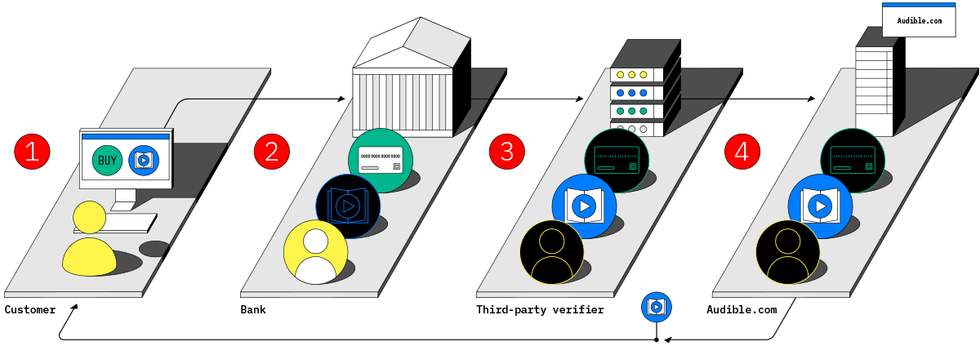

Illustration of a process

1. Barath orders Bruce’s audiobook from Audible. 2. His bank does not know what he is buying, but it guarantees the payment. 3. A third party decrypts the order details but does not know who placed the order. 4. Audible delivers the audiobook and receives the payment.

DECOUPLED E-COMMERCE: By inserting an independent verifier between the bank and the seller and by blinding the buyer’s identity from the verifier, the seller and the verifier cannot identify the buyer, and the bank cannot identify the product purchased. But all parties can trust that the signed payment is valid.
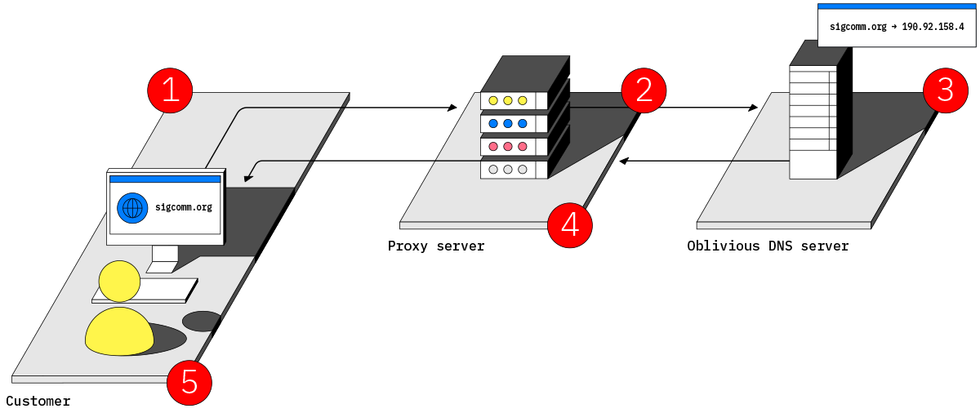

Illustration of a process

1. Bruce’s browser sends a doubly encrypted request for the IP address of sigcomm.org. 2. A third-party proxy server decrypts one layer and passes on the request, replacing Bruce’s identity with an anonymous ID. 3. An Oblivious DNS server decrypts the request, looks up the IP address, and sends it back in an encrypted reply. 4. The proxy server forwards the encrypted reply to Bruce’s browser. 5. Bruce’s browser decrypts the response to obtain the IP address of sigcomm.org.

DECOUPLED WEB BROWSING: can track which websites their users visit because requests to the Domain Name System (DNS), which converts domain names to IP addresses, are unencrypted. A new protocol called Oblivious DNS can protect users’ browsing requests from third parties. Each name-resolution request is encrypted twice and then sent to an intermediary (a “proxy”) that strips out the user’s IP address and decrypts the outer layer before passing the request to a domain name server, which then decrypts the actual request. Neither the ISP nor any other computer along the way can see what name is being queried. The Oblivious resolver has the key needed to decrypt the request but no information about who placed it. The resolver encrypts its reply so that only the user can read it.

Similar methods have been extended beyond DNS to multiparty-relay protocols that protect the privacy of all Web browsing through free services such as Tor and subscription services such as INVISV Relay and Apple’s iCloud Private Relay.


How decoupling can protect data in motion

Three classes of new technology developed in the last few years now make decoupling practical in many more applications.

Imagine you’re on a Zoom call. Your device and those of your colleagues are sending video to Zoom’s servers. By default, this is encrypted when sent to Zoom, but Zoom can decrypt it. That means Zoom’s servers see the video and hear the audio, and then forward it to others on the call. Zoom also knows who’s talking to whom, and when.

Meetings that were once held in a private conference room are now happening in the cloud, and third parties like Zoom see it all: who, what, when, where. There’s no reason a videoconferencing company has to learn such sensitive information about every organization it provides services to. But that’s the way it works today, and we’ve all become used to it.

There are multiple threats to the security of that Zoom call. A Zoom employee could go rogue and snoop on calls. Zoom could spy on calls of other companies or harvest and sell user data to data brokers. It could use your personal data to train its AI models. And even if Zoom and all its employees are completely trustworthy, the risk of Zoom getting breached is omnipresent. Whatever Zoom can do with your data in motion, a hacker can do to that same data in a breach. Decoupling data in motion could address those threats.

Videoconferencing doesn’t need access to unencrypted video to push bits between your device and others. A properly decoupled video service could secure the who, what, where, and when of your data in motion, beginning with the “what”—the raw content of the call. True end-to-end encryption of video and audio would keep that content private to authorized participants in a call and nobody else. (Zoom does currently offer this option, but using it disables many other features.)

To protect the “who,” functional decoupling within the service could authenticate users using cryptographic schemes that mask their identity, such as blind signatures, which Chaum invented decades ago for anonymizing purchases.

Organizational decoupling can protect the “where” and “when,” preventing the service from learning the network addresses of the participants and thus their locations and identities through different means. Newer multihop relay systems, more efficient than Tor, route data through third-party infrastructure so that when it reaches the video service, the true source is unknown.

Taken together, these decoupling measures would protect users from both Zoom’s deliberate actions and its security failures.

How decoupling can protect data storage

Data at rest, unencrypted on a laptop or phone, poses obvious risks from thieves and malware. Cloud storage is convenient, fast, and reliable, but those benefits come with new risks. A breach that affects any customer could affect all of them, making it all the more lucrative for a hacker to try to break in.

Most storage and database providers started encrypting data on disk years ago, but that’s not enough to ensure security. In most cases, the data is decrypted every time it is read from disk. A hacker or malicious insider silently snooping at the cloud provider could thus intercept your data despite it having been encrypted.

Cloud-storage companies have at various times harvested user data for AI training or to sell targeted ads. Some hoard it and offer paid access back to us or just sell it wholesale to data brokers. Even the best corporate stewards of our data are getting into the advertising game, and the decade-old feudal model of security—where a single company provides users with hardware, software, and a variety of local and cloud services—is breaking down.

Decoupling can help us retain the benefits of cloud storage while keeping our data secure. As with data in motion, the risks begin with access the provider has to raw data (or that hackers gain in a breach). End-to-end encryption, with the end user holding the keys, ensures that the cloud provider can’t independently decrypt data from disk. But the uses of data at rest are different, so the decoupling remedies must also be different.

Functional decoupling once again becomes just as important as organizational decoupling. We need decoupled infrastructure for authentication so that users can prove who they are, for authorization so that users can be given or denied access to data, for repositories that store raw data, and for applications that operate only on data the user permits them to access. Ideally, these functions would be decoupled across multiple providers, using standard protocols and programming interfaces to weave together seamless services for users.

We also must consider use cases. We store data in the cloud not only to retrieve it ourselves, but to share it with others. Many cloud systems that hold our data—whether Amazon’s Simple Storage Service (S3), Google Drive, or Microsoft 365, or analytics platforms, such as Intuit or Salesforce—provide the illusion of control, by giving customers tools for sharing. In reality, the cloud-storage provider still has complete access to and control over your data.

Here we need to decouple data control from data hosting. The storage provider’s job is to host the data: to make it available from anywhere, instantly. The hosting company doesn’t need to control access to the data or even the software stack that runs on its machines. The cloud software that grants access should put control entirely in the end user’s hands.

Modern protocols for decoupled data storage, like Tim Berners-Lee’s Solid, provide this sort of security. Solid is a protocol for distributed personal data stores, called pods. By giving users control over both where their pod is located and who has access to the data within it—at a fine-grained level—Solid ensures that data is under user control even if the hosting provider or app developer goes rogue or has a breach. In this model, users and organizations can manage their own risk as they see fit, sharing only the data necessary for each particular use.

By Invitation Only: How to keep private meetings private


Online services such as Zoom, Google Meet, and Microsoft Teams know who is meeting with whom, when, where, and what they’re saying because users’ devices are sending all video and audio data to the cloud, which can decrypt video streams internally and see participants’ IP addresses and identities. By using multiparty relays, end-to-end encryption, and oblivious authentication, a decoupled meeting service such as Booth prevents tech giants and hackers from snooping on private discussions.
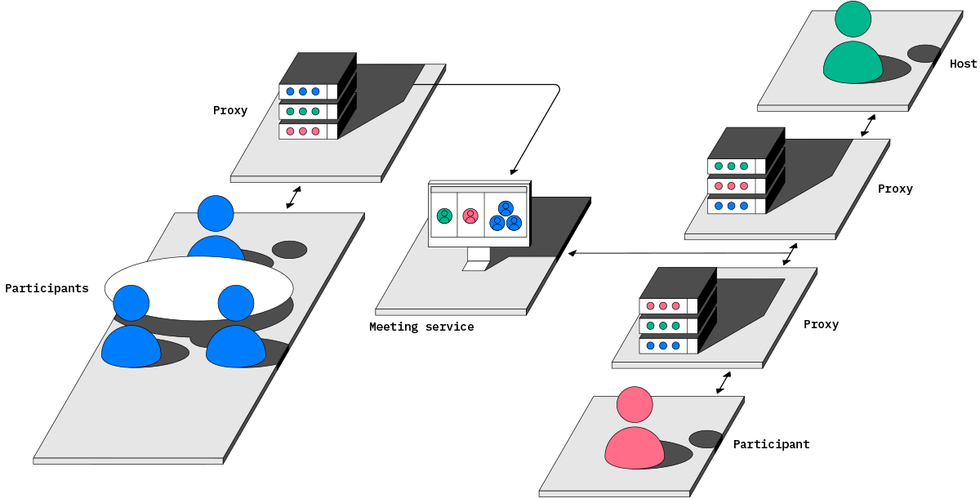

Illustration of a process

Each meeting is assigned a randomly generated link. The host sends these to each meeting participant so that they—and only they—can join the meeting. The cloud service does not know who they are.

The meeting data stream, encrypted end-to-end between users, applies decoupling and is routed through third-party proxies. The multiparty relay scheme can authenticate each user without revealing their identities to the meeting service.


How decoupling can make computation more secure

Almost all cloud services have to perform some computation on our data. Even the simplest storage provider has code to copy bytes from an internal storage system and deliver them to the user. End-to-end encryption is sufficient in such a narrow context. But often we want our cloud providers to be able to perform computation on our raw data: search, analysis, AI model training or fine-tuning, and more. Without expensive, esoteric techniques, such as secure multiparty computation protocols or homomorphic encryption techniques that can perform calculations on encrypted data, cloud servers require access to the unencrypted data to do anything useful.

Fortunately, the last few years have seen the advent of general-purpose, hardware-enabled secure computation. This is powered by special functionality on processors known as trusted execution environments (TEEs) or secure enclaves. TEEs decouple who runs the chip (a cloud provider, such as Microsoft Azure) from who secures the chip (a processor vendor, such as Intel) and from who controls the data being used in the computation (the customer or user). A TEE can keep the cloud provider from seeing what is being computed. The results of a computation are sent via a secure tunnel out of the enclave or encrypted and stored. A TEE can also generate a signed attestation that it actually ran the code that the customer wanted to run.

With TEEs in the cloud, the final piece of the decoupling puzzle drops into place. An organization can keep and share its data securely at rest, move it securely in motion, and decrypt and analyze it in a TEE such that the cloud provider doesn’t have access. Once the computation is done, the results can be reencrypted and shipped off to storage. CPU-based TEEs are now widely available among cloud providers, and soon GPU-based TEEs—useful for AI applications—will be common as well.

How decoupling protects both privacy and security

One of the key benefits of decoupling is that it ensures there will be no single point of failure. If a cloud provider of a decoupled videoconferencing service is breached, all that’s visible is the flow of encrypted bytes to and from other nameless cloud servers. Same with storage: A breach reveals only a bunch of encrypted disks and encrypted flows of data. Same with compute: The hardware enclave shields the data in use from the attacker’s prying eyes.

The remaining risks are largely within each mode. The fact that decoupled storage feeds into decoupled compute doesn’t magnify the risk—but it’s worth thinking through in more detail.

Suppose Microsoft Azure is used to host a Solid pod, but it’s encrypted at rest and only decrypted within one of Azure’s secure enclaves. What can Microsoft or a hacker learn? The fact that Azure hosts both services does not give it much additional information, especially if data in motion is also encrypted to ensure that Microsoft doesn’t even know who is accessing that data. With all three modes decoupled, Azure sees an unknown user accessing an unknown blob of encrypted data to run unknown code within a secure enclave on Intel processors. This is exactly what an enterprise should want and expect from its cloud service providers: that they are no longer a breach risk even as they deliver the same useful cloud services as before.


“Self-regulation is a time-honored stall tactic. We need government policy that mandates decoupling-based best practices, a tech sector that implements this architecture, and public awareness of the benefits of this better way forward.”


Decoupling also allows us to look at security more holistically. For example, we can dispense with the distinction between security and privacy. Historically, privacy meant freedom from observation, usually for an individual person. Security, on the other hand, was about keeping an organization’s data safe and preventing an adversary from doing bad things to its resources or infrastructure.

There are still rare instances where security and privacy differ, but organizations and individuals are now using the same cloud services and facing similar threats. Security and privacy have converged, and we can usefully think about them together as we apply decoupling.

Decoupling also creates new opportunities: for companies to offer new services in a decoupled cloud ecosystem, for researchers to develop new technologies that can improve security and privacy, and for policymakers to ensure better security for everyone.

Decoupling isn’t a panacea. There will always be new, clever side-channel attacks. And most decoupling solutions assume a degree of noncollusion between independent companies or organizations. But that noncollusion is already an implicit assumption today: We trust that Google and Advanced Micro Devices will not conspire to break the security of the TEEs they deploy, for example, because the reputational harm from being found out would hurt their businesses. The primary risk, real but also often overstated, is if a government secretly compels companies to introduce backdoors into their systems. In an age of international cloud services, this would be hard to conceal and would cause irreparable harm.

How a Credit-Reporting Agency Should Work: Decoupling could thwart a privacy disaster


Some of the most pernicious risks we face today are from organizations that we have no choice in interacting with, such as credit-reporting agencies. Equifax, for example, had famously lax security, which allowed hackers to steal personal data on some 163 million people in 2017. Yet the company still holds some of the most sensitive personal financial data that exists.

Applying the decoupling principle to those credit records could ensure a far better outcome if the company were breached again. Attackers would not be able to identify any individuals nor read any credit facts because the compromised data would be encrypted and scattered across myriad, far-flung personal data stores.
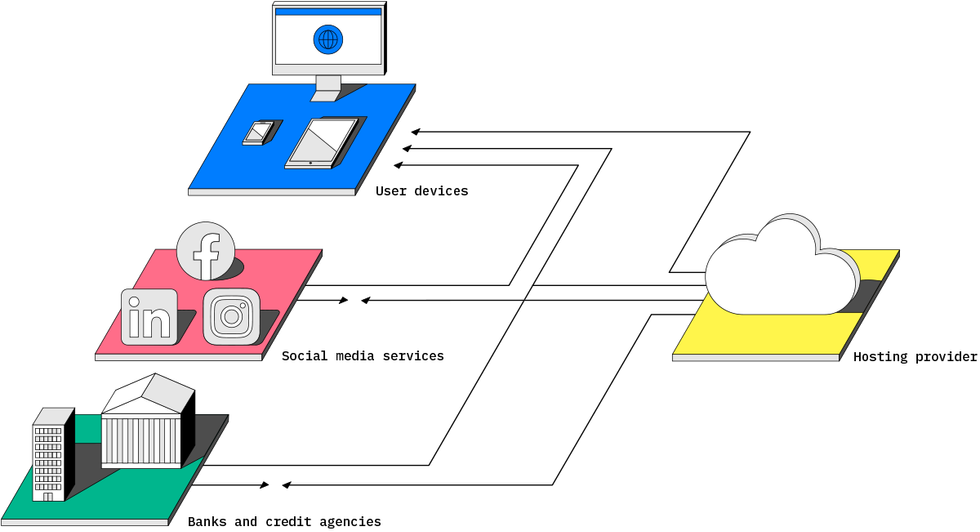

Illustration of a process

DATA AT REST: Individuals and organizations could hold their credit data themselves, along with all their other personal data, in cloud repositories that they control and encrypt. New storage protocols such as Solid decouple the hosting provider from data access control and from applications. Individual credit facts (such as bank account numbers, reports from lenders, and so forth) could be cryptographically signed by those parties and supplied to the individual for storage in the repository. When applying for a loan, the user could then grant time-limited access to a specific organization for a specific application.
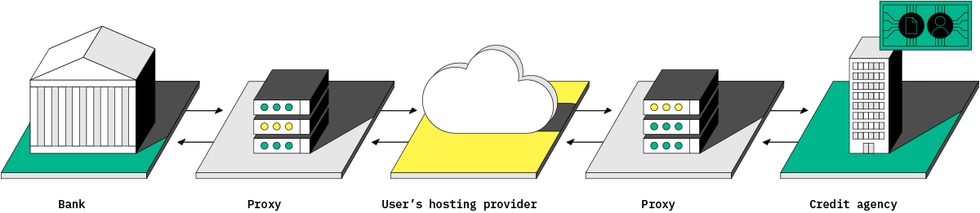

Illustration of a process

DATA IN MOTION: Communications to and from the reporting agency’s servers should be decoupled by multiparty-relay protocols that build in blinding and encryption to conceal who is doing the communicating as well as the identity of the individual whose data is being analyzed.

DATA IN USE: A credit-analysis algorithm should run only in a secure enclave on the server—known as a trusted execution environment—so that the credit agency cannot see the data as it is processed. The user can check an attestation, perhaps via an external auditor, that only a permitted algorithm was used, but cannot see the proprietary code that was executed.


Rethinking Equifax

Decoupling doesn’t just benefit individual organizations or users: It also has positive ripple effects when properly applied. All of the decoupling we’ve talked about could lead to a better and very different outcome if Equifax were breached again, for example.

Imagine that individuals and organizations held their credit data in cloud-hosted repositories that enable fine-grained encryption and access control. Applying for a loan could then take advantage of all three modes of decoupling. First, the user could employ Solid or a similar technology to grant access to Equifax and a bank only for the specific loan application. Second, the communications to and from secure enclaves in the cloud could be decoupled and secured to conceal who is requesting the credit analysis and the identity of the loan applicant. Third, computations by a credit-analysis algorithm could run in a TEE. The user could use an external auditor to confirm that only that specific algorithm was run. The credit-scoring algorithm might be proprietary, and that’s fine: In this approach, Equifax doesn’t need to reveal it to the user, just as the user doesn’t need to give Equifax access to unencrypted data outside of a TEE.

Building this is easier said than done, of course. But it’s practical today, using widely available technologies. The barriers are more economic than technical.

Rethinking AI

As more organizations apply AI, decoupling becomes ever more important. Most cloud AI offerings—whether large language models like ChatGPT, automated transcription services from video and voice companies, or big-data analytics—require the revelation of troves of private data to the cloud provider. Sometimes organizations seek to build a custom AI model, trained on their private data, that they will then use internally. Sometimes organizations use pretrained AI models on their private data. Either way, when an AI model is used, the cloud service learns all sorts of things: the content of the prompts or data input, access patterns of the organization’s users, and sometimes even business use cases and contexts. AI models typically require substantial data, and that means substantial risk.

Once again, the three modes of decoupling can enable secure, cloud-hosted AI. Data, of organizations or ordinary people, can be held in a decoupled data store with fine-grained user control and mechanisms that decouple identity from usage. When the data needs to be processed, access can be explicitly granted for that purpose to allow the secure movement of the data from the store to a TEE. The actual AI training or operation on the user’s data can leverage GPU-based secure enclaves. Basically, a GPU TEE is like a CPU TEE, so nothing is leaked about the raw data.

How decoupling could lead to better policy

Why hasn’t this design philosophy been adopted widely? It’s hard to say for sure, but we think it’s because the enabling technologies— multiparty relay protocols, secure fine-grained data stores and hardware-based TEEs—have matured only in the last few years. Also, security rarely drives business decisions, so even after the tech is available, adoption can lag.

Regulation, especially in the United States, is also lagging. What few data protections exist do not cover—or even clearly distinguish among—the three modes of decoupling. At the same time, it’s unreasonable to expect policymakers to make the first move. They can’t mandate something they don’t know is even possible. Technologists need to educate policymakers that potential solutions are in hand.

One of the challenges of trying to regulate tech is that industry incumbents push for tech-only approaches that simply whitewash bad practices. For example, when Facebook rolls out “privacy-enhancing” advertising, but still collects every move you make, has control of all the data you put on its platform, and is embedded in nearly every website you visit, that privacy technology does little to protect you. We need to think beyond minor, superficial fixes.

Decoupling might seem strange at first, but it’s built on familiar ideas. Computing’s main tricks are abstraction and indirection. Abstraction involves hiding the messy details of something inside a nice clean package: When you use Gmail, you don’t have to think about the hundreds of thousands of Google servers that have stored or processed your data. Indirection involves creating a new intermediary between two existing things, such as when Uber wedged its app between passengers and drivers.

The cloud as we know it today is born of three decades of increasing abstraction and indirection. Communications, storage, and compute infrastructure for a typical company were once run on a server in a closet. Next, companies no longer had to maintain a server closet, but could rent a spot in a dedicated colocation facility. After that, colocation facilities decided to rent out their own servers to companies. Then, with virtualization software, companies could get the illusion of having a server while actually just running a virtual machine on a server they rented somewhere. Finally, with serverless computing and most types of software as a service, we no longer know or care where or how software runs in the cloud, just that it does what we need it to do.

With each additional abstraction and layer of indirection, we’ve become further separated from true control of the underlying compute infrastructure. Meanwhile, we’ve gained operational benefits. And these operational benefits are key, even in the context of security: After all, denial of service is an attack on availability, making it a security issue even if there is no loss in confidentiality or integrity of data.

We’re now at a turning point where we can add further abstraction and indirection to improve security, turning the tables on the cloud providers and taking back control as organizations and individuals while still benefiting from what they do.

The needed protocols and infrastructure exist, and there are services that can do all of this already, without sacrificing the performance, quality, and usability of conventional cloud services.

But we cannot just rely on industry to take care of this. Self-regulation is a time-honored stall tactic: A piecemeal or superficial tech-only approach would likely undermine the will of the public and regulators to take action. We need a belt-and-suspenders strategy, with government policy that mandates decoupling-based best practices, a tech sector that implements this architecture, and public awareness of both the need for and the benefits of this better way forward.

Reference: https://ift.tt/hBx5Hw0

Saturday, November 4, 2023

“Catastrophic” AI harms among warnings in declaration signed by 28 nations


Enlarge / UK Technology Secretary Michelle Donelan (front row center) is joined by international counterparts for a group photo at the AI Safety Summit at Bletchley Park in Milton Keynes, Buckinghamshire, on November 1, 2023. (credit: Getty Images)

On Wednesday, the UK hosted an AI Safety Summit attended by 28 countries, including the US and China, which gathered to address potential risks posed by advanced AI systems, reports The New York Times. The event included the signing of "The Bletchley Declaration," which warns of potential harm from advanced AI and calls for international cooperation to ensure responsible AI deployment.

"There is potential for serious, even catastrophic, harm, either deliberate or unintentional, stemming from the most significant capabilities of these AI models," reads the declaration, named after Bletchley Park, the site of the summit and a historic World War II location linked to Alan Turing. Turing wrote influential early speculation about thinking machines.

Rapid advancements in machine learning, including the appearance of chatbots like ChatGPT, have prompted governments worldwide to consider regulating AI. Their concerns led to the meeting, which has drawn criticism for its invitation list. In the tech world, representatives from major companies included those from Anthropic, Google DeepMind, IBM, Meta, Microsoft, Nvidia, OpenAI, and Tencent. Civil society groups, like Britain's Ada Lovelace Institute and the Algorithmic Justice League in Massachusetts, also sent representatives.

Read 6 remaining paragraphs | Comments

Reference : https://ift.tt/hvD7u69

Wednesday, November 1, 2023

The Future of Fully Homomorphic Encryption


This sponsored article is brought to you by NYU Tandon School of Engineering.

In our digital age, where information flows seamlessly through the vast network of the internet, the importance of encrypted data cannot be overstated. As we share, communicate, and store an increasing amount of sensitive information online, the need to safeguard it from prying eyes and malicious actors becomes paramount. Encryption serves as the digital guardian, placing our data in a lockbox of algorithms that only those with the proper key can unlock.


Whether it’s personal messages, health data, financial transactions, or confidential business communications, encryption plays a pivotal role in maintaining privacy and ensuring the integrity of our digital interactions. Typically, data encryption protects data in transit: it’s locked in an encrypted “container” for transit over potentially unsecured networks, then unlocked at the other end, by the other party for analysis. But outsourcing to a third-party is inherently insecure.


A man with short light brown hair and beard, wearing glasses, smiles at the camera.

But what if encryption didn’t just exist in transit and sit unprotected on either end of the transmission? What if it was possible to do all of your computer work — from basic apps to complicated algorithms — fully encrypted, from beginning to end.

That is the task being taken up by Brandon Reagen, Assistant Professor of Computer Science and Engineering and Electrical and Computer Engineering at the NYU Tandon School of Engineering. Reagen, who is also a member of the NYU Center for Cybersecurity, focuses his research on designing specialized hardware accelerators for applications including privacy preserving computation. And now, he is proving that the future of computing can be privacy-forward while making huge advances in information processing and hardware design.

All-encompassing Encryption

In a world where cyber threats are ever-evolving and data breaches are a constant concern, encrypted data acts as a shield against unauthorized access, identity theft, and other cybercrimes. It provides individuals, businesses, and organizations with a secure foundation upon which they can build trust and confidence in the digital realm.

The goal of cybersecurity researchers is the protection of your data from all sorts of bad actors — cybercriminals, data-hungry companies, and authoritarian governments. And Reagen believes encrypted computing could hold an answer. “This sort of encryption can give you three major things: improved security, complete confidentiality and sometimes control over how your data is used,” says Reagen. “It’s a totally new level of privacy.”

“My aim is to develop ways to run expensive applications, for example, massive neural networks, cost-effectively and efficiently, anywhere, from massive servers to smartphones” —Brandon Reagen, NYU Tandon

Fully homomorphic encryption (FHE), one type of privacy preserving computation, offers a solution to this challenge. FHE enables computation on encrypted data, or ciphertext, to keep data protected at all times. The benefits of FHE are significant, from enabling the use of untrusted networks to enhancing data privacy. FHE is an advanced cryptographic technique, widely considered the “holy grail of encryption,” that enables users to process encrypted data while the data or models remain encrypted, preserving data privacy throughout the data computation process, not just during transit.

While a number of FHE solutions have been developed, running FHE in software on standard processing hardware remains untenable for practical data security applications due to the massive processing overhead. Reagen and his colleagues have recently been working on a DARPA-funded project called The Data Protection in Virtual Environments (DPRIVE) program, that seeks to speed up FHE computation to more usable levels.


Diagram showing four different parts, including interconnected logic, memory, and other elements, of a cybersecurity chip.

Specifically, the program seeks to develop novel approaches to data movement and management, parallel processing, custom functional units, compiler technology, and formal verification methods that ensure the design of the FHE implementation is effective and accurate, while also dramatically decreasing the performance penalty incurred by FHE computations. The target accelerator should reduce the computational run time overhead by many orders of magnitude compared to current software-based FHE computations on conventional CPUs, and accelerate FHE calculations to within one order of magnitude of current performance on unencrypted data.

The Hardware Promising Privacy

While FHE has been shown to be possible, the hardware required for it to be practical is still rapidly being developed by researchers. Reagen and his team are designing it from the ground up, including new chips, datapaths, memory hierarchies, and software stacks to make it all work together.

The team was the first to show that the extreme levels of speedup needed to make HE feasible was possible. And by early next year, they’ll begin manufacturing of their prototypes to further their field testing.

Reagen — who earned a doctoral degree in computer science from Harvard in 2018 and undergraduate degrees in computer systems engineering and applied mathematics from the University of Massachusetts, Amherst, in 2012 — focused on creating specialized hardware accelerators for applications like deep learning. These accelerators enhance specialized hardware that can be made orders of magnitude more efficient than general-purpose platforms like CPUs. Enabling accelerators requires changes to the entire compute stack, and to bring about this change, he has made several contributions to lowering the barrier of using accelerators as general architectural constructs, including benchmarking, simulation infrastructure, and System on a Chip (SoC) design.


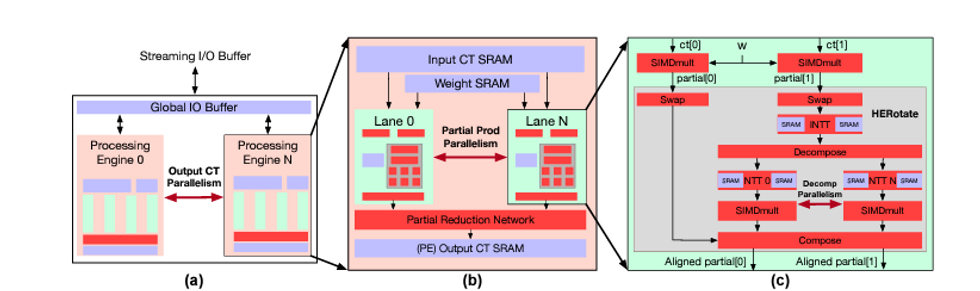
Diagram showing different parts of the Cheetah accelerator architecture, including IO buffers, engines, and memory.

“My aim is to develop ways to run expensive applications, for example, massive neural networks, cost-effectively and efficiently, anywhere, from massive servers to smartphones,” he says.

Before coming to NYU Tandon, Reagen was a former research scientist on Facebook’s AI Infrastructure Research team, where he became deeply involved in studying privacy. This combination of a deep cutting-edge computer hardware background and a commitment to digital security made him a perfect fit for NYU Tandon and the NYU Center for Cybersecurity, which has been at the forefront of cybersecurity research since its inception.

“A lot of the big problems that we have in the world right now revolve around data. Consider global health coming off of COVID: if we had better ways of computing global health data analytics and sharing information without exposing private data, we might have been able to respond to the crisis more effectively and sooner” —Brandon Reagen, NYU Tandon

For Reagen, this is an exciting moment in the history of privacy preserving computation, a field that will have huge implications for the future of data and computing.

“I’m an optimist — I think this could have as big an impact as the Internet itself,” says Reagen. “And the reason is that, if you think about a lot of the big problems that we have in the world right now, a lot of them revolve around data. Consider global health. We’re just coming off of COVID, and if we had better ways of computing global health data analytics and sharing information without exposing private data, we might have been able to respond to the crisis more effectively and sooner. If we had better ways of sharing data about climate change data from all over the world, without exposing what each individual country or state or city was actually emitting, you could imagine better ways of managing and fighting global climate change. These problems are, in large part, problems of data, and this kind of software can help us solve them.”

Reference: https://ift.tt/GjJRe7O

This Durable Strand of Jelly Can Block Pain


Is there a better way for scientists to shine a light on nerve cells throughout the body? When researchers Xinyue Liu and Siyuan Rao first began their collaboration at MIT, they treated this question literally.

Optogenetics is an interdisciplinary branch of science in which cells are genetically altered to be light-sensitive, making it possible to inhibit or excite cells, and study their function by applying colored light. Typically, the light-transmitting wires that reach target cells have been made of materials that work well when stationary in the brain. However, if they’re implanted elsewhere in a test animal’s body, they could break, or damage tissue, or affect behavior—making it difficult to study the peripheral nervous system and pain in particular.

“This flexible fiber expands the toolbox of approaches we have.”
—Rob Bonin, University of Toronto

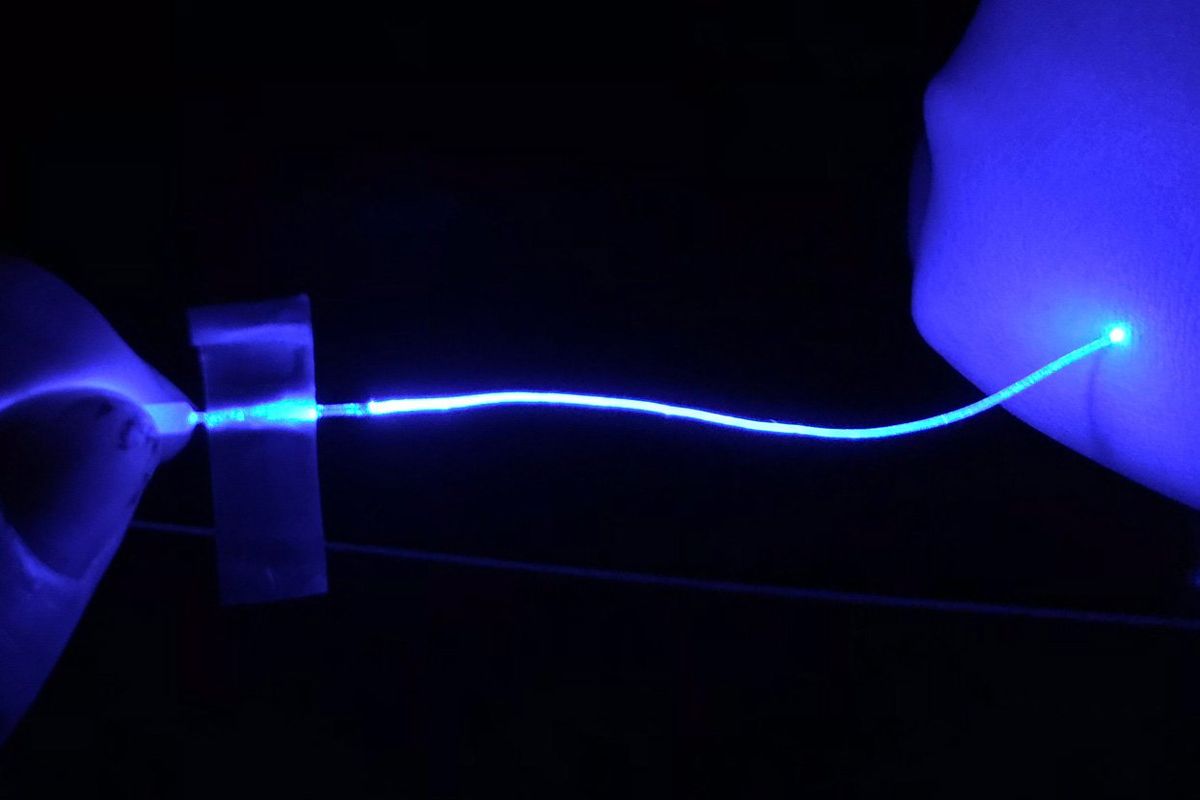
Now, Liu, Rao, and colleagues have developed a soft, flexible, durable optical fiber capable of delivering an optogenetic light signal away from the brain or spine using a new material, hydrogel. The filament consists of an inner core and outer cladding of two versions of the hydrogel with different refractive properties, yet is only about one millimeter in diameter.

Researchers described the optical fiber and a variety of ways it was put through its paces in model mice in a paper in Nature Methods, published 19 October. The work adds another technique—and a bit of flexibility—to the repertoire of optogenetics, the study of the peripheral nervous system, and possibly future translational medicine, including the treatment of pain, chronic pain, and nerve disorders.

“This flexible fiber expands the toolbox of approaches we have for peripheral optogenetic work,” said Rob Bonin, a pain researcher at the University of Toronto who was not involved in the research, citing flexibility and durability as two major advantages of the new approach.

Broadly, hydrogels are soft networks of polymers and water, such as tofu or jelly. “Our body is also made of hydrogels. Except for bones and teeth, our muscles and other organs are all actually hydrogels,” said Liu, a materials scientist now at Michigan State University. The fiber uses a polyvinyl alcohol hydrogel, selected for its combination of optical properties and durability under repeated mechanical stress.

The investigation of soft materials was initiated with optogenetic pain research in the peripheral nervous system specifically in mind. “If your implant itself is causing pain, how are you going to use this technology to study pain?” said Rao, a neuroscientist now at the University of Massachusetts Amherst.

And although at the moment the hydrogel fiber primarily figures as a research tool in mice, the same qualities that set this new technology apart for basic science—durable and apparently comfortable in a freely moving body with no compromises in optical performance—are also positives for potential therapeutic purposes. “We are working towards that direction,” said Rao.

The technology promises a wide range of potential applications beyond just the brain and spine.

Researchers anchored one end of their fiber to the mice’s skulls, threaded it underneath the skin, and wrapped a cuff at the other end around the sciatic nerve in the leg. From a practical standpoint, this made the implant compatible with existing external light sources, and kept mice from scratching at any element of the device. But it also worked as a demonstration that enabled a full range of motion of the subject. At a mouse scale, the fiber only needed to be 6 centimeters long, but the authors said it could be extended for other uses.

A series of tests showed that the fiber transmitted light, as well as its performance in the mice, both blocking pain caused by a hot plate on the foot, and inducing movement in the leg. Critically, it performed well after several weeks of voluntary exercise wheel use, which researchers estimated added up to thousands of bends and twists.

Other optogenetic studies of the peripheral nervous system in mice have attempted various methods of light delivery that don’t use an optical fiber at all, instead shining light through the skin or implanting miniaturized remote devices. In comparison, the new hydrogel fiber should be able to more precisely target specific cells, said Rao.

For Bonin, the external light source has its pros and cons, including higher intensity light and the possibility that a tether could affect behavior, respectively.

Federico Iseppon, a pain researcher at University College London who was not involved in the study, said that although the fiber may be relatively easy to use, it will still require specialized knowledge to fabricate and surgically implant. It promises a wide range of potential applications beyond just the brain and spine. “Its plasticity lies in the multiple different tissues that could be targeted with this technology,” he said.

Liu is currently working on an interface, such as a patch, between the hydrogel and organs that would enable connections that the current cuff design doesn’t allow. Ideally, the fiber will eventually also let scientists record activity as well as send signals to cells.

Reference: https://ift.tt/Lt24H38

Energy Harvesting for Wearable Technology Steps Up


Wearable devices, like nearly every other piece of tech, need energy. Fortunately, though, at wearables’ modest power budgets, energy is effectively everywhere. It’s in the sun’s rays and radio waves, the skin’s sweat and body heat, a person’s motion and their footfalls. And today, technology is maturing to the point that meaningful amounts of these energy giveaways can be harvested to liberate wearables from ever needing a battery. Which seems plenty attractive to a range of companies and researchers.

“Energy is something we take for granted, because we just plug things into the wall, and it feels as inevitable as air. But we do actually need that energy to be generated,” says Alper Bozkurt, who with Veena Misra codirects the Center for Advanced Self-Powered Systems of Integrated Sensors and Technologies (ASSIST) at North Carolina State University.

The best-known wearable energy-harvesting tech today is, of course, solar, which pulls down electrons from sun- or ambient light. But solar is just the opening gambit. There are, researchers have discovered, a wide range of options to harvest enough microwatts to replace wearables’ batteries. Among them, piezoelectric and triboelectric generators, which leverage mechanical strain and materials’ electrostatic properties to generate electricity. Meanwhile, the well-known phenomenon of electromagnetic induction harvests bumps, jumps, and strides to create tiny but still useful trickles of current.

While wearable devices don’t generally require much power, wearables must be, well, easy to wear. A backpack with a giant solar panel might work technically, but not in reality. A light human health sensor would be no use to biologists trying to keep a tracker on a bison for the rest of its life.

The variety of needs—and energy sources—is apparent in a flurry of recent energy-harvesting research, including some hybrid work that integrates multiple modalities.

The power of breaking a sweat

Black 3D printed circuitry sits on a piece of material attached to a person's forearm. Caltech’s team has experimented with different forms of energy to harvest for powering its e-skin, including human sweat and friction of materials during movement.Wei Gao/Caltech


California Institute of Technology’s Wei Gao developed a self-powering “electronic skin.”. E-skin, he says, is a sensor-embedded device applied directly to skin to read and transmit health indicators like heart rate, body temperature, blood sugar, and metabolic byproducts.

“Personalized health care could revolutionize traditional medical practice,” Gao says. “But to incorporate many different types of sensors, we need different material designs and tools. Not least of those considerations is energy storage [and generation].”

Gao’s first e-skin, produced in April 2020, was made of soft, flexible rubber, and it harnessed the patient’s sweat to power the device. Using built-in fuel cells, the device absorbed the lactate in the sweat and combined it with atmospheric oxygen to generate water and pyruvate. Through this process the biofuels generated enough electricity to power both the e-skin’s sensors and data transmission, continuously charging a capacitor from 1.5 to 3.8 volts for about 60 hours. (For capacitors, voltage translates to electrons stored—the voltage drop across a capacitor is proportional to its total charge.)

Months later Gao and his team developed an e-skin model that used kinetic energy from movement to generate triboelectricity, the liberation of current from the relative motion of materials of differing electrostatic properties. This second-generation e-skin sandwiched thin sheets of Teflon, copper, and polyimide that slide as the person moves, generating maximum power of 0.94 milliwatts.

The team next turned to 3D printing. In a study reported in Science Advances in September, they 3D-printed the essential components—physical sensors, chemical sensors, microfluidics, and supercapacitors—for a multimodal health-tracking system called e3-skin (epifluidic elastic electronic skin).

The platform uses an array of sensors, hydrogel-coated electrodes, and more, along with a microsize supercapacitor that in this case was powered by a solar cell. The precision of 3D printing allows researchers to create customized components for early warning and diagnosis of health conditions, Gao says.

Leveraging watch tech for…bisons?

Much talk of wearable technology focuses on health or other human needs. But biologists are also looking at energy harvesting for the tracking of animals, as current technology is insufficient. Batteries die before animals do. Solar won’t work for nocturnal animals or creatures in low-light environments. A little device that harvests energy from a runner’s evening jog clearly is not designed for a massive bison, which can weigh up to a tonne.

A furry brown animal with horns stands in a field. A Red and black collar is around their neck. A team of biologists built a custom “Kinefox” GPS tracker that wildlife—including this European bison test subject—can recharge simply by moving around as usual.Rasmus W. Havmøller
Those challenges inspired teams of researchers at the University of Copenhagen, Technical University of Denmark, and Germany’s Max Planck Institute of Animal Behavior to build a better wearable-size generator for their purposes: tracking wild animals for, ideally, their whole lives. That goal is currently out of reach—using battery- and solar-powered devices—for most mammalian species.

In work published in PLoS One in May they detailed the Kinefox, a GPS tracker that wildlife can recharge simply by moving. The team tested their devices with three species: four domestic dogs, an Exmoor pony, and a European bison.

The team was inspired by self-winding watches, which have existed since the late 18th century and transform wrist movement into energy. So the researchers bought a commercial microgenerator designed for wearable and IoT devices called the Kinetron MSG32. They combined it with a lithium-ion capacitor and a custom GPS-enabled tracker that transmits data via the Sigfox low-power wireless network.

“We wanted to take the stuff already created and use it off the shelf for animal tracking, even though it isn’t designed for that,” Gregersen says.

The researchers’ first version fitted the Kinefox to the animals’ existing collars and harnesses to observe and learn.

However, Gregersen says, “The first collar we put on the bison got destroyed immediately. They’re 900-kilo animals that run up against trees. It’s not a use case in human wearables.”

Taking results from the first version, the team ultimately created a custom tracker and collar. They glued the microgenerator’s pendulum-based automatic-watch movement to a ferromagnetic ring, placing the combination around a coil of copper wire. As the pendulum swings back and forth with the animal’s movement, the ring creates an alternating current in the coil—and a voltage-doubling circuit transforms it into direct current.

“There’s a lot of value in being able to place a tracker once, when the animal is born, or only having to tranquilize it once,” Gregersen says. “If something can transmit new types of data, or it can last longer than anything else, it has an application and it has value.”

Kinefox is open-source, with files published on GitHub. And where a traditional wildlife tracker costs €3,500 to €4,000, the Kinefox costs about €270 in materials, according to researchers at Max Planck.

In the future, DIY may not even be necessary. The team is in talks with the Tilburg, Netherlands–based company Kinetron to make a microgenerator designed specifically for animals, rather than self-winding wristwatches, Gregersen says.

Challenges: Sustainability and industry collaboration

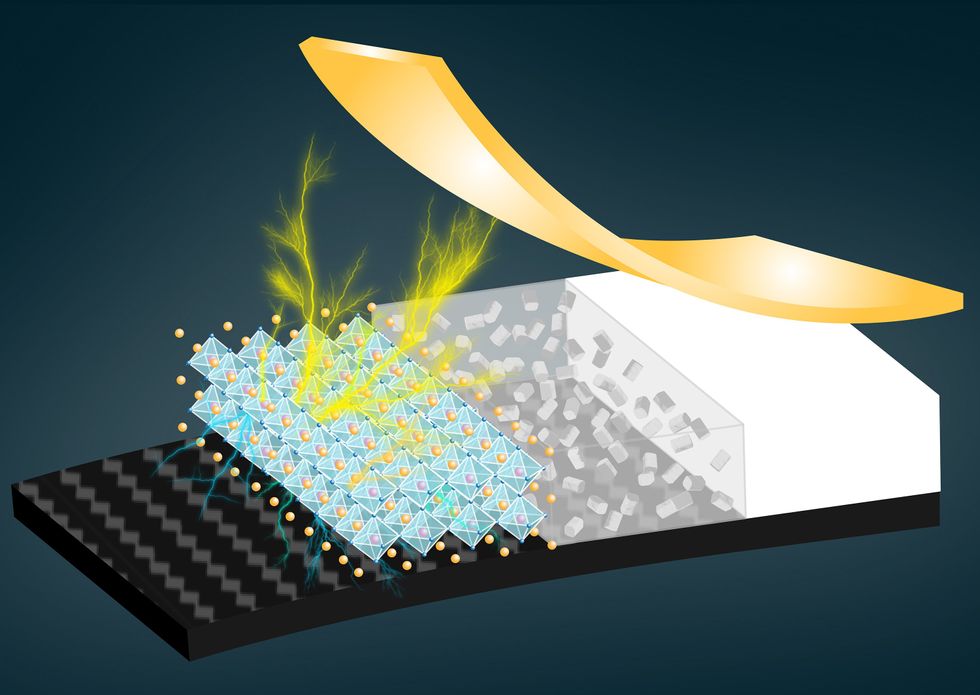
An illustration of a device with multiple layers of materials. This efficient energy harvester combines piezoelectric composites with carbon fiber-reinforced polymer and epoxy resin, a unique combination that was able to store electricity even after 100,000 uses.Tohoku University

Looking to the future more broadly, some researchers are focused on combining unique materials and creating energy-harvesting systems from more sustainable materials. A team including researchers from Japan’s Tohoku University recently developed a durable, efficient energy harvester that combines piezoelectric composites with carbon-fiber-reinforced polymer (CFRP).

The group fabricated their device using CFRP, sodium potassium niobate (KNN) nanoparticles, and epoxy resin. And even after 100,000 uses, Yu says, the device could still store the electricity it generated.

This combination of strength and energy generation could be used in several types of wearables and Internet of Things applications, including infrastructure systems to reinforce bridges and highways that sense when a crack, pothole, or other damage appears, Yu says.

The sweet spot, says Bozkurt of the ASSIST center, will be in data analysis—and matching the energy-harvesting capabilities to collect and transmit the data that users truly need.

“If I measure your heartbeat in picoseconds, that would be a waste because your heart doesn’t beat that quickly,” he says. For one project, “we asked medical doctors, ‘How much data do you need?’ They said, ‘We don’t know. We see our patients every month, so if we get more than one monthly reading it’ll be an improvement.’ That was some perspective.”

Reference: https://ift.tt/vrziQdu

Justine Bateman's Fight Against Generative AI In Hollywood


Stephen Cass: Hello and welcome to Fixing the Future, an IEEE Spectrum podcast where we look at concrete solutions to some big problems. I’m your host, Stephen Cass, senior editor at Spectrum. And before we start, I just want to tell you that you can get the latest coverage from some of Spectrum‘s most important beats including AI, climate change, and robotics by signing up for one of our free newsletters. Just go to spectrum.ieee.org/newsletters to subscribe.

The rapid development of generative AI technologies over the last two years, from deepfakes to large language models, has threatened upheavals in many industries. Creative work that was previously believed to be largely immune to automation now faces that very prospect. One of the most high-profile flashpoints in creative workers pushing back against digital displacement has been the months-long dual strikes by Hollywood writers and actors. The writers recently claimed victory and have gone back to work, but as of this recording, actors and their union SAG-AFTRA remain on the picket lines. Today, I’m very pleased to be able to speak with someone with a unique perspective on the issues raised by generative AI, Justine Bateman. Some of you may remember Justine from her starring role as big sister Mallory in the 1980s hit sitcom Family Ties, and she’s had a fascinating career since as a filmmaker and author. Justine has also displayed her tech chops by getting a degree in computer science from UCLA in 2016, and she has testified before Congress about net neutrality. She is currently SAG-AFTRA’s advisor on AI. Justine, welcome to the show.

Justine Bateman: Thank you.

Cass: So a lot of industries are being affected by generative AI. How did writers and actors become the focal point in the controversy about the future of work?

Bateman: Well, it’s curious, isn’t it? I guess it was low-hanging fruit because I mean, I feel like tech should solve problems, not introduce new ones like massive unemployment. And also, we have to remember that so much of this, to me, the root of it all is greed. And the arts can be a lucrative place. And it can also be very lucrative in selling to others the means by which they can feel like, “they are artists too,” in heavy quotes, which is not true. Either you’re born an artist or you’re not. Either you’re gifted at art or you’re not, which is true of everything else, sports, coding. Either you’re gifted as a coder or not. I’ll tell you this even though I have a computer science degree. I know I am gifted as a writer, as a director, and my previous career of being an actor. I am not gifted in coding. I worked my butt off. And once you know what it feels like to be gifted at something, you know what it feels like to not be gifted at something and to have to really, really work hard at it. So yeah, but I did it anyway, but there’s a difference. So yeah, I mean, and in that direction, there’s many people, they’d like to imply that they are gifted at coding by giving the generative AI a solution to that. Yeah.

Cass: So by here or by they, you really are locating your beef with the companies like OpenAI and so on, more so than perhaps the studios?

Bateman: Well, they’re both complicit. Sam Altman and OpenAI and everyone involved there, those that are doing the same at the Google offshoots, Microsoft, which is essentially OpenAI, I guess. I mean, if most of your money’s from there, I don’t know what else you are. Where else? Where else? I know DALL-E, I believe, is on top of OpenAI’s neural network. And there’s Midjourney. There’s so many other places. Meta has their own generative AI model, I believe. This is individuals making a decision to pull generative AI into our society. And so it’s not only them, but then those that subscribe to it that will financially subscribe to these services like the heads of the studios. They will all go down in the history books as having been the ones that ended the 100-year-old history— well, the 100-year-old entertainment business. They chose to bring it into their studios, into the business, and then everyone else. Everyone else who manages multiple people who is now deciding whether or not to pull in generative AI and fire their workforce, their human labor workforce. All those people are complicit too. Yeah.

Cass: When I looked up SAG-AFTRA’s proposal on AI, the current official statement reads, “Establish a comprehensive set of provisions to protect human-created work and require informed consent and fair compensation when a digital replica is made of a performer or when their voice, likeness, or performance will be substantially changed using AI.” Can you sketch out what some of those provisions might look like in a little more detail?

Bateman: Well, I can only say so much because I’m involved with the negotiations, but let’s just play it ourselves. Imagine if the digital replica was made of you, you would want to know what are you going to do with this? What are you going to have the say? What are you going to have this digital replica do? And how much are you going to pay me to essentially not be involved? So it kind of comes down to that. And at the bare minimum, granting your permission to even do that because I’m sure they’d like to not have to ask for permission and not have to pay anybody. But what we’re talking about, I mean, with the writers and the directors, it’s bad enough that you’re going to take all of their past work and use it to train models. It’s already been done. I think that should be absolutely not permitted. And if somebody wants to participate in that, they should give their consent and they should be compensated to be part of a training set. But the default should be no, instead of this ******* fair-use argument on all the copyrighted material.

Cass: So yeah, I’d love to drill down a little bit more into the copyright issues that you just talked about. So with regard to copyright, if I read a whole bunch of fantasy novels and I make what is clearly a kind of a bad imitation of Lord of the Rings, it’s like, “Okay, you kind of synthesize something. It’s not a derivative work. You can have your own copyright.” But if I actually go to Lord of the Rings and I very just change a few names around the place or maybe rearrange things a little bit, that is considered a derivative work. And so therefore, I’m not entitled to the copyright on it. Now the large language model creators would say, “Well, ours is more like the case of where we’re synthesizing across so many works, we’re creating new works. We’re not being derivative. And so therefore, of course, we reserve the copyrights.” Whereas I think you have a different view on that in terms of these derivative works.

Bateman: Sure, I do. First of all, your first example is a person with a brain. The other example is code. Code for a for-profit organization, multiple organizations. Totally different. Here’s the biggest difference. If you wanted to write a fantasy book, you would not have to read anything by Tolkien or anybody else, and you could come up with a fantasy book. An LLM? Tell me what it can do without ingesting any data. Anything? No, it’s like an empty blender. That’s the difference. So if this empty blender that is— I think these companies are valued at $1 trillion less, more? I don’t know right now. And yet, it is wholly dependent. And I believe I’m correct, wholly dependent on absorbing all this, yeah, now it’s just going to be called data, okay? But it’s really copyrighted books. And much of what is written— much of what you output is, by default, copyrighted. If you file it with the copyright office, it makes it easier to defend that in a court but scraping everybody else’s work.

Now if this LLM or a generative AI model was able to spit something out on its own without absorbing anything, or it was only trained on those CEO’s home movies and diaries, then fine. Let’s see what you can do. But no. If they think that they can write a bunch of— quote, “write a bunch of books” because they’ve absorbed all the books that they could get a hold of and then chop it all up and spit out little Frankenstein spoonfuls, no. That is all copyright violation. All of it. You think you’re going to make a film because you have ingested all of the films of the last 100 years? No, that’s a copyright violation. If you can do it on your own, terrific. But if you can’t do it unless you absorb all of our work, then that’s illegal.

Cass: So with regards to these questions of likenesses and sort of basically turning existing actors into sort of puppets that can say and do anything the studio wants, do you worry that studios will start looking for ways to just bypass human actors entirely and create born digital characters? I’m thinking of the big superhero franchises that already got plenty of these CGI characters that are pretty photorealistic. I mean, completely human ones, maybe still a little uncanny valley, but how hard would it be to make all those human characters CGI, too, and now you’ve got replaceable animators and voice actors and maybe motion capture performers instead of one big tentpole actor who you maybe really do have to negotiate with because they have the star power?

Bateman: No, that’s exactly what they’ll do. Everything you just said.

Cass: Is there any way within sort of your sort of SAG-AFTRA’s remit to prevent that from happening? Or are we kind of looking at the last few years before the death of the big movie star? And maybe the idea of the big movie star will become extinct. And while there’ll be human actors, it’ll never be that Chris Pratt sort of J. Law level of performer again.

Bateman: Well, everything that’s going to happen now with generative AI, we’ve been edging towards for the last 15 years. Generative AI is very good at spitting out some Frankenstein regurgitation of the past, right? That’s what it does. It doesn’t make anything new. It’s the opposite of the future. It’s the opposite of something new. And a lot of filmmaking in the last 15 years has been that, okay? So the audience is sort of primed for that kind of thing. Another thing you talk about, big movie stars. And I’m going to name some others like Tom Cruise, Meryl Streep, Harrison Ford, Meg Ryan like this. Well, all these people— with the exception of maybe Harrison Ford, but all these people really hit it in their 20s. Now who in their 20s is a big star now, Zendaya? Oh, the actor who’s in Call Me By Your Name. The name’s slipping my mind right now. There’s a couple, but where’s the new crop? And it’s not their fault. It’s just they’re not being made. So we’re already edging towards— the biggest movie stars that we have in the business right now, most of them are in their late 40s, early 50s, or older. So we’ve already not been doing that. We’ve already not been cultivating new film stars.

Yeah. And then you look at the amount of CGI that we just put on regular faces or plastic surgery. So now we’re edging closer and closer to audience accepting a full— or not CGI but a full generative AI person. And frankly, a lot of the demos that I’ve seen, you just can’t tell the difference. So yeah, all of that is going to happen. And then they’ll see there’s— and the other element that’s been going on for the last 10, 15 years is this obsession with content. And that’s thanks to the streamers. Come in, just churn it out as much as possible and as sort of in a most— the note that I’ve heard like Netflix gives— people that I know who are running TV shows, the note they get is make it more second screen. Meaning, the viewer’s phone or laptop is their first screen. And then what’s up on their television through internet connection, on Netflix or Amazon, whatever, is secondary. So you don’t have something on the screen that distracts them from their primary screen because then they might get up and shut it off. Somebody coined the term visual Muzak once. So that they don’t want you to get up. They don’t want you to pay attention. They don’t want you to see what’s going on.

And also, if you do happen to look up, they want to make sure that if you haven’t been looking up for the last 20 minutes, you’re not lost at all. So that kind of thing, generative AI can churn out 24/7, and also customize it to your particular viewing habits. And then people go, “Oh, no, it’s going to be okay because anything that’s fully generative AI can’t be copyrighted.” And my answer to that is, “Who’s going to be trying to copyright all these one-off films that they just churn out?” They’re going to be like Kleenex. Who cares? They make something specifically for you because they see that you like nature documentaries and then dramas that take place in outer space? So then they’ll just do films that combine— all generative AI films will combine all these things. And for an upcharge, you can go get scanned and put yourself in it and stuff. Where else are they going to show that? And if you screen record it and then post it somewhere, what do they care? It was a nominal cost compared with making a regular film with a lot of people. And so what do they care? They just make another one for you and another one for you and another one for you. And they’re going to have generative AI models just spitting stuff out round the clock.

Cass: So the economics of mass entertainment, as opposed to live theater and so on, has always been that the distribution model allowed for a low marginal cost per copy, whether that’s VHS cassettes or reels that are shown in the cinema and so on. And this is just an economic extension of that all the way back to production, essentially.

Bateman: I think so. But yes, and if we’re just looking at dollars, it is the natural progression of that. But it completely divorces itself— or any company engaging in this completely divorces themselves from actually being in the film business because that is not filmmaking. That is not series making. That doesn’t have anything to do with the actual art of filmmaking. So it’s a choice that’s being made by the studios, potentially, if they’re going to man the streamers and if they’re going to make all AI films. Or they’re right now trying to negotiate different ways that they are going to replace human actors. That’s a choice that’s being made, essentially, to not be in the film business.

Cass: So I’m not terribly familiar with acting as a professional discipline. And so can you tell a little bit for people with a tech background what actors really bring to the table in terms of guiding characters, molding characters, moving it from beyond just the script on the page how ever that’s produced? What’s the extra creative contribution that actors really put in beyond just, “Oh, they’re able to do a convincing sad face or happy face”?

Bateman: Sure. That’s a great question. And not all people working as actors do what I’m about to say, okay? Every project should have a thesis statement that the kind of— or an intention. I mean, in coding, it’s like what’s the spec? I mean, what is it you want this code to do? And that’s for script, what’s the intention? What do you want audiences to come away with? Fine. And the writer writes in that direction. Regardless of what the story is, there’s some sort of thesis statement, like I said. Director, same thing. Everybody’s got to be on board with that. And what the director’s pulling in, what the writers’ pulling everything, it’s like a mood and circumstances that deliver that to the audience. Now you’re delivering it ideally emotionally to them, right? So it really gets under their skin. And there’s a lot of films that any of your listeners have watched where it’s some film that made a big impact on them. This is when it’s a great actor, you really get pulled in, right? And when, say, somebody’s just standing in front of the camera saying lines, you’re not as emotionally engaged, right? So it’s an interesting thing to notice next time you see a film, whether or not you were emotionally engaged or not. And other things can contribute to that like the editing or the story or the cinematography and various things. But yeah, bottom line, the actor is a tour guide. Your emotional tour guide through this story. And they should also support whatever that thesis statement is.

Cass: So in your thesis for your computer science degree, you were really bemoaning, I think, Hollywood’s conservatism when it comes to exploring these technologies for new possibilities in storytelling. And so do you have any ideas of how some of these maybe technologies could actually work with actors and writers to explore new fun storytelling possibilities?

Bateman: Absolutely. You get the prize, Stephen. I don’t think anybody— yeah, I know I have that posted still. It’s from 2016. So this is a while ago. And yeah, it is posted on my LinkedIn. But good for you. I hope you didn’t read the entire thing. It’s a long one. So of course, I mean, there’s a reason I got a computer science degree. And I love tech. I think there are incredible ways that it can change the structure of a script. And one of the things I probably expressed in there, they’re what I call layered projects instead of having a story that’s written out in a line because that’s the way you’re delivering it in a theater or you’re watching the beginning and then the middle and then the end. Delivering a story that’s more so shaped like a tree and not choose your own adventure, but rather the story is that big.

And yeah, anyway, I could talk for a while about sort of the pseudocode of the designs of the layered projects that I’ve got, but that is a case. All those projects that I’ve designed that are these layered projects where we’re using either touchscreen technology or augmented reality, they service my thesis statement of my project. They service the story. They service the way the audience is perhaps going to watch the story. That is where I see technology servicing the artists such that they can expand what they’re wanting to do. I don’t see generative AI like that at all. I see generative AI as a regurgitation of our past work for those who, frankly, aren’t artists. And because it’s a replacement, it’s not people— I know there’s people, especially the blue-check people like to say that this is a tool. And I think, “Well, I forgive you because you’re not an artist and you don’t know the business and you don’t know filmmaking. You don’t understand how this stuff’s put together at all.” Fine. But blue-check guy, if you think this is just a tool, then I’d like to introduce you to any generative AI software that does code in place of coders. I’m sure there are a lot of software engineers that just are like, “What the hell?”

Cass: So just to wrap up that then, is there any question you think I should have asked you, which I haven’t asked you?

Bateman: What’s going to happen after the inferno?

Cass: Oh, what’s the inferno? What’s going to happen after the inferno? Now I’m worried.

Bateman: This is going to get very bad in every sector. This is no joke. And I’m not even talking about-- I know there are a lot of people talking about like, “Oh, it’s going to get into our defense system, and it’s going to set off nuclear bombs and stuff.” That may be true. But I’m talking about everything that’s going to happen before that. Everything that’s starting to happen right now. And that’s the devaluing of humans that’s making people feel like they’re just cogs in some machine and they have no agency and they don’t really matter. And tech is just at the forefront of everything. And we just have to go along with whatever it’s coming up with. I don’t think tech’s in the forefront of **** right now, honestly. And like I said, I’m a soft— I have a CS degree. I love tech. I mean, I wouldn’t have spent four years doing all of that if I didn’t. But for Christ’s sake, it needs to sit down for a minute. Just ******* sit down. Unless you see some problems that can actually be solved with tech, it’s going to destroy it with all the things I just said about how it’s going to make people feel. It’s going to be taking their jobs. It’s going to infiltrate education system. Everybody’s going to be learning the same thing because everybody is going to be as if everybody’s at the same university. They’re all going to be tapped into the same generative AI programs. It’s starting to happen now. You take one program. Instead of learning something from one teacher and a bunch of students are learning from that one teacher, that one school, they’re tapping into certain programs that multiple schools are using. And they’re all learning to write in the same way.

Anyway, all that is going to— it’ll crush the structure of the entertainment business because the structure of the entertainment business is a pipeline of duties and tasks by various people from conception to release of that project. And you start pulling out chunks of that pipeline, and the whole structure collapses. But I think on the other side of this inferno— but I think on the other side of it, there is going to be something really raw and really real and really human that will be brand new in the way jazz was new or rock and roll was new or as different as the 1960s were from the 1950s. Because when you think about it, when you look at the 20th century, all of these decades, something specific happened in them, multiple things happened in them that were specific that really showcased or instigated by the arts, politics. Everything changed. Every era has its own kind of flavor. And that stopped in about 2000. When I ask you about the aughts or you had to go to a party that was dressed in the aughts, what would you put on? I don’t know. What are these decades at all? There’s a lot of great things about the internet and some good things about social media, but basically it flattened everything. And so I feel that after this burns everything down, we’re going to actually have something new. A new genre in the arts. A new kind of day. A new decade like we haven’t had since the ‘90s, really. And that’s what I’m looking forward to. That’s what I’m built for, I mean, as far as being a filmmaker and a writer. So I’m looking forward to that.

Cass: Wow. Well, those are some very prophetic words. Maybe we’ll see, hopefully, whether or not there is an inferno or what’s on the other side of the inferno. But yeah, thank you so much for coming on and chatting with us today. It was really super talking with you today.

Bateman: My pleasure.

Cass: Today, we were speaking with Justine Bateman who is the AI advisor of the SAG-AFTRA Actors Union. I’m Stephen Cass for IEEE Spectrum‘s Fixing the Future, and I hope you’ll join us next time.

Reference: https://ift.tt/by8UKDu

VMware migration reduces Tottenham Hotspur's licensing fees by 85 percent

<p>Tottenham Hotspur, a professional soccer team that’s part of the Premier League, has saved over 85 per...