Monday, August 17, 2026

Digital Signal Processing Pioneer Bede Liu Dies At 91


<img src="https://spectrum.ieee.org/media-library/portrait-of-an-elderly-asian-man-softly-smiling-in-a-suit-jacket-and-tie.jpg?id=67609508&width=1245&height=700&coordinates=0%2C62%2C0%2C63"/><br/><br/><p>Bede Liu, a digital signal processing pioneer, died on 7 May. He was 91.</p><p>Liu was widely regarded as one of the founders of modern digital signal processing, a field that applies mathematical algorithms to analyze, modify, and transmit signals including sound, images, and video.</p><p>The IEEE Life Fellow taught electrical engineering at <a href="https://www.princeton.edu/" rel="noopener noreferrer" target="_blank">Princeton</a> for more than 50 years. From 1994 to 1997, he chaired the university’s <a href="https://ece.princeton.edu/front" rel="noopener noreferrer" target="_blank">electrical and computer engineering department</a>.</p><p>Liu’s research aided the transition from analog to digital processing of sound, images, and video. His work helped establish many of the mathematical and engineering techniques that underpin modern communications, multimedia systems, and consumer electronics.</p><p>Although little known outside engineering circles, his work is embedded in technologies used by billions of people. The low-power digital signal processors that make cellphone calls, streaming video, and Internet communications possible can be traced to research he conducted in the 1970s and ‘80s.</p><p>Liu received the 2018 <a href="https://corporate-awards.ieee.org/award/ieee-jack-kilby-signal-processing-medal/" rel="noopener noreferrer" target="_blank">IEEE Jack S. Kilby Signal Processing Medal</a> for “sustained contributions to the analysis and the development of low-complexity realizations of digital signal processing algorithms.”</p><p>“We stream music and video. We take photos with our phones, and we send them around. We don’t even think about it,” IEEE Life Fellow <a href="https://ece.princeton.edu/people/h-vincent-poor" rel="noopener noreferrer" target="_blank">H. Vincent Poor</a> said in an <a href="https://engineering.princeton.edu/news/2026/06/24/bede-liu-pioneer-digital-signal-processing-and-beloved-mentor-dies-age-91" rel="noopener noreferrer" target="_blank">obituary for Liu</a>. “But it’s all because of the signal processing, image processing, and video processing that’s been developed over the years, as well as other technologies that have grown up beside it and enabled it, like semiconductors. The development of these processing advances was exactly what Bede was a major part of.” Poor is a professor of electrical and computer engineering at Princeton.</p><h2>An impactful scholar and teacher</h2><p>Liu was born in Shanghai in 1934. During his childhood, his family relocated to Taiwan amid the upheaval of the <a href="https://en.wikipedia.org/wiki/Chinese_Civil_War" rel="noopener noreferrer" target="_blank">Chinese Civil War</a>. His father, Henry Liu Sr., was an electrical engineer.</p><p>Liu earned his bachelor’s degree in electrical engineering in 1954 from the <a href="https://www.ntu.edu.tw/english/" rel="noopener noreferrer" target="_blank">National Taiwan University</a>, in Taipei. After graduating, he and his family moved to the United States. Liu and his father attended the Polytechnic Institute of Brooklyn (now the <a href="https://engineering.nyu.edu/" rel="noopener noreferrer" target="_blank">New York University Tandon School of Engineering</a>) together. They earned their master’s degrees in electrical engineering in 1956. Liu continued his studies at the school, earning a doctoral degree in electrical engineering four years later.</p><p>In 1959 he was awarded a <a href="https://spectrum.ieee.org/7-bell-labs-ieee-milestones" target="_self">Bell Labs</a> <a href="https://www.nokia.com/bell-labs/institute/media/bell-labs-fellows/" rel="noopener noreferrer" target="_blank">fellowship</a> and worked at the company’s Murray Hill, N.J., location until he joined Princeton in 1962.</p><p>“Liu was a highly impactful scholar and teacher—always thinking ahead of future needs and changing technologies,” said IEEE Life Fellow <a href="https://ece.princeton.edu/people/peter-j-ramadge" rel="noopener noreferrer" target="_blank">Peter J. Ramadge</a>, a Princeton professor emeritus of engineering.</p><p>Cellphones make use of a considerable amount of digital signal processing, Liu once noted. Many of the field’s advances, he added, involved making sophisticated processing practical on devices with limited computing power—which is the challenge that confronted generations of engineers designing portable electronics.</p><p>Liu’s research contributions helped shape both the theory and practice of digital signal processing. With <a href="https://en.wikipedia.org/wiki/Abe_Peled" rel="noopener noreferrer" target="_blank">Abe Peled</a>, a former graduate student, he authored the 1976 textbook <a href="https://www.amazon.com/Digital-Signal-Processing-Theory-Implementation/dp/0471019410" rel="noopener noreferrer" target="_blank"><em><em>Digital Signal Processing: Theory, Design, and Implementation</em></em></a>, which is a standard reference for engineers. Published before digital signal processing had fully emerged as a distinct discipline, it helped define the subject for practitioners and students around the world.</p><p>Liu also published 250 technical papers and was granted 12 U.S. patents. His papers are available to read on the <a href="https://ieeexplore.ieee.org/author/37087189074" rel="noopener noreferrer" target="_blank">IEEE Xplore Digital Library</a>.</p><p>The first patent granted to him and Peled was in 1976 for a hardware design that processed bits in parallel, rather than in sequence. The innovation greatly increased computing efficiency for data including sound and communication signals.</p><p>Peled says Liu “demonstrated an openness to new ideas and a willingness to challenge the orthodoxy of the EE department at that time—which leaned heavily toward more theoretical information theory.”</p><h2>A mentor to well-known engineers</h2><p>Liu’s influence extended beyond his own research. He advised 53 doctoral students, many of whom went on to distinguished careers in academia and industry, including leadership positions at <a href="https://about.google/" rel="noopener noreferrer" target="_blank">Google</a> and <a href="https://www.ibm.com/about" rel="noopener noreferrer" target="_blank">IBM</a>. One former student, computer scientist <a href="https://spectrum.ieee.org/bob-kahn-2667754905" target="_self">Robert Kahn</a>, helped create the architecture of the modern Internet. Kahn, an IEEE Life Fellow, received the 2024 <a href="https://spectrum.ieee.org/medal-of-honor-bob-kahn" target="_self">IEEE Medal of Honor</a>.</p><p>“His former students were very successful,” Poor said of Liu, “and I think that’s a testament to his skill as a mentor.”</p><p class="pull-quote">“Liu was a highly impactful scholar and teacher—always thinking ahead of future needs and changing technologies.”<strong>—Peter J. Ramadge</strong></p><p>Together with several Ph.D. students, Liu developed methods of filtering and compressing digital signals to mitigate errors and dramatically reduce the computation needed for signal processing.</p><p>As digital signal processing moved from laboratories into commercial products, the impact of Liu’s ideas spread across industries. His research helped spawn the development of lower-cost and lower-power electronics and contributed to advances in mobile communications, multimedia technology, industrial automation, and biomedical imaging.</p><h2>A focus on media integrity and copyrights</h2><p>In the 2000s, Liu turned his attention to media integrity and copyright issues.</p><p>“With the increasing accessibility of digital media source material, the protection of ownership and the prevention of unauthorized alteration has become an important concern,” he wrote in his 2002 book, <a href="https://www.amazon.com/Multimedia-Data-Hiding-Min-Wu/dp/0387954260" target="_blank"><em><em>Multimedia Data Hiding</em></em></a>. The book, which he co-wrote with his former doctoral student IEEE Fellow Min Wu, discussed the theory, techniques, applications, and security of digital watermarking—hidden signals that could identify a genuine copy of a song, image or video to prevent unauthorized distribution or tampering.</p><p>A Princeton team that included Liu, Wu, and another of his doctoral students uncovered serious vulnerabilities in watermarking technologies being considered by an industry consortium. They found that the standardization efforts were immature and would not protect against digital piracy.</p><p>“Now nearly every copy of a Hollywood film given to a critic or theater carries a unique digital forensic watermark to prevent unauthorized redistribution,” said Wu.</p><h2>A force in the community</h2><p>Liu, an active IEEE volunteer, served on the <a href="https://www.ieee.org/about/corporate/board" rel="noopener noreferrer" target="_blank">IEEE Board of Directors</a> in 1984 and 1985. He was the 1982 president of the <a href="https://ieee-cas.org/welcome" rel="noopener noreferrer" target="_blank">IEEE Circuits and Systems Society</a>.</p><p>He was a member of the U.S. <a href="https://www.nae.edu/" rel="noopener noreferrer" target="_blank">National Academy of Engineering</a>, an academician of China’s <a href="https://www.nature.com/articles/136208a0" rel="noopener noreferrer" target="_blank">Academia Sinica</a>, and a foreign member of the <a href="https://english.cas.cn/" rel="noopener noreferrer" target="_blank">Chinese Academy of Sciences</a>.</p><p>Outside the classroom, he was recognized for his humility, humor, enthusiasm, and generosity. When thinking of Liu, IEEE Life Fellow <a href="https://www.cs.princeton.edu/~ken/" rel="noopener noreferrer" target="_blank">Kenneth Steiglitz</a> says, <em><em>cheer</em></em> is the first word that comes to mind.</p><p>Liu was “always ready with a positive remark, a quick smile or, maybe, some tips on the right way to cook a duck,” says Steiglitz, professor emeritus of computer science at Princeton.</p><p>Liu encouraged his students to take on ambitious, unconventional projects, and he inspired students and colleagues with his adventurous spirit.</p> Reference: https://ift.tt/e0XBbGz

Nvidia discloses $21B stake in SpaceX


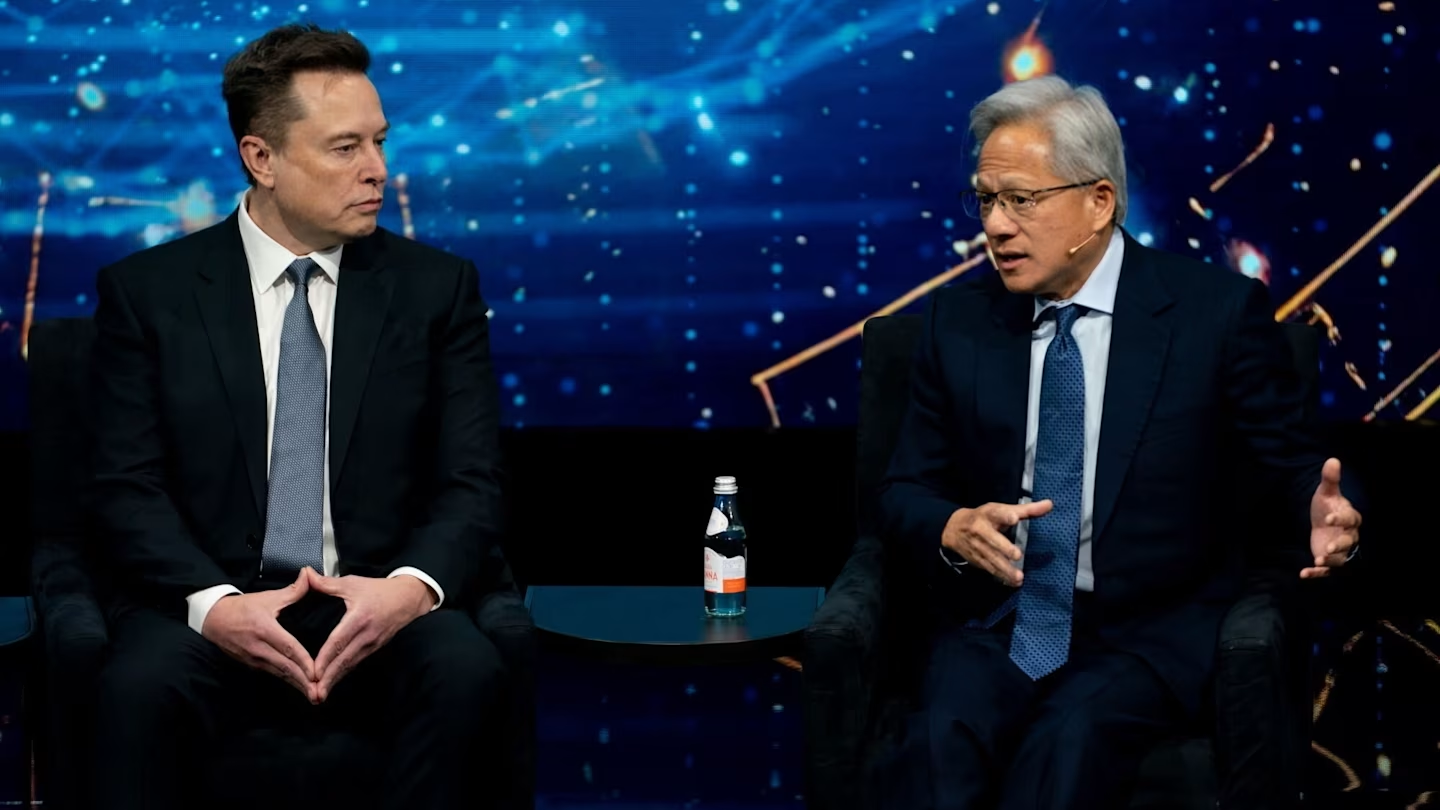
<p>Nvidia has disclosed that it owns nearly 123 million shares in SpaceX, further highlighting the chipmaker’s entangled financial relationships with some of its biggest customers.</p> <p>The $5.5 trillion company owned SpaceX stock worth nearly $21 billion at the end of June, according to an SEC filing on Friday. Elon Musk’s rocket conglomerate’s shares have fallen sharply since its June initial public offering, meaning Nvidia’s stake would now be worth $17 billion.</p> <p>The disclosure marks a huge pay-off on Nvidia’s investment in xAI, completed in January, shortly before Musk combined the AI lab with SpaceX.</p><p><a href="https://arstechnica.com/information-technology/2026/08/nvidia-discloses-21b-stake-in-spacex/">Read full article</a></p> <p><a href="https://arstechnica.com/information-technology/2026/08/nvidia-discloses-21b-stake-in-spacex/#comments">Comments</a></p> Reference : https://ift.tt/TleonjU

Friday, August 14, 2026

Digital Signal Processing Pioneer Bede Liu Dies At 91


<img src="https://spectrum.ieee.org/media-library/portrait-of-an-elderly-asian-man-softly-smiling-in-a-suit-jacket-and-tie.jpg?id=67609508&width=1245&height=700&coordinates=0%2C62%2C0%2C63"/><br/><br/><p>Bede Liu, a digital signal processing pioneer, died on 7 May. He was 91.</p><p>Liu was widely regarded as one of the founders of modern digital signal processing, a field that applies mathematical algorithms to analyze, modify, and transmit signals including sound, images, and video.</p><p>The IEEE Life Fellow taught electrical engineering at <a href="https://www.princeton.edu/" rel="noopener noreferrer" target="_blank">Princeton</a> for more than 50 years. From 1994 to 1997, he chaired the university’s <a href="https://ece.princeton.edu/front" rel="noopener noreferrer" target="_blank">electrical and computer engineering department</a>.</p><p>Liu’s research aided the transition from analog to digital processing of sound, images, and video. His work helped establish many of the mathematical and engineering techniques that underpin modern communications, multimedia systems, and consumer electronics.</p><p>Although little known outside engineering circles, his work is embedded in technologies used by billions of people. The low-power digital signal processors that make cellphone calls, streaming video, and Internet communications possible can be traced to research he conducted in the 1970s and ‘80s.</p><p>Liu received the 2018 <a href="https://corporate-awards.ieee.org/award/ieee-jack-kilby-signal-processing-medal/" rel="noopener noreferrer" target="_blank">IEEE Jack S. Kilby Signal Processing Medal</a> for “sustained contributions to the analysis and the development of low-complexity realizations of digital signal processing algorithms.”</p><p>“We stream music and video. We take photos with our phones, and we send them around. We don’t even think about it,” IEEE Life Fellow <a href="https://ece.princeton.edu/people/h-vincent-poor" rel="noopener noreferrer" target="_blank">H. Vincent Poor</a> said in an <a href="https://engineering.princeton.edu/news/2026/06/24/bede-liu-pioneer-digital-signal-processing-and-beloved-mentor-dies-age-91" rel="noopener noreferrer" target="_blank">obituary for Liu</a>. “But it’s all because of the signal processing, image processing, and video processing that’s been developed over the years, as well as other technologies that have grown up beside it and enabled it, like semiconductors. The development of these processing advances was exactly what Bede was a major part of.” Poor is a professor of electrical and computer engineering at Princeton.</p><h2>An impactful scholar and teacher</h2><p>Liu was born in Shanghai in 1934. During his childhood, his family relocated to Taiwan amid the upheaval of the <a href="https://en.wikipedia.org/wiki/Chinese_Civil_War" rel="noopener noreferrer" target="_blank">Chinese Civil War</a>. His father, Henry Liu Sr., was an electrical engineer.</p><p>Liu earned his bachelor’s degree in electrical engineering in 1954 from the <a href="https://www.ntu.edu.tw/english/" rel="noopener noreferrer" target="_blank">National Taiwan University</a>, in Taipei. After graduating, he and his family moved to the United States. Liu and his father attended the Polytechnic Institute of Brooklyn (now the <a href="https://engineering.nyu.edu/" rel="noopener noreferrer" target="_blank">New York University Tandon School of Engineering</a>) together. They earned their master’s degrees in electrical engineering in 1956. Liu continued his studies at the school, earning a doctoral degree in electrical engineering four years later.</p><p>In 1959 he was awarded a <a href="https://spectrum.ieee.org/7-bell-labs-ieee-milestones" target="_self">Bell Labs</a> <a href="https://www.nokia.com/bell-labs/institute/media/bell-labs-fellows/" rel="noopener noreferrer" target="_blank">fellowship</a> and worked at the company’s Murray Hill, N.J., location until he joined Princeton in 1962.</p><p>“Liu was a highly impactful scholar and teacher—always thinking ahead of future needs and changing technologies,” said IEEE Life Fellow <a href="https://ece.princeton.edu/people/peter-j-ramadge" rel="noopener noreferrer" target="_blank">Peter J. Ramadge</a>, a Princeton professor emeritus of engineering.</p><p>Cellphones make use of a considerable amount of digital signal processing, Liu once noted. Many of the field’s advances, he added, involved making sophisticated processing practical on devices with limited computing power—which is the challenge that confronted generations of engineers designing portable electronics.</p><p>Liu’s research contributions helped shape both the theory and practice of digital signal processing. With <a href="https://en.wikipedia.org/wiki/Abe_Peled" rel="noopener noreferrer" target="_blank">Abe Peled</a>, a former graduate student, he authored the 1976 textbook <a href="https://www.amazon.com/Digital-Signal-Processing-Theory-Implementation/dp/0471019410" rel="noopener noreferrer" target="_blank"><em><em>Digital Signal Processing: Theory, Design, and Implementation</em></em></a>, which is a standard reference for engineers. Published before digital signal processing had fully emerged as a distinct discipline, it helped define the subject for practitioners and students around the world.</p><p>Liu also published 250 technical papers and was granted 12 U.S. patents. His papers are available to read on the <a href="https://ieeexplore.ieee.org/author/37087189074" rel="noopener noreferrer" target="_blank">IEEE Xplore Digital Library</a>.</p><p>The first patent granted to him and Peled was in 1976 for a hardware design that processed bits in parallel, rather than in sequence. The innovation greatly increased computing efficiency for data including sound and communication signals.</p><p>Peled says Liu “demonstrated an openness to new ideas and a willingness to challenge the orthodoxy of the EE department at that time—which leaned heavily toward more theoretical information theory.”</p><h2>A mentor to well-known engineers</h2><p>Liu’s influence extended beyond his own research. He advised 53 doctoral students, many of whom went on to distinguished careers in academia and industry, including leadership positions at <a href="https://about.google/" rel="noopener noreferrer" target="_blank">Google</a> and <a href="https://www.ibm.com/about" rel="noopener noreferrer" target="_blank">IBM</a>. One former student, computer scientist <a href="https://spectrum.ieee.org/bob-kahn-2667754905" target="_self">Robert Kahn</a>, helped create the architecture of the modern Internet. Kahn, an IEEE Life Fellow, received the 2024 <a href="https://spectrum.ieee.org/medal-of-honor-bob-kahn" target="_self">IEEE Medal of Honor</a>.</p><p>“His former students were very successful,” Poor said of Liu, “and I think that’s a testament to his skill as a mentor.”</p><p class="pull-quote">“Liu was a highly impactful scholar and teacher—always thinking ahead of future needs and changing technologies.”<strong>—Peter J. Ramadge</strong></p><p>Together with several Ph.D. students, Liu developed methods of filtering and compressing digital signals to mitigate errors and dramatically reduce the computation needed for signal processing.</p><p>As digital signal processing moved from laboratories into commercial products, the impact of Liu’s ideas spread across industries. His research helped spawn the development of lower-cost and lower-power electronics and contributed to advances in mobile communications, multimedia technology, industrial automation, and biomedical imaging.</p><h2>A focus on media integrity and copyrights</h2><p>In the 2000s, Liu turned his attention to media integrity and copyright issues.</p><p>“With the increasing accessibility of digital media source material, the protection of ownership and the prevention of unauthorized alteration has become an important concern,” he wrote in his 2002 book, <a href="https://www.amazon.com/Multimedia-Data-Hiding-Min-Wu/dp/0387954260" target="_blank"><em><em>Multimedia Data Hiding</em></em></a>. The book, which he co-wrote with his former doctoral student IEEE Fellow Min Wu, discussed the theory, techniques, applications, and security of digital watermarking—hidden signals that could identify a genuine copy of a song, image or video to prevent unauthorized distribution or tampering.</p><p>A Princeton team that included Liu, Wu, and another of his doctoral students uncovered serious vulnerabilities in watermarking technologies being considered by an industry consortium. They found that the standardization efforts were immature and would not protect against digital piracy.</p><p>“Now nearly every copy of a Hollywood film given to a critic or theater carries a unique digital forensic watermark to prevent unauthorized redistribution,” said Wu.</p><h2>A force in the community</h2><p>Liu, an active IEEE volunteer, served on the <a href="https://www.ieee.org/about/corporate/board" rel="noopener noreferrer" target="_blank">IEEE Board of Directors</a> in 1984 and 1985. He was the 1982 president of the <a href="https://ieee-cas.org/welcome" rel="noopener noreferrer" target="_blank">IEEE Circuits and Systems Society</a>.</p><p>He was a member of the U.S. <a href="https://www.nae.edu/" rel="noopener noreferrer" target="_blank">National Academy of Engineering</a>, an academician of China’s <a href="https://www.nature.com/articles/136208a0" rel="noopener noreferrer" target="_blank">Academia Sinica</a>, and a foreign member of the <a href="https://english.cas.cn/" rel="noopener noreferrer" target="_blank">Chinese Academy of Sciences</a>.</p><p>Outside the classroom, he was recognized for his humility, humor, enthusiasm, and generosity. When thinking of Liu, IEEE Life Fellow <a href="https://www.cs.princeton.edu/~ken/" rel="noopener noreferrer" target="_blank">Kenneth Steiglitz</a> says, <em><em>cheer</em></em> is the first word that comes to mind.</p><p>Liu was “always ready with a positive remark, a quick smile or, maybe, some tips on the right way to cook a duck,” says Steiglitz, professor emeritus of computer science at Princeton.</p><p>Liu encouraged his students to take on ambitious, unconventional projects, and he inspired students and colleagues with his adventurous spirit.</p> Reference: https://ift.tt/PrExKFc

Predict Antenna Coupling on Electrically Large Platforms Before Building Hardware


<img src="https://spectrum.ieee.org/media-library/wipl-d-logo-with-stylized-antenna-arcs-above-the-text.png?id=26851692&width=980"/><br/><br/><p>Learn how full-wave simulation predicts very low antenna coupling on aircraft-sized platforms, and which three modeling techniques deliver accurate results with fewer computational resources.</p><p><span><a href="https://content.knowledgehub.wiley.com/efficient-and-accurate-prediction-of-cosite-isolation-on-large-platforms/" target="_blank">Download this free whitepaper now!</a></span></p> Reference: https://ift.tt/m9k7dsX

PBS station fears losing 50TB of data after being ghosted by cloud storage provider


<p>After its cloud storage provider went defunct, a PBS affiliate decided to sue a data center provider to regain access to 50TB of TV shows, videos, and other data dating back 70 years.</p> <p>As reported this week by <a href="https://current.org/2026/08/nine-pbs-sues-iron-mountain-over-blocked-access-to-archival-data/?wallit_nosession=1">Current</a>, a trade newspaper covering public broadcasting, St. Louis affiliate Nine PBS filed a lawsuit against Iron Mountain Data Centers on July 28, seeking access to the data. In the litigation filed in Denver District Court, Nine PBS says that its cloud storage provider, Open Source Storage (OSS), used one of Iron Mountain’s Denver data centers to store the channel’s data. However, OSS is being unresponsive, and Nine PBS says Iron Mountain has refused to release its data.</p> <p>The data in question includes the station’s coverage of the COVID-19 pandemic, East St. Louis’ history, <a href="https://ny.pbslearningmedia.org/resource/ess05.sci.ess.earthsys.flood/the-great-flood-of-1993/">The Great Flood of 1993</a>, and over 11,000 files, <a href="https://www.denverpost.com/2026/07/29/st-louis-pbs-archives-denver-data-center-lawsuit/">The Denver Post</a> reported in July. The lawsuit claims that “most” of the data is “unique and irreplaceable,” according to the Post.</p><p><a href="https://arstechnica.com/information-technology/2026/08/pbs-station-fears-losing-50tb-of-data-after-being-ghosted-by-cloud-storage-provider/">Read full article</a></p> <p><a href="https://arstechnica.com/information-technology/2026/08/pbs-station-fears-losing-50tb-of-data-after-being-ghosted-by-cloud-storage-provider/#comments">Comments</a></p> Reference : https://ift.tt/6YlBOrw

OpenAI and Anthropic in price war as Chinese AI rivals gain ground


<p>Leading US AI labs such as OpenAI and Anthropic are releasing cheaper models as they fight to retain cost-conscious customers who are switching to cut-price alternatives from Chinese rivals.</p> <p>The price war comes as rising AI bills push companies to curb usage and seek cheaper models, helping Chinese developers including Moonshot and DeepSeek make inroads with users from Silicon Valley to Europe.</p> <p>OpenAI recently said that it was slashing prices for GPT-5.6 Luna, its “fastest and most affordable model”, by 80 percent. Anthropic has launched Claude Opus 5, touting the system’s “frontier intelligence... at half the price” of Fable 5, the company’s most capable model.</p><p><a href="https://arstechnica.com/ai/2026/08/openai-and-anthropic-in-price-war-as-chinese-ai-rivals-gain-ground/">Read full article</a></p> <p><a href="https://arstechnica.com/ai/2026/08/openai-and-anthropic-in-price-war-as-chinese-ai-rivals-gain-ground/#comments">Comments</a></p> Reference : https://ift.tt/UTxGQAb

Thursday, August 13, 2026

White House recruits security firms to hack overseas cybercriminals


<p>The Trump administration is recruiting private security firms to conduct federal government-authorized operations, including cyber attacks, against overseas-based criminal organizations that commit hacks on US persons, organizations, or government entities.</p> <p>In a <a href="https://www.whitehouse.gov/presidential-actions/2026/08/expanding-capabilities-to-combat-transnational-cyber-enabled-crime/">National Security Presidential Memorandum</a> issued Thursday, US President Donald Trump directed the National Coordination Center (NCC), which operates under the Homeland Security Task Force, to develop a program for conducting specific cyber operations that combat foreign transnational criminal organizations (TCOs). The Departments of Justice and Homeland Security will provide oversight. The lynchpin of that program is bringing in private sector companies to participate.</p> <h2>Devil will be in the still-undefined details</h2> <p>A <a href="https://www.whitehouse.gov/fact-sheets/2026/08/fact-sheet-president-donald-j-trump-expands-capabilities-to-combat-transnational-cyber-enabled-crime/">fact sheet</a> that accompanied Thursday’s memo listed ransomware, sextortion schemes, phishing campaigns, financial fraud, and impersonation scams as activities eligible for private-sector security firms to target. The memo said such firms could “conduct Cyber Surveillance Operations and Cyber Effects Operations” against “cyber-enabled” TCOs. Such groups are defined as “any foreign group that conducts cyber-enabled crime against the United States Government, a United States person, or United States interests, and that is not an institutional part of a foreign government or wholly operated under a foreign government’s direction.”</p><p><a href="https://arstechnica.com/security/2026/08/white-house-recruits-security-firms-to-hack-overseas-cybercriminals/">Read full article</a></p> <p><a href="https://arstechnica.com/security/2026/08/white-house-recruits-security-firms-to-hack-overseas-cybercriminals/#comments">Comments</a></p> Reference : https://ift.tt/TSGfK2Y

This IEEE Senior Member Develops AI Tools for E-Commerce Sites

<img src="https://spectrum.ieee.org/media-library/a-professionally-dressed-indian-man-smiling-with-a-trophy-in-one-hand-and-an-awar...