New regulations in Indonesia show that strict online controls are no longer confined to autocratic countries like China.


TensorFlow, PyTorch and Keras: those three deep learning frameworks have dominated AI for years even as newer entrants gain steam. But one framework you don’t hear much about in the West is China’s PaddlePaddle, the most popular Chinese framework in the world’s most populous country.
It is an easy-to-use, efficient, flexible, and scalable deep learning platform, originally developed by Baidu, the Chinese AI giant, to apply deep learning to many of its own products. Today, it is being used by more than 4.77 million developers and 180,000 enterprises globally. While comparable numbers are hard to come by for other frameworks, suffice to say, that’s big.
Baidu recently announced new updates to PaddlePaddle, along with 10 large deep-learning models that span natural-language processing, vision, and computational biology. Among the models is a hundred-billion-parameter natural language processsing (NLP) model called ERNIE 3.0 Zeus, a geography-and-language pre-trained model called ERNIE-GeoL, and a pre-trained model for compound representation learning called HELIX-GEM.
The company has also created three new industry-focused large models—one for the electric power industry, one for banking, and another one for aerospace—by fine-tuning the company’s ERNIE 3.0 Titan model with industry data and expert knowledge in unsupervised learning tasks.
Software frameworks are packages of associated support programs, compilers, code libraries, toolsets, and application programming interfaces (APIs) to enable development of a project or system. Deep learning frameworks bring together everything needed to design, train, and validate deep neural networks through a high-level programming interface. Without these tools, implementing deep learning algorithms would take a lot of time because otherwise reusable pieces of code would have to be written from scratch.
Baidu started to develop such tools as early as 2012 within months of Geoffrey Hinton’s deep learning breakthrough at the ImageNet competition.
In 2013, a doctoral student at the University of California, Berkeley, created a framework called Caffe, that supported convolutional neural networks used in computer vision research. Baidu built on Caffe to develop PaddlePaddle, which supported recurrent neural networks in addition to CNNs, giving it an advantage in the field of NLP.
The name PaddlePaddle is derived from PArallel Distributed Deep Learning, a reference to the framework’s ability to train models on multiple GPUs.
Google’s open-sourced TensorFlow in 2015 and Baidu open-sourced PaddlePaddle the next year. When Eric Schmidt introduced TensorFlow to China in 2017, it turns out China was ahead of him.
While TensorFlow and Meta’s PyTorch, open-sourced in 2017, remain popular in China, PaddlePaddle is more oriented toward industrial users.
“We dedicated a lot of effort to reducing the barriers to entry for individuals and companies,” said Ma Yanjun, General Manager of the AI Technology Ecosystem at Baidu.
PyTorch and TensorFlow require greater deep-learning expertise on the part of users compared to PaddlePaddle, whose toolkits are designed for non-experts in production environments.
“In China, many of the developers are trying to use AI in their work, but they do not have much AI background,” explained Ma. “So, to increase the use of AI in different industry sectors, we’ve provided PaddlePaddle with a lot of low threshold toolkits that are easier to use so it can be used by a wider community.”
AI engineers normally don't know much about industry sectors and industry sector experts don’t know much about AI. But PaddlePaddle’s easy-to-understand code comes with a wealth of learning materials and tools to help users. It scales easily and has a comprehensive set of APIs to address various needs.
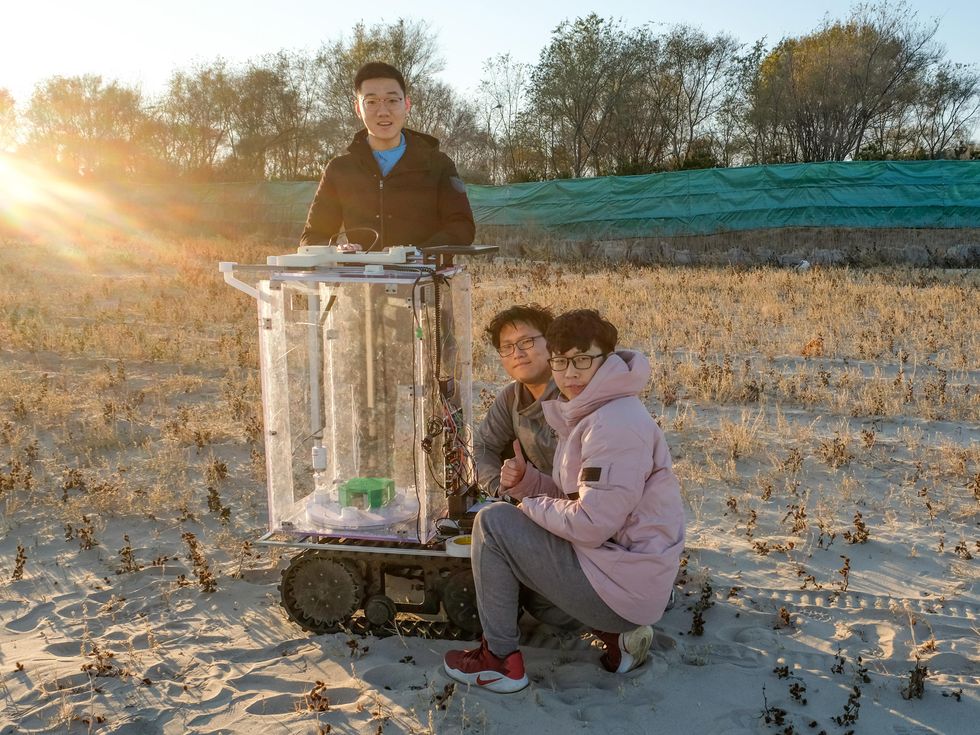 These developers used PaddlePaddle for a desert robot to automate the process of tree planting.Baidu
It supports large-scale data training and can train hundreds of machines in parallel. It provides a neural machine translation system, recommender systems, image classification, sentiment analysis and semantic role labeling.
Toolkits and libraries are the strong side of PaddlePaddle, Ma said. For example, PaddleSeg can be used for segmentation of images. PaddleDetection can be used for object detection. “We cover the whole pipeline of AI development from data processing to training, to model compression, to the adaptation to different hardware,” said Ma, “and then how to deploy them in different systems, for example, in Windows or in the Linux operating system or on an Intel chip or on a Nvidia chip.”
The platform also hosts toolkits for cutting-edge research purposes, like Paddle Quantum for quantum-computing models and Paddle Graph Learning for graph-learning models.
“That's why PaddlePaddle is quite popular in China right now,” he said. “Developers are using such toolkits and not just the tool itself.”
Since it was open-sourced, PaddlePaddle has evolved quickly to have better performance and user experience in different industry sectors outside Baidu as well as countries outside China thanks to extensive English-language documentation. Currently, PaddlePaddle offers over 500 algorithms and pretrained models to facilitate the rapid development of industrial applications. Baidu has worked to reduce model size so they can be deployed in real-world applications. Some of the models are very small and fast and can be deployed on a camera or cell phone.
PaddlePaddle has parameter server technology to train sparse models that can be used in real-time recommender systems and search. But it has also merged models into even larger systems that are used for scenarios that don’t require real-time results, like text generation or image generation.
Baidu sees large, dense models as another way of reducing the barrier to AI adoption because so-called foundation models can be adapted to specific scenarios. Without the foundation model, you need to develop everything from scratch.
Ma said research areas are converging with cross-model learning of different modalities, like speech and vision. He said Baidu is also using knowledge graphs in the deep learning process. “Previously a deep learning system dealt with raw texts or raw images without any knowledge input and the system used self-supervised learning to gather rules outside the data,” Ma said. “But now we are seeing knowledge graphs as an input.”
Reference: https://ift.tt/75LZR2u


Enlarge (credit: Getty Images)
Researchers have unearthed never-before-seen malware that hackers from North Korea have been using to surreptitiously read and download email and attachments from infected users' Gmail and AOL accounts.
The malware, dubbed SHARPEXT by researchers from security firm Volexity, uses clever means to install a browser extension for the Chrome and Edge browsers, Volexity reported in a blog post. The extension can't be detected by the email services, and since the browser has already been authenticated using any multifactor authentication protections in place, this increasingly popular security measure plays no role in reining in the account compromise.
The malware has been in use for "well over a year," Volexity said, and is the work of a hacking group the company tracks as SharpTongue. The group is sponsored by North Korea's government and overlaps with a group tracked as Kimsuky by other researchers. SHARPEXT is targeting organizations in the US, Europe, and South Korea that work on nuclear weapons and other issues North Korea deems important to its national security.




Enlarge (credit: Getty Images)
In the US government's ongoing campaign to protect data in the age of quantum computers, a new and powerful attack that used a single traditional computer to completely break a fourth-round candidate highlights the risks involved in standardizing the next generation of encryption algorithms.
Last month, the US Department of Commerce's National Institute of Standards and Technology, or NIST, selected four post-quantum computing encryption algorithms to replace algorithms like RSA, Diffie-Hellman, and elliptic curve Diffie-Hellman, which are unable to withstand attacks from a quantum computer.
In the same move, NIST advanced four additional algorithms as potential replacements pending further testing in hopes one or more of them may also be suitable encryption alternatives in a post-quantum world. The new attack breaks SIKE, which is one of the latter four additional algorithms. The attack has no impact on the four PQC algorithms selected by NIST as approved standards, all of which rely on completely different mathematical techniques than SIKE.
<img src="https://spectrum.ieee.org/media-library/a-young-black-woman-speaking-into-a-microphone-while-seated-in-an-auditorium-crow...