The start-up has had a meteoric rise, thanks to its charismatic co-founder, Ryan Breslow. But he sometimes stretched the truth to get there.


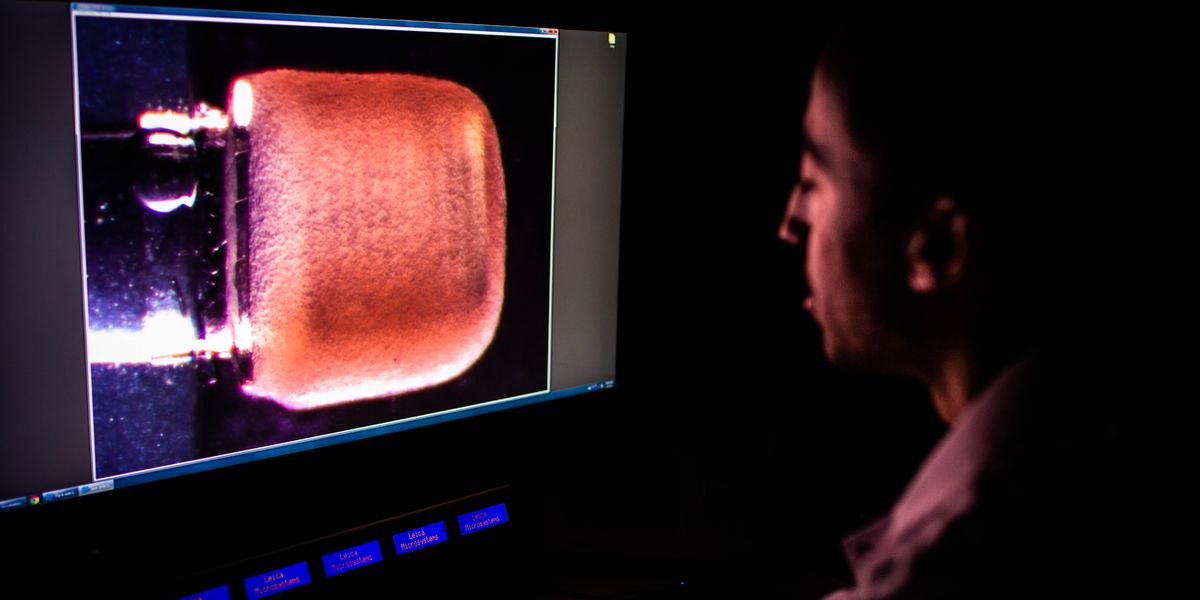

In recent years, scientists have been using biomimetic tissue models—reconstructed tissues designed to replicate the attributes of living tissue—to study disease and development in the human body. The heart, however, is a different story. Even though advances in stem cell research now make it easier to grow cardiac tissue, replicating a functioning human heart in a lab remains complicated.
To address this gap, a multidisciplinary research team has developed a miniature replica of a heart chamber that brings together advanced stem cell technologies and nanoengineering. Called the miniaturized Precision-enabled Unidirectional Microfluidic Pump (miniPUMP), the device comprises a hollow, microscopic, cylindrical scaffold built using precision 3D-printing, which forms a framework for the cardiac tissue made of heart muscle cells derived from human stem cells. The device mimics the lower heart chamber, the ventricle.
And just like a real heart, the tissue beats spontaneously, says Christos Michas, a biomedical researcher at Boston University, lead author of the study. The device is submerged in cell media containing glucose and other nutrients that the cells need to survive. “It’s possible to make the tissue beat by simulating [it] electrically, [but] you don’t need to. You just assemble it, and it just does its own thing,” he says.
The novelty of the miniPUMP, Michas explains, is the marrying of nano-fabrication and tissue-engineering in a way that hasn’t been considering before. “With the nano-engineered parts, we were able to replicate different aspects of the heart, specifically, the chamber, which contracts and then springs back, and also the valves that regulate the flow of the blood,” he says. They were thus able to mimic some aspects of heart function, such as pressure and volume of fluid pumped, that has so far not been represented in research literature. “By doing that, we have access to more metrics of the performance of the heart, so we can have a better model of the heart.”
Apart from the convenience of having scaled-down organ models for research, the miniaturization of the device has further advantages, says co-author Alice White, mechanical engineering chair at Boston University. First, it doesn’t use a lot of stem cells, which are a precious commodity. "[It] also means that we could maybe do lots of things in parallel in a relatively small space,” White says. The other big advantage, she adds, is that their mini heart chamber is compatible with other organ-on-a chip technologies that are being developed.
The chip in question is a microfluidic chip, Michas explains, which is lined with living human cells. They used a 3D-printing technique called two-photon direct laser writing, in which a biocompatible liquid resin solidifies in contact with the laser. “It didn’t really matter what the material was, as long as it could maintain its structure and have very fine features,” he adds. Precision fabrication was crucial given that many of the miniPUMP components were smaller than a dust particle, and the whole thing was smaller than a postage stamp.
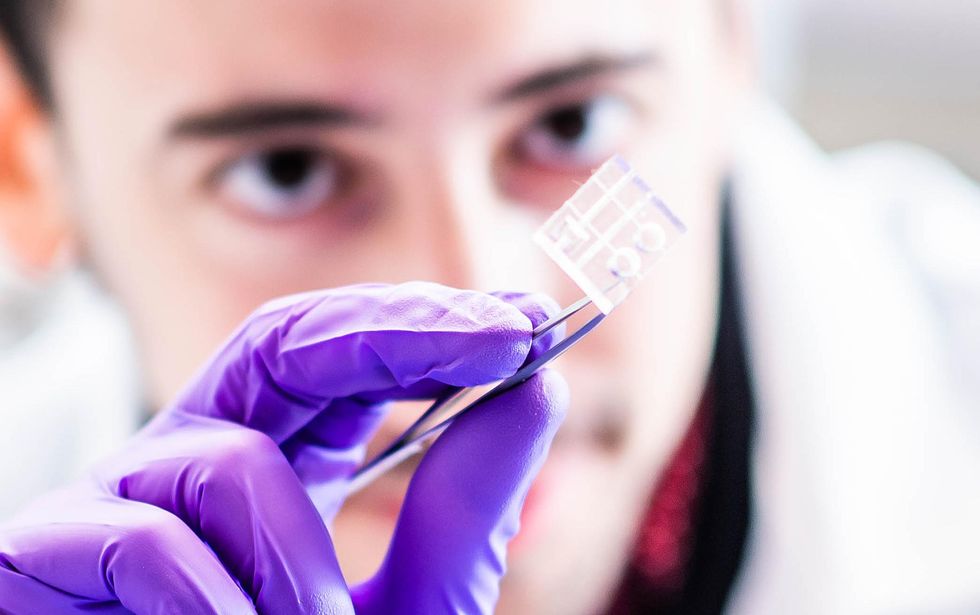 A miniature replica of a heart chamber made from engineered parts and tissue from stem cells—and all contained on a chip not much bigger than a postage stamp—could help researchers study disease and test new treatments.Jackie Ricciardi/Boston University
One of the biggest challenges for the team was replicating the pumping function of the heart. “First of all, you need a cardiac chamber—something that resembles a balloon—so it can contain fluid,” says Michas. “[Arranging] the tissue on such a small scale, in a 3D format, is very challenging, because the tissue on its own would collapse into a sphere.” This is where the micro-engineered scaffold came into use.
The second aspect, Michas adds, is that the fluid must flow in a directional manner, just like it does in the heart. “That means that we had to have valves, but the valves that we would need for such a scaled-down system would be extremely sensitive to pressure.” Once again, fine-resolution 3D-printing enabled that.
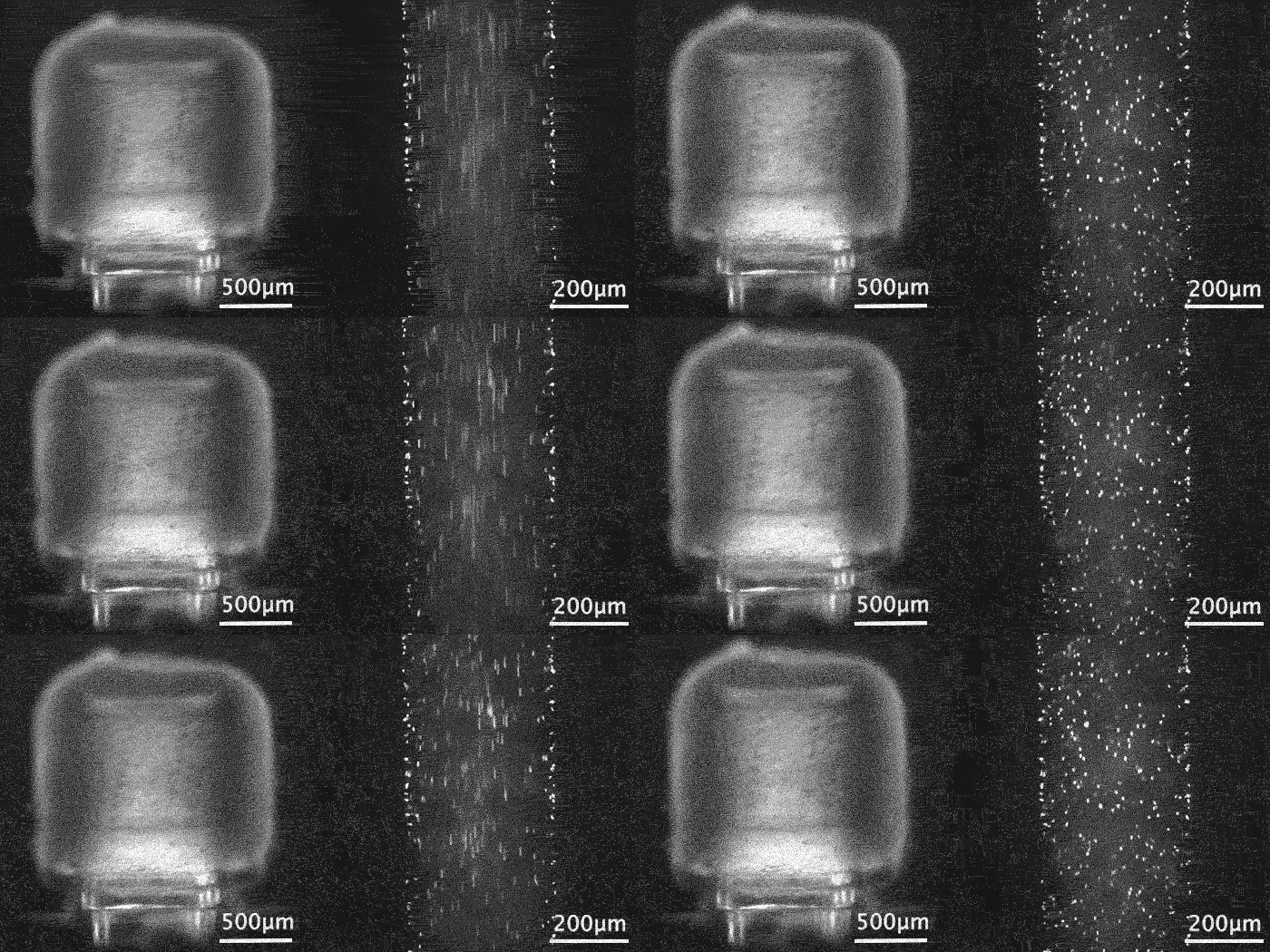 On the left, a chamber of the miniPUMP beats thanks to the contraction of the cardiac tissue. As the tissue beats, it ejects fluid out of the chamber (right)—just as a human heart would pump blood. Science Advances
Michas and his colleagues’ mini-heart chamber continued to beat in the lab for three weeks. “We did not conduct a full study to see the effect of therapeutic treatments on the heart, but with the proper adjustments, I’m pretty confident that it will last for months," Michas says.
This longevity, as well as replicating the natural beating mechanism of the heart muscle, provides scientists opportunities to study the heart as well as test the effectiveness of therapeutics with no risk to human patients. Apart from drug development and testing, Michas sees other possibilities too, such as disease modeling. “We know that in the case of hypertension, the heart, over time, changes the way it beats, how much blood it can pump, how fast it [does so],” he says. “So, if we want to understand this better and develop therapies, then we need to have easy accessible models to replicate it. The miniPUMP could be used for that [by controlling valve pressure]. That is one of the additional metrics that other systems usually lack.”
Another possibility, Michas says, is in developing advanced therapies, like gene therapies. “These allow us, again, to replicate a little bit of the process of those therapies and see if they [work] or not.” Lastly is modeling human development. “That is a very complicated scientific question, and models like this, to some extent, could help us better understand how the body forms during embryo development.”
The miniPUMP project is part of CELL-MET, a National Science Foundation-funded engineering research center exploring cellular metamaterials. “The goal of CELL-MET is to create a patch of functional heart tissue from a patient's own stem cells,” says White. “The thesis was that the nano-fabrication and bringing this level of control to the challenge of tissue engineering would result in some big advances.” The project also includes researchers from Florida International University, who helped with the mechanical measurements at the scaffolds, and those from Harvard Medical School who had expertise in heart disease and working with stem cells.
Reference: https://ift.tt/TBh51uj

Until recently, it wasn’t possible to say that AI had a hand in forcing a government to resign. But that’s precisely what happened in the Netherlands in January 2021, when the incumbent cabinet resigned over the so-called kinderopvangtoeslagaffaire: the childcare benefits affair.
When a family in the Netherlands sought to claim their government childcare allowance, they needed to file a claim with the Dutch tax authority. Those claims passed through the gauntlet of a self-learning algorithm, initially deployed in 2013. In the tax authority’s workflow, the algorithm would first vet claims for signs of fraud, and humans would scrutinize those claims it flagged as high-risk.
In reality, the algorithm developed a pattern of falsely labelling claims as fraudulent, and harried civil servants rubber-stamped the fraud labels. So, for years, the tax authority baselessly ordered thousands of families to pay back their claims, pushing many into onerous debt and destroying lives in the process.
“When there is disparate impact, there needs to be societal discussion around this, whether this is fair. We need to define what ‘fair’ is,” says Yong Suk Lee, a professor of technology, economy, and global affairs at the University of Notre Dame in the United States. “But that process did not exist.”
Postmortems of the affair showed evidence of bias. Many of the victims had lower incomes, and a disproportionate number had ethnic minority or immigrant backgrounds. The model saw not being a Dutch citizen as a risk factor.
“The performance of the model, of the algorithm, needs to be transparent or published by different groups,” says Lee. That includes things like what the model's accuracy rate is like, he adds.
The tax authority’s algorithm evaded such scrutiny; it was an opaque black box, with no transparency into its inner workings. For those affected, it could be nigh impossible to tell why exactly they had been flagged. And they lacked any sort of due process or recourse to fall back upon.
“The government had more faith in its flawed algorithm than in its own citizens, and the civil servants working on the files simply divested themselves of moral and legal responsibility by pointing to the algorithm,” says Nathalie Smuha, a technology legal scholar at KU Leuven in Belgium.
As the dust settles, it’s clear that the affair will do little to halt the spread of AI in governments—60 countries already have national AI initiatives. Private-sector companies no doubt see opportunity in helping the public sector. For all of them, the tale of the Dutch algorithm—deployed in an EU country with strong regulations, rule of law, and relatively accountable institutions—serves as a warning.
“If even within these favorable circumstances, such a dangerously erroneous system can be deployed over such a long time frame, one has to worry about what the situation is like in other, less regulated jurisdictions,” says Lewin Schmitt, a predoctoral policy researcher at the Institut Barcelona d'Estudis Internacionals in Spain.
So, what might stop future wayward AI implementations from causing harm?
In the Netherlands, the same four parties that were in government prior to the resignation have now returned to government. Their solution is to bring all public-facing AI—both in government and in the private sector—under the eye of a regulator in the country’s data authority, which a government minister says would ensure that humans are kept in the loop.
On a larger scale, some policy wonks place their hope in the European Parliament’s AI Act, which puts public-sector AI under tighter scrutiny. In its current form, the AI Act would ban some applications, such as government social credit systems and law enforcement use of face recognition, outright.
Something like the tax authority’s algorithm would abide, but due to its public-facing role in government function, the AI Act would have marked it a high-risk system. That means that a broad set of regulations would apply, including a risk management system, human oversight, and a mandate to remove bias from the data involved.
The tale of the Dutch algorithm—deployed in an EU country with strong regulations, rule of law, and relatively accountable institutions—serves as a warning.
“If the AI Act had been put in place five years ago, I think we would have spotted [the tax algorithm] back then,” says Nicolas Moës, an AI policy researcher in Brussels for the Future Society think tank.
Moës believes that the AI Act provides a more concrete scheme for enforcement than its overseas counterparts, such that which recently took effect in China—which focuses less on public sector use and more on reining in private companies’ use of customers’ data—and proposed US regulations that are currently floating in the legislative ether.
“The EU AI Act is really kind of policing the entire space, while others are still kind of tackling just one facet of the issue, very softly dealing with just one issue,” says Moës.
Lobbyists and legislators are still busy hammering the AI Act into its final form, but not everyone believes that the act—even if it’s tightened—will go far enough.
“We see that even the [General Data Protection Regulation], which came into force in 2018, is still not properly being implemented,” says Smuha. “The law can only take you so far. To make public sector AI work, we also need education.”
That, she says, will need to come through properly informing civil servants of an AI implementation’s capabilities, limitations, and societal impacts. In particular, she believes that civil servants must be able to question an its output, regardless of whatever temporal or organizational pressures they might face.
“It's not just about making sure the AI system is ethical, legal and robust, it’s also about making sure that the public service in which the AI system is organized in a way that allows for critical reflection,” she says.
Reference: https://ift.tt/RaMgEZz

Enlarge (credit: Petro Zadorozhny | Getty Images)
In the snowy streets of the north Ukrainian town of Trostyanets, the Russian missile system fires rockets every second. Tanks and military vehicles are parked on either side of the blasting artillery system, positioned among houses and near the town’s railway system. The weapon is not working alone, though. Hovering tens of meters above it and recording the assault is a Ukrainian drone. The drone isn’t a sophisticated military system, but a small, commercial machine that anyone can buy.

Drone videos shared and posted to social media depict the brutality of the war and reveal what has happened during battles. Drones have captured fighting in the destroyed Ukrainian city of Bucha, with lines of tanks moving around streets and troops moving alongside them. Commercial drones have helped journalists document the sheer scale of destruction in Kyiv and Mariupol, flying over burnt-out buildings that have been reduced to rubble.


The thermostat chased me for 10 years.
That is pretty extreme, by the way. If you’ve got an idea for a business or a new product, you usually don’t have to wait a decade to make sure it’s worth doing.
For most of the 10 years that I idly thought about thermostats, I had no intention of building one. It was the early 2000s, and I was at Apple making the first iPhone. I got married, had kids. I was busy.
But then again, I was also really cold. Bone-chillingly cold.
Every time my wife and I drove up to our Lake Tahoe ski cabin on Friday nights after work, we’d have to keep our snow jackets on until the next day. The house took all night to heat up.
Adapted from the book BUILD: An Unorthodox Guide to Making Things Worth Making by Tony Fadell. Copyright 2022 by Tony Fadell. Reprinted by permission of Harper Business, an imprint of HarperCollins Publishers.
Walking into that frigid house drove me nuts. It was mind-boggling that there wasn’t a way to warm it up before we got there. I spent dozens of hours and thousands of dollars trying to hack security and computer equipment tied to an analog phone so I could fire up the thermostat remotely. Half my vacations were spent elbow-deep in wiring, electronics littering the floor. But nothing worked. So the first night of every trip was always the same: We’d huddle on the ice block of a bed, under the freezing sheets, watching our breath turn into fog until the house finally warmed up by morning.
Then on Monday I’d go back to Apple and work on the first iPhone. Eventually I realized I was making a perfect remote control for a thermostat. If I could just connect the HVAC system to my iPhone, I could control it from anywhere. But the technology that I needed to make it happen—reliable low-cost communications, cheap screens and processors—didn’t exist yet.
How did these ugly, piece-of-crap thermostats cost almost as much as Apple’s most cutting-edge technology?
A year later we decided to build a new, superefficient house in Tahoe. During the day I’d work on the iPhone, then I’d come home and pore over specs for our house, choosing finishes and materials and solar panels and, eventually, tackling the HVAC system. And once again, the thermostat came to haunt me. All the top-of-the-line thermostats were hideous beige boxes with bizarrely confusing user interfaces. None of them saved energy. None could be controlled remotely. And they cost around US $400. The iPhone, meanwhile, was selling for $499.
How did these ugly, piece-of-crap thermostats cost almost as much as Apple’s most cutting-edge technology?
The architects and engineers on the Tahoe project heard me complaining over and over about how insane it was. I told them, “One day, I’m going to fix this—mark my words!” They all rolled their eyes—there goes Tony complaining again!
At first they were just idle words born of frustration. But then things started to change. The success of the iPhone drove down costs for the sophisticated components I couldn’t get my hands on earlier. Suddenly high-quality connectors and screens and processors were being manufactured by the millions, cheaply, and could be repurposed for other technology.
My life was changing, too. I quit Apple and began traveling the world with my family. A startup was not the plan. The plan was a break. A long one.
We traveled all over the globe and worked hard not to think about work. But no matter where we went, we could not escape one thing: the goddamn thermostat. The infuriating, inaccurate, energy-hogging, thoughtlessly stupid, impossible-to-program, always-too-hot-or-too-cold-in-some-part-of-the-house thermostat.
Someone needed to fix it. And eventually I realized that someone was going to be me.
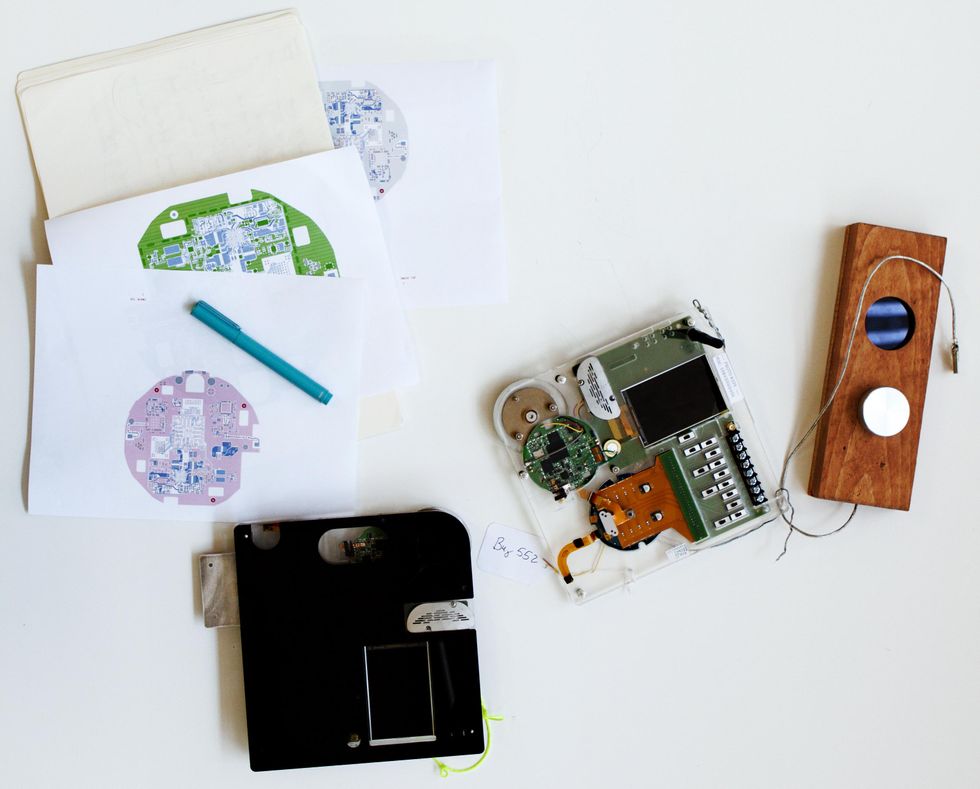 This 2010 prototype of the Nest thermostat wasn’t pretty. But making the thermometer beautiful would be the easy part. The circuit board diagrams point to the next step—making it round.Tom Crabtree
The big companies weren’t going to do it. Honeywell and the other white-box competitors hadn’t truly innovated in 30 years. It was a dead, unloved market with less than $1 billion in total annual sales in the United States.
The only thing missing was the will to take the plunge. I wasn’t ready to carry another startup on my back. Not then. Not alone.
Then, magically, Matt Rogers, who’d been one of the first interns on the iPod project, reached out to me. He was a real partner who could share the load. So I let the idea catch me. I came back to Silicon Valley and got to work. I researched the technology, then the opportunity, the business, the competition, the people, the financing, the history.
Making it beautiful wasn’t going to be hard. Gorgeous hardware, an intuitive interface—that we could do. We’d honed those skills at Apple. But to make this product successful—and meaningful—we needed to solve two big problems:
It needed to save energy.
And we needed to sell it.
In North America and Europe, thermostats control half a home’s energy bill—something like $2,500 a year. Every previous attempt to reduce that number—by thermostat manufacturers, by energy companies, by government bodies—had failed miserably for a host of different reasons. We had to do it for real, while keeping it dead simple for customers.
Then we needed to sell it. Almost all thermostats at that point were sold and installed by professional HVAC technicians. We were never going to break into that old boys’ club. We had to find a way into people’s minds first, then their homes. And we had to make our thermostat so easy to install that literally anyone could do it themselves.
It took around 9 to 12 months of making prototypes and interactive models, building bits of software, talking to users and experts, and testing it with friends before Matt and I decided to pitch investors.
Once we had prototypes of the thermostat, we sent it out to real people to test.
It was fatter than we wanted. The screen wasn’t quite what I imagined. Kind of like the first iPod, actually. But it worked. It connected to your phone. It learned what temperatures you liked. It turned itself down when nobody was home. It saved energy. We knew self-installation was potentially a huge stumbling block, so everyone waited with bated breath to see how it went. Did people shock themselves? Start a fire? Abandon the project halfway through because it was too complicated? Soon our testers reported in: Installation went fine. People loved it. But it took about an hour to install. Crap. An hour was way too long. This needed to be an easy DIY project, a quick upgrade.
So we dug into the reports—what was taking so long? What were we missing?
Our testers...spent the first 30 minutes looking for tools.
Turns out we weren’t missing anything—but our testers were. They spent the first 30 minutes looking for tools—the wire stripper, the flathead screwdriver; no, wait, we need a Phillips. Where did I put that?
Once they gathered everything they needed, the rest of the installation flew by. Twenty, 30 minutes tops.
I suspect most companies would have sighed with relief. The actual installation took 20 minutes, so that’s what they’d tell customers. Great. Problem solved.
But this was going to be the first moment people interacted with our device. Their first experience of Nest. They were buying a $249 thermostat—they were expecting a different kind of experience. And we needed to exceed their expectations. Every minute from opening the box to reading the instructions to getting it on their wall to turning on the heat for the first time had to be incredibly smooth. A buttery, warm, joyful experience.
And we knew Beth. Beth was one of two potential customers we defined. The other customer was into technology, loved his iPhone, was always looking for cool new gadgets. Beth was the decider—she dictated what made it into the house and what got returned. She loved beautiful things, too, but was skeptical of supernew, untested technology. Searching for a screwdriver in the kitchen drawer and then the toolbox in the garage would not make her feel warm and buttery. She would be rolling her eyes. She would be frustrated and annoyed.
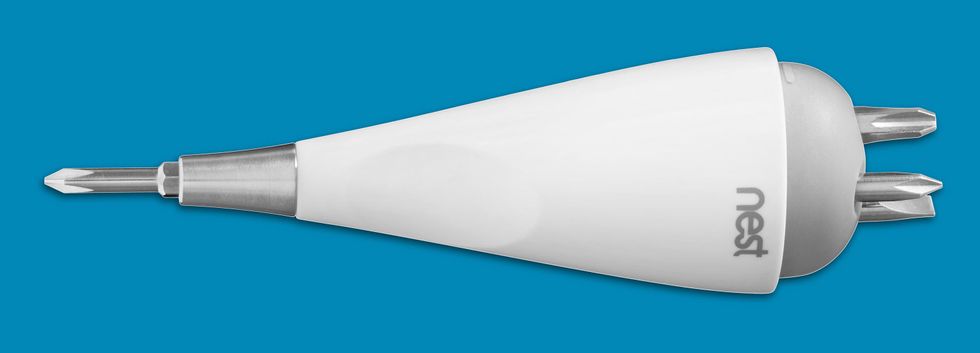 Shipping the Nest thermostat with a screwdriver "turned a moment of frustration into a moment of delight"Dwight Eschliman
So we changed the prototype. Not the thermostat prototype—the installation prototype. We added one new element: a little screwdriver. It had four different head options, and it fit in the palm of your hand. It was sleek and cute. Most importantly, it was unbelievably handy.
So now, instead of rummaging through toolboxes and cupboards, trying to find the right tool to pry their old thermostat off the wall, customers simply reached into the Nest box and took out exactly what they needed. It turned a moment of frustration into a moment of delight.
Sony laughed at the iPod. Nokia laughed at the iPhone. Honeywell laughed at the Nest Learning Thermostat.
At first.
In the stages of grief, this is what we call Denial.
But soon, as your disruptive product, process, or business model begins to gain steam with customers, your competitors will start to get worried. And when they realize you might steal their market share, they’ll get pissed. Really pissed. When people hit the Anger stage of grief, they lash out, they undercut your pricing, try to embarrass you with advertising, use negative press to undermine you, put in new agreements with sales channels to lock you out of the market.
And they might sue you.
The good news is that a lawsuit means you’ve officially arrived. We had a party the day Honeywell sued Nest. We were thrilled. That ridiculous lawsuit meant we were a real threat and they knew it. So we brought out the champagne. That’s right, f---ers. We’re coming for your lunch.
With every generation, the product became sleeker, slimmer, and less expensive to build. In 2014, Google bought Nest for $3.2 billion. In 2016 Google decided to sell Nest, so I left the company. Months after I left, Google changed its mind. Today, Google Nest is alive and well, and they’re still making new products, creating new experiences, delivering on their version of our vision. I deeply, genuinely, wish them well.
Reference: https://ift.tt/mQpbfgU<img src="https://spectrum.ieee.org/media-library/a-young-black-woman-speaking-into-a-microphone-while-seated-in-an-auditorium-crow...