The company is undertaking a far-reaching effort to change how it works. For some, it is an echo of their early idealism and a vision for what the internet could have been.
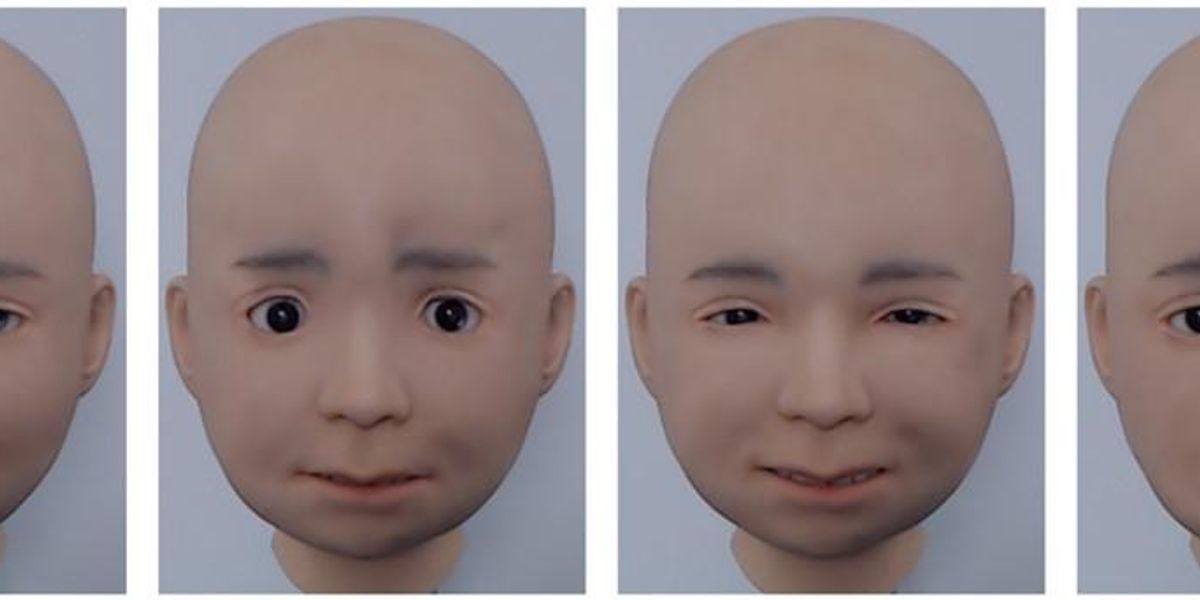

Nikola is an android under development at Riken, a scientific research institute in Japan. Nikola’s job is to help researchers validate the accuracy of facial expressions, which it does by doing its best to make a bunch of facial expressions that, hopefully, can be identified by humans. It’s just a head at the moment, but will eventually have body parts, and it’s generally modeled on a male human child “to promote natural interactions with both adults and children,” always a dicey proposition with robots.
This is part of a larger project from Riken, called the Guardian Robot Project, the goal of which is “to develop an autonomous robot that can be close to people and make people feel the ‘heart.’ Once such a robot is realized, it will be accepted by people and will play an active role in every aspect of our homes and society!” But if it’s going to do that, does it really need to rely on an android form factor for those “natural interactions” that Riken is looking for? I’m not so sure.
To be clear, Nikola here is absolutely not the worst android I have ever met. And it’s a research platform, too, so we shouldn’t judge it too harshly. That's especially true because experiments show that it’s effective at what it’s supposed to do; the paper accompanying this video reveals that people were able to accurately interpret the facial expressions that the robot was making. The reason that this research was necessary is because androids can be tricky to read at times, especially when making expressions associated with negative emotions, which are more difficult to distinguish. And that’s one of the reasons why I’m so skeptical that androids are the best answer for human-robot interaction.
And if I were the Riken researchers, I’d also back off a little bit on the somewhat aspirational claim about robots making people "feel the heart." Even more dubious is the assertion that they will play an active role in every aspect of our homes and society. Making people feel things is not particularly difficult for robots. There’s a bit of a leap, though, from feeling things to playing an active role in everything. Even now, robots that make us feel things can play very small, targeted roles in our homes and society. This is not to say that such roles aren’t important and effective and valuable, just that (and I’m sorry to have to keep saying this) we really need to make sure that we keep expectations realistic and grounded.
Grounded expectations are especially relevant with robots that are intended to connect with us or otherwise influence our emotions, mainly because using other humans as a benchmark will doom your robot to failure. We’ve seen over and over again that simple robots can be just as effective as complex robots at emotional engagement, without wandering into the Uncanny Valley. That said, check out this graphic from the Guardian Robot website itself:

Look at that lil’ guy! How cute he is! And not just cute, but expressive too, with a bare minimum of degrees of freedom. A couple of basic eyes, a minimally adjustable mouth, and there you go. I love him already, and there’s no reason why you couldn’t translate what he’s got going on into hardware, with the help of an artist or animator.
The aims of Riken’s Guardian Robot Project extend far beyond the Nikola android, and yet the projectappears to be in its very early stages. So, there are plenty of directions that things can still go. I appreciate that they’re doing the basic research first and exploring different form factors; we’ll see what they ultimately come up with.
Reference: https://ift.tt/5gecIjk


Enlarge (credit: Drew Angerer | Getty Images)
Microsoft has been pushing harder to increase the baseline security features of Windows PCs for a couple of years now—the "secured-core PC" initiative launched back in 2019 was meant to guard against firmware-level attacks, and Windows 11's system requirements mandate support for many supported-but-optional security features from Windows 10. Microsoft justified these new requirements in part by pointing to the NotPetya data-wiping malware, which has widely been attributed to Russian hackers.
To help protect against similar cyberattacks, a post from Microsoft President & Vice Chair Brad Smith is detailing more about how the company is responding to the Russian invasion of Ukraine. According to the post, Microsoft was able to identify new wiper malware (dubbed "FoxBlade") and provided both mitigation strategies and updated Microsoft Defender definitions to the Ukrainian government "within three hours" of discovering it.
Reporting from The New York Times provides additional details of how Microsoft worked with US government agencies to distribute the FoxBlade fixes with other European countries to limit or prevent its potential spread.


AT&T shut down its 3G network in the U.S. on 22 February—a process called ‘sunsetting.’ It’s the first of the three major carriers in the country to do so. T-Mobile will be shutting down its 3G network on 1 July, while Verizon has announced it will be doing the same on 31 December.
All three companies have cited the ongoing development of 4G and especially 5G networks as a major reason for the shutdowns. 5G in particular is much more spectrum-hungry than earlier generations of wireless. Shutting down 3G networks opens up valuable bandwidth to improve 5G coverage and performance.
Shutting down a nationwide wireless network isn’t as simple as flipping a big, Frankenstein-style lever from the ‘on’ to the ‘off’ position. Sundeep Rangan, the associate director of NYU Wireless, says that, generally speaking, sunsetting a wireless network requires going site by site to each cell tower to shut off any 3G equipment. Then that equipment can either be dismantled or repurposed for 4G and 5G networks.
Crucially, Rangan explains, that process doesn’t need to happen overnight. It might take days, weeks, or even longer for AT&T to make those network changes. In some locations, 3G service might even still be available on a site-by-site basis as AT&T workers make their way to each tower. The sunset date specifically indicates the day on which AT&T is no longer contractually obligated to offer nationwide 3G service. AT&T did not respond to a request for comment on the specifics of its sunsetting process.
AT&T rolled out its initial 3G networks in four cities in June 2004—nearly 18 years ago. That’s resulted in 3G ultimately having a shorter lifespan than its predecessor 2G networks that were deployed in the early 1990s. AT&T sunset its 2G network in 2017; T-Mobile’s is still active (the company will sunset its 2G network this December); and Verizon’s was operational until the end of 2020. All told, 2G networks in the United States were in use for nearly 30 years in some instances.
Companies are sunsetting their 3G networks after shorter yenures, speculates Rangan, because the bandwidth they use is extremely valuable and crucial to their plans for future 5G deployments. 5G continues to demonstrate that it will require an immense amount of spectrum for its data-intensive, low-latency applications. Any frequencies that AT&T and the other companies can free up from lesser-used 3G networks can be redirected toward those needs.
But “lesser used” doesn’t mean “not used at all.” AT&T itself estimated in September that 2.7 million customers were still reliant on its 3G networks—about 2.7 percent of its postpaid and prepaid customers.
The most obvious way in which customers—whether they use AT&T, Verizon, or T-Mobile—can still be reliant on 3G networks is to still own a 3G smartphone. However, that would only include people who haven’t bought a new phone since the first 4G phones debuted in 2008. Once 4G modems were available, it would have been rare for a company to manufacture a phone without one, and that would have been truer with each passing year. But inevitably, there are still people out there who have never needed or wanted to upgrade their phones.
To be clear, not all of those customers are carrying around 3G cellphones in their pockets. They very well may be driving around in cars using 3G-connected electronics. Plenty of cars—even ones manufactured as late as the 2021 model year—rely on 3G networks for navigation and location data, emergency calls, remote lock functions, and more. Unless car manufacturers have taken it upon themselves to upgrade car systems (some have), cars that use 3G for these applications simply won’t have those features anymore.
Elsewhere, the American Association of School Administrators filed a petition to the U.S. Federal Communications Commission (FCC) to delay AT&T’s 3G sunset because up to 10 percent of public school buses in the country rely on 3G connections for GPS and communications.
The Alarm Industry Communications Committee and American Association of Retired Persons also raised concerns to the FCC over the number of security systems and medical alert devices, respectively, that use 3G networks. They’ve argued that the ongoing covid pandemic and semiconductor shortages have made it difficult for people to upgrade or replace their devices. The 3G sunset, the groups say, will leave people in danger if security or alert devices are unable to send notifications when there’s trouble. In its response to the FCC, AT&T said that because the company first announced its 3G sunset three years earlier, companies and customers had ample time to make upgrades.
AT&T’s shutdown of its 3G network is being felt more keenly in these industries for the same reason the company wanted to shut down the network in the first place: Not many cellphone users needed it. 3G network speeds are capped at about 2 megabits per second, which is more than enough for the kinds of data connected cars, alarm systems, and medical alert devices send and receive. Using 3G networks made it cheaper for these devices to operate because they could avoid the pricier 4G networks. 2G’s sunsetting faced a similar problem, as hordes of IoT devices with low data rates still relied on those incumbent networks.
While 3G may not have lasted as long as 2G, it was a watershed moment for cellular technology. According to NYU’s Rangan, it heralded the shift from using cellular technologies strictly for voice to using them for data. With 3G, we all got our first glimpse at what we now take for granted: using our phones to browse the Internet, stream video, and more. But that also made working on 3G a tricky prospect, as it changed so much over its lifespan. “I think a lot of people will actually be okay, probably happy,” says Rangan. “Engineers did a fantastic job and put a lot of effort into it. It was a beast.”
Reference: https://ift.tt/Xju5tRQ

Vannevar Bush was the first trained electrical engineer to publicly proclaim in influential circles that EE’s are one engine of innovation and the driving in digital technology. As the early the 1930s, he viewed the entrepreneur and the engineer as twin forces for progress and technological advancement.
Born in 1890 in Massachusetts, he came to prominence as the nation’s top designer of computers while at MIT In the 1930s. During World War II, as personal science and engineering adviser to President Roosevelt, he led all research by civilians for the military and organized the Manhattan Project. After the war, he distinguished himself as a prime advocate for government funding of science and as a leading visionary the coming revolution in information technology. His “As We May Think” article, for the July 1945 issue of The Atlantic magazine, envisioned a desktop computer and a “web” of “associative trails” that no less than the founders of Google cite as the inspiration for today’s information science and the Internet.
Bush was a fount of wisdom, particularly when it came to defining the engineer's role in the industrial research and development enterprise. During the course of compiling Bush's seminal works for my new book The Essential Writings of Vannevar Bush, just published by Columbia University Press (2022), I pulled out some of particular interest to Spectrum readers:
Writing is essential to the success of an electrical engineer, Bush wrote in 1922, in his first textbook, "The Principles of Electrical Engineering" (co-authored with a colleague, William H. Timbie). The success of any engineer’s plan, Bush insisted, often depends on good writing:
“Once the plan has been decided upon, he must convince his superiors that the plan should be carried out. This convincing requires that the engineer write brief clear English, which adequately and concisely conveys the meaning in a convincing way. Good proposals have been turned down because the engineers who drafted them could not present them in convincing form.”
The physical world is limited but the world of ideas without boundaries; and there are seemingly no limits especially in technology and science. To highlight this point, in Bush’s “Science the Endless Frontier” report to President Truman in July 1945, Bush wrote:
“The pioneer spirit is still vigorous within this nation. Science offers a largely unexplored hinterland for the pioneer who has the tools for his task.”

Bush didn’t foresee the technical means by which vast amount of information could be stored electronically but he correctly predicted in 1945 that radical miniaturization of information was on the horizon. Writing in his most famous essay, “As We May Think,” published in The Atlantic magazine in 1945, he envisioned that:
“A library of a million volumes could be compressed into one end of a desk.”
Bush promoted a cold-eyed realism about the uncertain outcomes of discovery and invention. He tried to balance optimism and pessimism about human activities in turbulent times. To scientists and engineers, he advised:
“We are embarked upon a great adventure, and it is our privilege to further it. Even though at times the box that is opened be Pandora’s, even though there are both good and evil in what we learn it is our duty and our calling to extend [humanity’s] grasp of the universe… By this process, of beginning to understand, we have made such progress as we have. Though the path be thorny, this is still the way in which we should proceed if we would finally emerge from darkness into the light.”
A master of metaphors, Bush searched for everyday analogies to explain technical products and processes. One of his favorites, from an essay, he penned in 1932 about the design and engineering of fabrics and clothing, was the duck:
“I have always envied the duck. He can dive under water and come up dry. Yet his coat is pervious to air as it should be for his good health, and it fits beautifully. The duck looks comfortable in his waterproof garments on a hot day, but the only raincoat I ever bought was hot, or it wasn’t waterproof, and it leaked at the neck when the rain drove horizontally. The Mongolians made a pervious felt that shed rain well, and Caesar thought well enough of it to adopt it. The duck can turn his head in any direction, and yet his covering on his neck lies marvelously smooth and sleek. Columbus found the Indians of Central America using feather garments; but even with their example, we still do not emulate the duck, nor do we look natty or comfortable in the rain.”
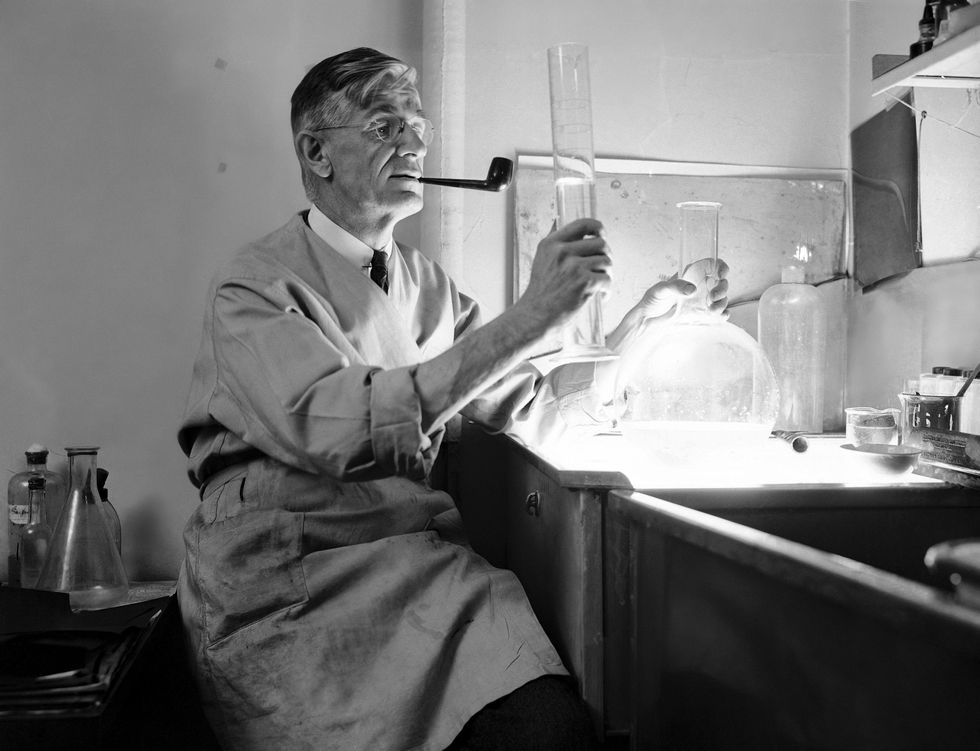
Before there was a “knowledge economy,” and before innovation became nearly synonymous with mastering new knowledge, Bush wrote, in 1932, about the perilous future facing individuals and institutions that failed to rely on research to enhance their survival:
“The key to accomplishment is research. It need not be complex, in order to be useful, but it certainly should be intelligent. In our modern tempo that industry is in danger which is in a static state. [Research] is a necessity [if only as] a defense against encroachment from without.”
While he spent many years as a professor of electrical engineering at MIT, Bush sought to imbue fellow professors with a goal of being practical, versatile and deep. Praising English-born engineer and inventor Elihu Thomson in 1933, Bush said:
“You have showed us that a man may be truly a professor and at the same time very practical. And one more thing I wish to emphasize. You have shown us that a scientist or an engineer may be, even in this complex world, versatile and yet not superficial.”
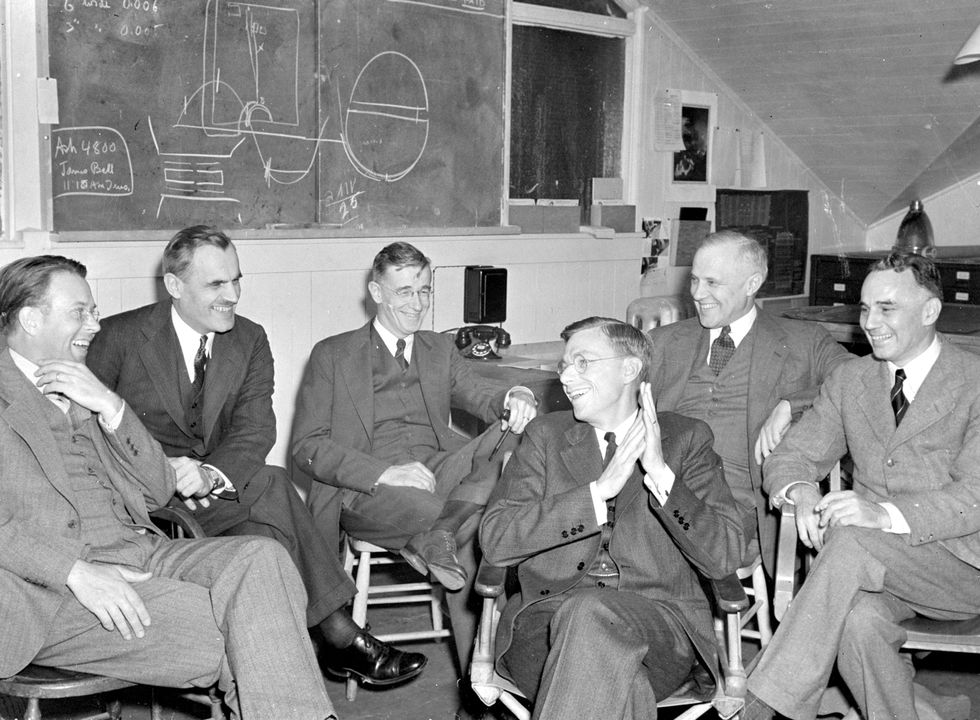
To the question of how we best consider the costs of technological advance, of what he viewed as “progress,” Bush told a Congressional committee in 1939:
“Progress, sir, always pays for itself by at least temporary disturbance. If we have a static world … that is lovely in one way, but if we are going to go ahead technically or in any other way then we must expect at least local disruption and temporary disruption, which means unemployment. There is no question, however, that the whole trend of invention, the whole trend of the introduction into industry of new devices and new ways of doing old things has been to greatly increase employment in the long run ….”
The decision to work on weapons technology, or not, was highly personal to Bush and a decision not easy to unpack. Bush opposed rigid opposition to working on military problems on the grounds that peace can sometimes best be preserved through strength, writing in 1935:
“Perhaps the worker on antiaircraft is more effectively a worker for peace than his brother who condemns him. I do not make the assertion, I pose the question.”
In 1940, as fascist Germany overran France and threatened England with invasion, and as the U.S. government began to consider military aid to Europe’s democracies, Bush answered his own question with the statement, “For war or peace we must leave no stones unturned in research.”
Throughout his long career as a builder of large research organizations, Bush retained his belief in the lone inventor and the daring technological entrepreneur. Speaking to an audience of electrical engineers in early 1944, he said:
“There must remain in the U.S. the opportunity for an Edison, the opportunity for any youth with initiative, resourcefulness, practicality and vision, to create his own name and, by his own efforts, new things that will tend to make this country vigorous and strong and safe.”

As the organizer of the Manhattan Project and among the experts who advised President Truman on dropping atomic bombs on Japan, Bush became an important voice after the war in trying to calm an American public anxious about nuclear war. In doing so, he sometimes erred in his predictions, as when he dismissed, in an 1947 article in the New York Times, the widespread fears that nuclear weapons would someday be launched by pushing a button (which eventually became possible):
“Push-button warfare be damned. This talk has done a lot of harm. … Certainly there would be innovations … but it would not be push-button warfare in any sense. Some of this ‘Buck Rogers’ thinking is a lot of hooey.”
While scientists seemed to grab the glory in the popular press, Bush always sought to remind others that engineers are the true heroes. As he told a Congressional committee on research in 1963:
“Much of what we call scientific research is really engineering research or even straight engineering. Putting a communications satellite into orbit, and working, is an engineering job, and incidentally a magnificent one.”
Compiled by G. Pascal Zachary. The source of Bush's quotations is The Essential Writings of Vannevar Bush, edited by Zachary and published by Columbia University Press (2022). Quote #11 comes from NYT, Jan 9, 1947, “Push-Button Ideas of War Hit by Bush.”
Reference: https://ift.tt/tkCbNTw<p>Terabytes worth of credentials, many belonging to the world’s biggest and most sensitive organizations...